Novel 288: Anonymous, Married Women (1855)


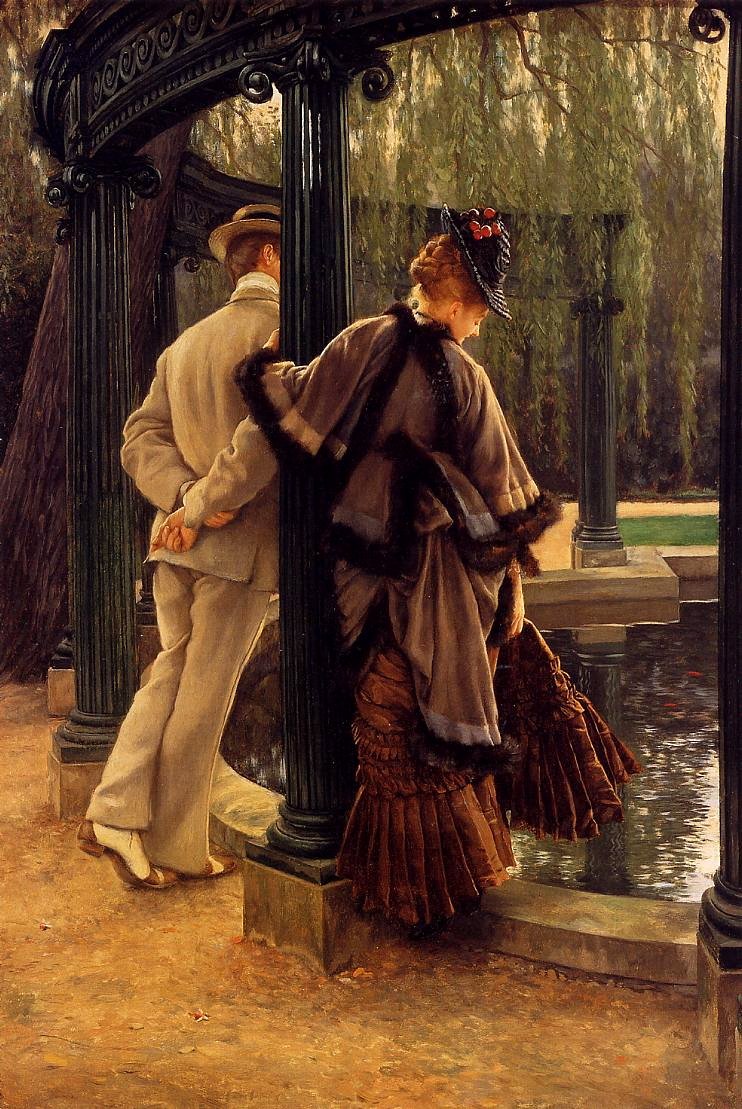
James Jacques Joseph Tissot, Quarreling


A virtuous young lady’s cousin breaks their engagement to marry an adventuress.


This is the second of this anonymous author’s novels (the first, Broomhill, had appeared three years earlier).  Despite some period clichés (e.g., the ideal clergyman who, after final exhortations to his family, expires with a heaven-witnessing smile), it represents some delightfully bad marriages.

“With greater powers of writing and more knowledge of life than usually belongs to the circulating library novel, Married Women is essentially of that class. . . .  The scenes, though not wanting in power or spirit, possess that faded air which characterizes general imitation.  But there is the main thing in a novel—a well-varied story, told with sufficient rapidity, relieved by secondary fortunes without complex involution, and if not reminding one of the actual yet rarely outraging probability.  It is a book for the reader rather than the critic; though better adapted to the main end of writing, that of pleasing the class of readers for whom it is designed, than some fictions of a more vaulting ambition.” Spectator, March 10 1855

“We have read this novel ourselves with much pleasure, and we have no doubt that many others will do the same.  If rigidly criticized, the story will be found straggling:—it concerns too many people, who are all independent of each other, and do not work together to produce unity of result.  But, notwithstanding this, the book is extremely interesting, and, what is more, the tendency is healthy and unexceptionable.  The characters are well and firmly drawn. . . .  Some of the scenes evince quiet power and force of delineation, without ambitious straining after effect.” Athenaeum, March 17, 1855

A contrasting view:

“Milk-and-water triviality. . . .  We suppose there is still a public for novels like this among the clients of circulating libraries in provincial towns; and, after all, an interest in such feeble creations is better than blank ennui or indulgence in acrid gossip.” Westminster Review, July 1855

Download this fortnight’s novel:

https://solo.bodleian.ox.ac.uk/permalink/44OXF_INST/35n82s/alma990146724840107026
(Right-click (or control-click, if you have a Mac) on the “view digitized copy” links to download the novel’s three volumes in pdf form)

Novel 286: Margaret Paul, Gentle and Simple (1878)


Henry Yeend King, At the Farm Gate


A virtuous young lady, neglected by her uncle, is taken up by an aristocratic cousin and a farmer grandfather.


For Paul, see Novels 025, 136, 198, and 251.

“A good story, and of a kind that demands a hearty welcome. . . .  It is admirably written, in a style that combines ease and carefulness, and it is as refined and elevated as it is clever.” Spectator, April 13, 1878

“There is much skill in Mrs. Paul’s method of bringing together the different threads of her narrative and keeping her reader’s attention upon a plot which has enough and not too much ramification, while it contains no incident which does not bear upon the progress of the story.” Examiner, May 18, 1878

“This cannot be called a powerful novel, but it is a good one:  thoughtful, well-written, and marked by a reticence, here and there, which speaks volumes for the culture and fine feeling of the author.” Contemporary Review, September, 1878

Download this fortnight’s novel:

v.1 https://access.bl.uk/item/viewer/ark:/81055/vdc_000000036480#?c=0&m=0&s=0&cv=0&xywh=-1030%2C-115%2C3397%2C2297

v.2 https://access.bl.uk/item/viewer/ark:/81055/vdc_000000059DF6#?c=0&m=0&s=0&cv=0&xywh=-1029%2C-115%2C3389%2C2292

Novel 272: Catherine Crowe, The Adventures of a Beauty (1852)


John Everett Millais, The Farmer's Daughter


A farmer’s daughter secretly marries a baronet’s heir.


For Crowe, see Novel 023.

“There are few writers who possess an equal ability with Mrs. Crowe, of throwing her characters into complications, and dextrously disentangling them.” Bentley’s Miscellany, January, 1852

It may be “enjoyed as one enjoys the feats of a conjuror who can make a card fly out of the pack into a gentleman’s pocket or a lady’s reticule, and restore it to its proper place.” Westminster Review, April, 1852

Download this fortnight’s novel:

https://archive.org/details/10892458.1980.emory.edu

Novel 270: Annie Edwardes, A Blue-Stocking (1877)


James Jacques Joseph Tissot, Boarding the Yacht


In Jersey, a gentleman rescues a young widow’s child from drowning.


For Edwardes, see Novels 158 and 212.

“Mrs. Edwardes is at her best in this book.  It has . . . the quiet humour which we have missed in her later works.” Spectator, October 20, 1877

“It is pleasant, bright, and inoffensive.” Saturday Review, November 24, 1877

Download this fortnight’s novel:

https://solo.bodleian.ox.ac.uk/permalink/f/89vilt/oxfaleph014766163

Novel 269: Frances Milton Trollope, The Vicar of Wrexhill (1837)


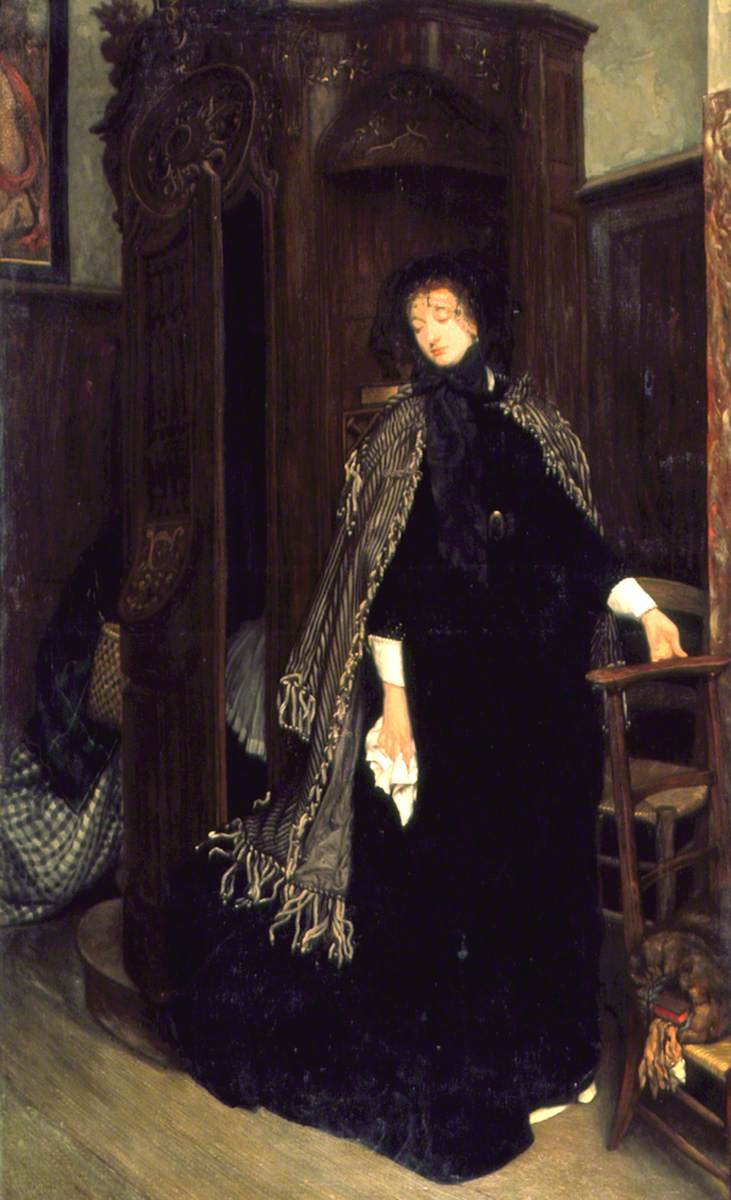
James Jacques Joseph Tissot, In Church


A widow falls under the spell of an Evangelical clergyman.


Here is another novel by Trollope, for whom see Novels 029, 079, 138, 189, 190, and 191.

This is certainly the best novel that Mrs. Trollope has produced, as regards dramatic execution and development of character.  It . . . shows how the highest and best feelings of our nature may be turned by evil guidance and misdirected enthusiasm.” Literary Gazette, September 16, 1837

“Never has the affectation of piety been more mercilessly lashed. . . .  Her object—a laudable one, as every one must admit, has been to show the pernicious effects of sectarian bigotry. . . .  This, Mrs. Trollope has done with unexampled vigour and ability.” Sunday Times, September 17, 1837

A contrasting view:

“To invent a succession of domestic atrocities, and then fasten them upon a particular class of religionists, proves nothing but that the author is an exceedingly illogical and absurd person. . . .  In truth this work is very disagreeable. . . .  Every thing in it is represented in excess . . . ; and the spirit of the whole is that of a perverse and tortuous mind, full of venom. . . .  Other authors contrive to get out of themselves—to lose themselves in the fiction. . . .  Mrs. Trollope never does this; she is always present to us in her books; we feel her influence in the bitter taunt, the vulgar spleen, the ill-natured reproof, the scurrilous criticism, and the giggling cant of good-breeding.” Court Magazine and Monthly Critic, October 1837

Download this fortnight’s novel:

v.1 https://archive.org/details/vicarofwrexhill01trol

v.2 https://archive.org/details/vicarofwrexhill02trol

v.3 https://archive.org/details/vicarofwrexhill03trol