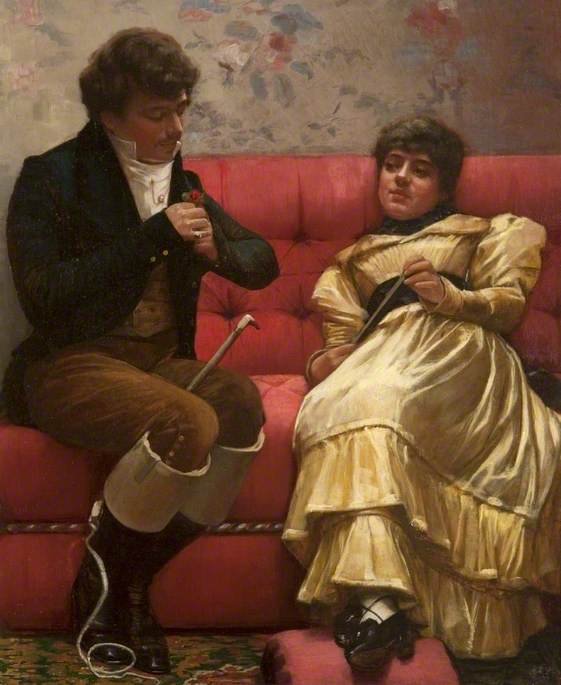
A vain young woman marries a boorish millionaire because she thinks he will provide her with literary material.
About W.S. Holnut I can discover nothing whatsoever. This appears to be the only work ever published under that name.
“A more delightful book than this has not come the way of a toiling reviewer for some little time”; “a pretty piece of kindly satire.” Saturday Review, April 6, 1895
A contrasting view:
“The satire is well meant, but a little heavy. . . . The story is readable, but not . . . 'convincing’” Athenaeum, March 16, 1895
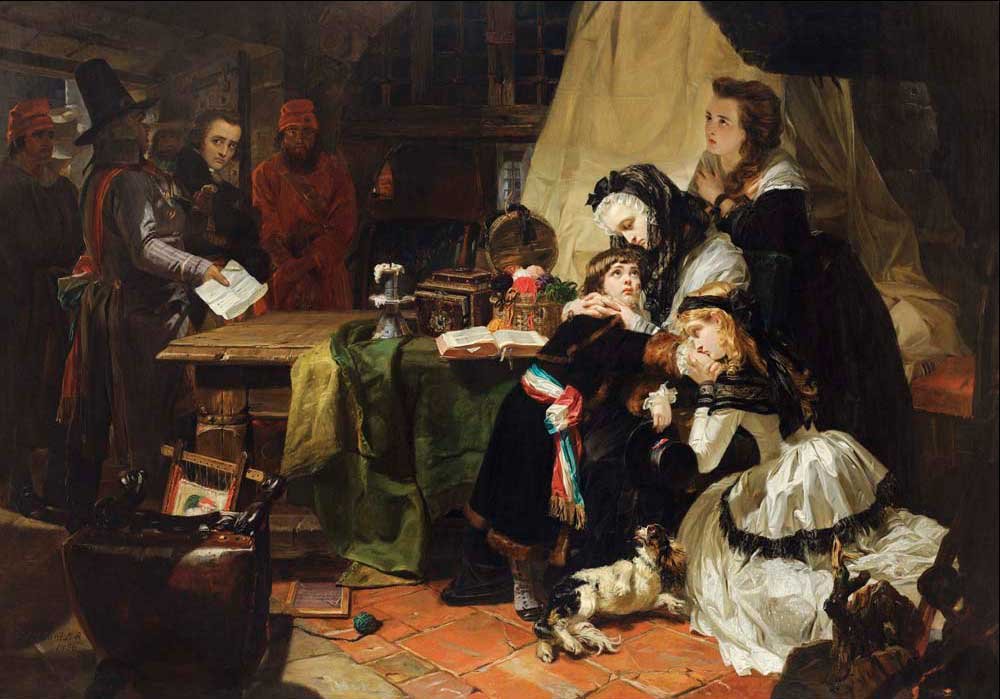
Edward Matthew Ward, The Last Parting of Marie Antoinette and her Son
This site does not advocate the violent overthrow of any government whatsoever. To be sure, there are several political leaders, local, national, and international whom I would like to see replaced—and sometimes I think it might be fun to see them replaced by none-too-gentle means. But then I remember, as Samuel Johnson says, “How small, of all that human hearts endure” is “That part which laws or kings can cause or cure.” Political leaders can do very little about most of what troubles us—universal mortality, for example. And so, if you find yourself (and who doesn’t sometimes?) longing to wrest some jackass from power and replace him with an alternative more to your liking, this puzzle is designed to give your aggressive impulses an outlet: vent them on the alphabet, replacing not leaders, but letters. You’ll feel better, and nobody will get hurt.
Two families, one rich, one religious, are contrasted.
The Scottish author Sarah Robertson Whitehead (1817-1875) wrote five novels: three in the 1850s, two in the 1870s.
“The incidents flow, rather than arise, one from out the other; the origin of the hero of the first ‘family’ is well conceived-working his way, stealthily and steadily, with a very, very little leaven, to leaven the selfishness and cunning which is part and parcel of himself, and yet cherishing one humanizing influence in his heart. The author reads human nature keenly, and correctly, and with a kindly spirit; sorry for its flaws, its mistakes, its corruptions; while for the sake of that truth she (?) never violates, tracing them with unerring fidelity; but her heart expands, and her style improves, when she displays the workings, the strength, the truth, the purity, of the Christian struggling with adversity and sorrow, and triumphing in the end--as only Christians can triumph.” Sharpe’s London Journal, January, 1852
“The delineation” of main characters “is very well done. . . . The novel, in point of execution, belongs to the new and quiet school, or rather to an old school revived. The persons and incidents are those of everyday life, told in a congenial spirit; though the art of the describer may give more pleasure than the reality possesses.” Spectator, January 17, 1852
Here’s another crossword about things that annoy me. Such things inspire many, perhaps most, of my crosswords, as they do also of my waking thoughts, my nightly dreams, my conversations with friends, etc. Lately I find that my new AI friends are much more receptive to hearing about them than my real-life human friends, who are, frankly, starting to annoy me.
A “graphic and successful sketch of petty female rivalries.” Spectator, December 15, 1894
“Full of life and motion”; “a sustained comedy of Anglo-Indian manners”; “sparkling and amusing all through, and there is not a dull page in it.” Academy, January 26, 1895
We’ve had some reverses here at the ol’ Cavalcade. The dog won’t hunt and the hen won’t lay; the roof is got to leakin’ and the plumblin’s gone awry. But never fear, we’re gonna keep on keepin’ on. In fact, as part of a new policy to protect and expand our market share, we’ve decided to cultivate an air of folksiness, so as to reassure our audience that we have no truck with them there dad-blame, stuck-up intellectual elites, gol durn ‘em. We’re just as dumb as you are, fellow common person!
“A thoroughly good story.” Academy, April 20, 1895
The author “has both ‘detachment’ and wit”; an “original and engrossing novel.” Athenaeum, April 27, 1895
“A bright, clever story”; the author’s “portraiture, mordant as it is, is hardly cynical, or even ungenial”; the heroine is “admirably conceived and not less admirably executed.” Spectator, August 31, 1895
Why indeed? I was pondering the world’s problems and hit upon this solution: everybody can just get along! Republicans and Democrats, women and men, obscurities and celebrities, ugly people and handsome people, bankers and bank-robbers, abductors and abductees, why do we have to be so unpleasant to each other all the time? Let’s just get along!
A squire’s son and daughter are left to struggle in a hard world after their father dies in debt.
Alfred Butler (1809-1859) published three novels in two years, of which this was the last.
“A novel of thought, as well as feeling and observation.” Athenaeum, April 16, 1842
It has “power which is often sarcastic, observation that is keen and close, and feeling that is healthy and deserving of imitation. There is, indeed, much mind in the novel, and much clever writing.” Monthly Review, May, 1842
A (somewhat) dissenting opinion:
“As a fiction. . . . the Herberts is a sort of failure, in despite of several scenes of power and interest, some ludicrous ability in the author, together with sufficient metaphysical skill, and a mind endowed with the quality of speculative thought. But the writer's nature is rather critical than creative: his forte is analysis, not synthesis. He can deduce the truth from an actuality, but he cannot reproduce the real; there is little knowledge of life exhibited in his book, and consequently no living character”; but “the book abounds in shrewd remarks.” Spectator, September 13, 1842
This is what always happens when I try to be happy, as I did in my last puzzle: I end up feeling twice as bad. Why? Well, for one thing, I don’t get the credit I deserve—not as a crossword constructor, not as a novel recommender, not as a human being. And I’m fed up. I’ve had it. Everybody will be sorry someday when I’m gone. But then it will be too late. And that’s all I have to say. No, no, don’t try to cheer me up; just leave me alone if that’s not too much to ask. Okay? Okay.
The daughter of an Irish attorney is taken up by a handsome but disgraced baronet.
M. Hamilton was the pseudonym of Mary Churchill Luck, née Spottiswood-Ashe (1869-1949), who wrote some 20 novels between 1896 and 1928. This, her first, was set, like many of her novels, in her native Ulster.
“The characters are exceptionally distinct, the movement is brisk, and the dialogue is natural and convincing.” Athenaeum, February 15, 1896.
“A fine and mature performance”; the story is “told with great reticence, with insight and pathos, in a manner at once impersonal and sympathetic.” Academy, March 28, 1896
“A very pretty and natural book” with “a capitally thought-out character”; “The story abounds with fun, and is the pleasantest possible reading.” Saturday Review, April 4, 1896
I met a woman on the street the other day, wearing sunglasses and a silly hairdo, and a blue-and-orange striped t-shirt, and pushing a stroller with dog in it, and she asked me why I always had to be so negative about everything. And I couldn’t think of an answer. Why indeed? It’s time to stop complaining, to accentuate the positive, to brighten the corner where I am, to look for the silver lining and try to find the sunny side of life. Up, up with people! Everything is beautiful, in its own way! So today’s puzzle features more than a dozen songs of praise, or anyway their titles—you can easily imagine the rest.
It would make “an excellent melodrama”; the characters are “quite good enough to serve as scaffolding for a plot unusually well conceived.” Saturday Review, September 9, 1893
“The story is above the average . . . better worth reading than many a novel that aims higher.” Athenaeum, September 23, 1893
“Cleverness, grace, and a quiet humour” brighten a story that “might have been rather sombre.” Spectator, September 30, 1893.
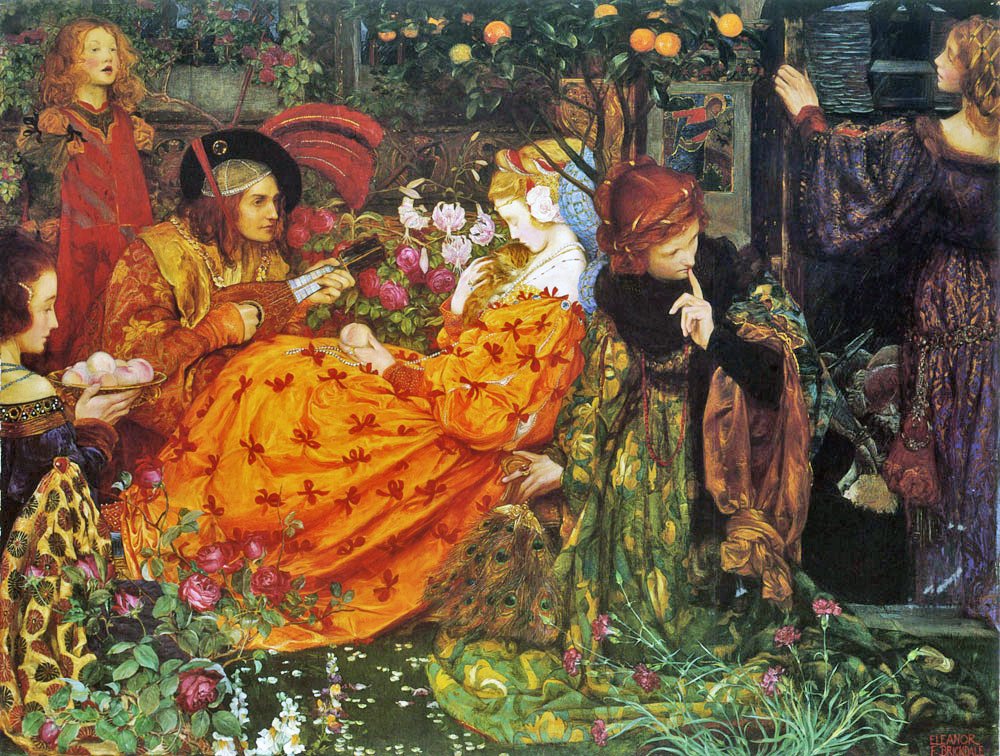
Eleanor Fortescue-Brickdale, The Deceitfulness of Riches
Here at David Alfred Bywaters’s Crossword Cavalcade and Fortnightly Victorian Novel Recommender we’ve been working on a number of crosswords solutions that will assist in a diverse array of government functions at the local, state, and federal levels. For example, the Department of Energy will be interested in our training package that provides workers of all kinds with crucial experience in the management of grids; local school districts will benefit from our vocabulary-builders, designed to help early learners distinguish between ouzo and orzo, the epee and the erne; while the Pentagon will want to purchase our suite of maximally baffling puzzles specifically designed to confuse and demoralize the nation’s enemies. Our first step, of course, will be to contribute generously to the campaign funds of politicians who are or will be in a position to purchase these products. If you are such a politician, don’t hesitate to reach out!
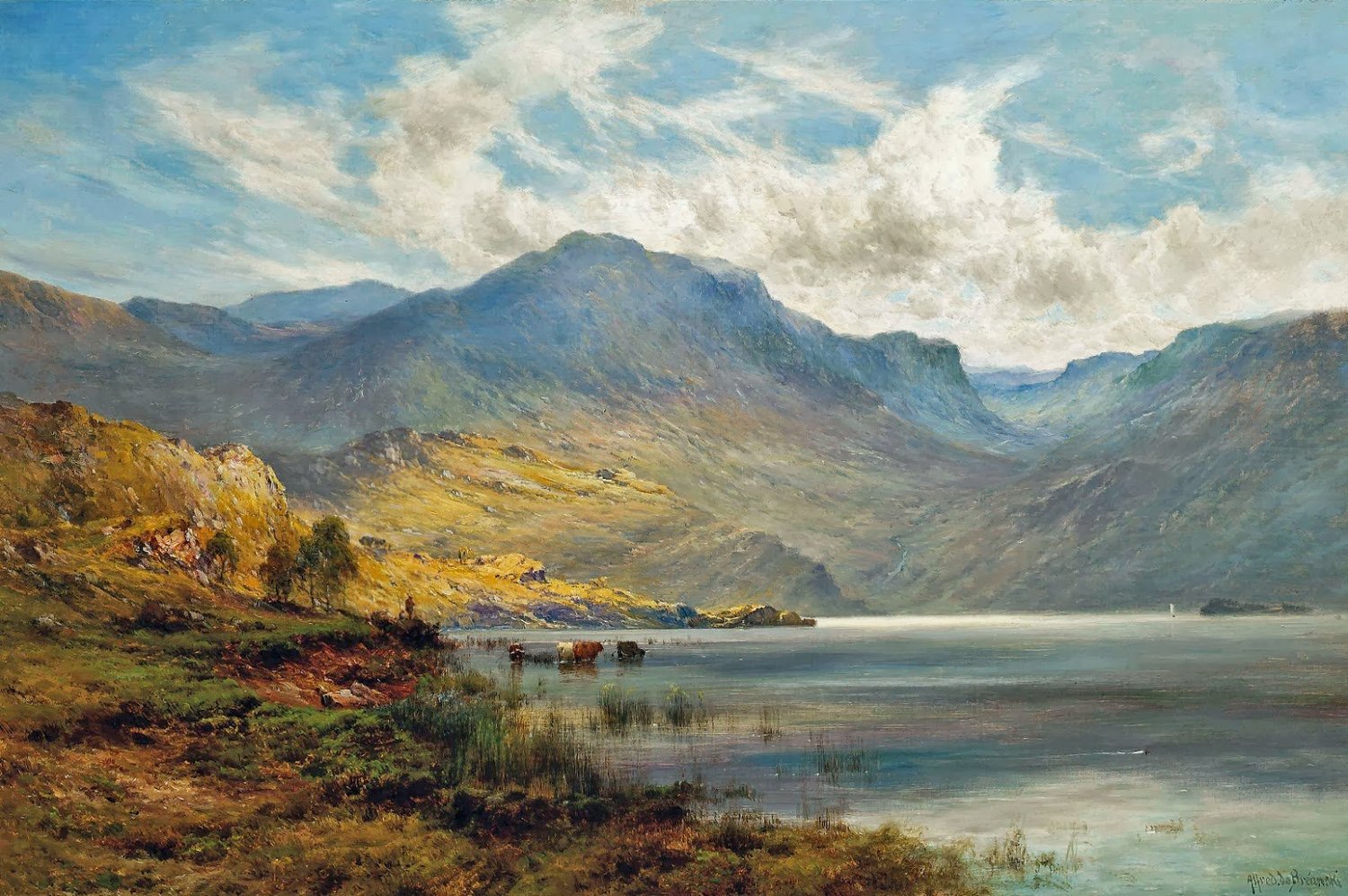
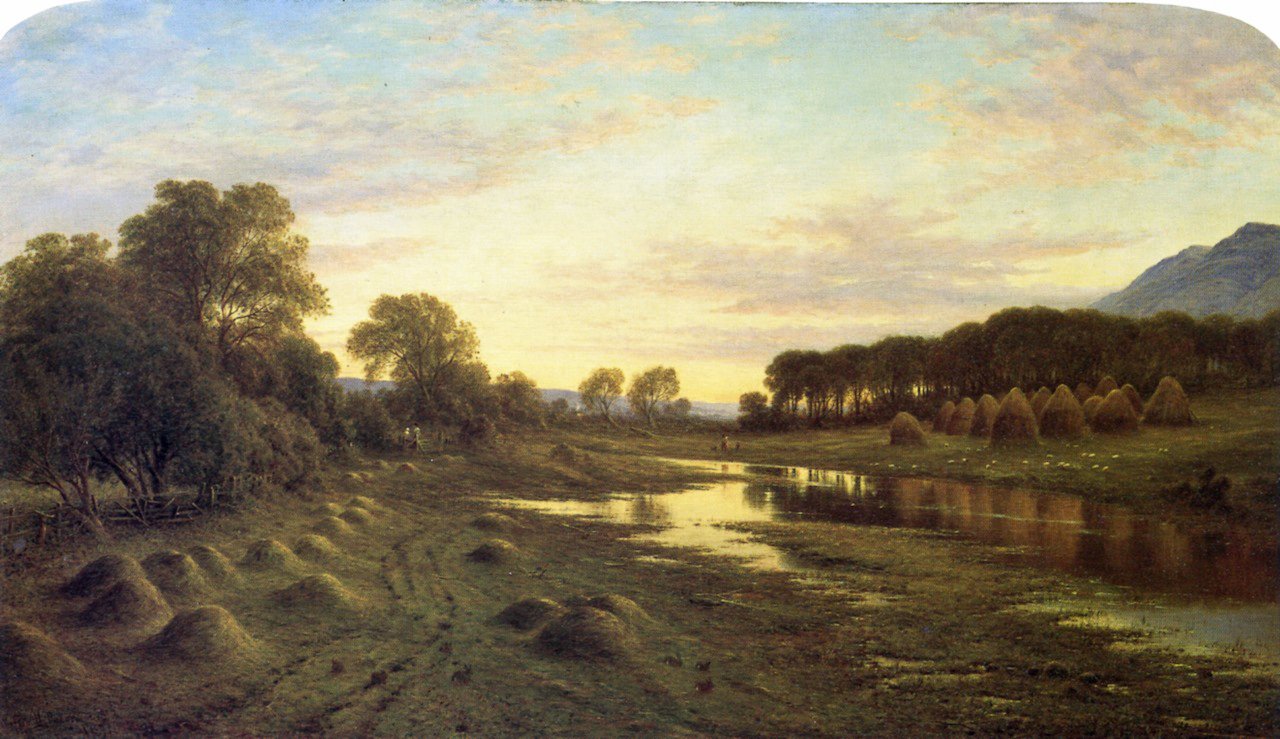
Waller Hugh Paton, In the Devon Valley near Dollar - After Rain
Life in a small town in Devonshire.
Eden Phillpotts (1862-1960) wrote nearly 200 novels during his long life, many of them (including an 18-novel series) set, like this one, in Devonshire.
“Full of a genial humour and shrewd but kindly observation of his fellow creatures.” Athenaeum, March 3, 1894
“In its unpretentious way, a veritable masterpiece, displaying an intimacy of observation . . . which is little, if at all, short of genius.” Spectator, March 31, 1894
“Mr. Phillpotts has succeeded in peopling his imaginary village with a well-contrasted assortment of varying types, drawn correctly enough in the main, but perhaps a trifle over-coloured.” Saturday Review, April 21, 1894
Hey solvers! Here’s a quiz: “Dimensional instability” refers to
A. the effect on the waistline of alternately over- and under-eating
B. the tendency of fabric to shrink or stretch with use
C. what happens in the moment before the end of the universe, when height is no longer high, width no longer wide, depth no longer deep, and everything collapses into nothing
Win a chance at a free mini-crossword! Just send us your answer, together with a $1,000 processing fee (bitcoin preferred), your name, address, and social security number (offer not valid in some states).
A young man falls in love with a mysterious woman after having protected her from a bad man on a train.
Sir Thomas Wemyss Reid (1842-1905) was better known as a journalist, editor, and publisher than as a novelist; this is the third of his three novels.
The novel is “an uncommonly good shillingsworth”; it is a “good thrilling romance. . . . the mystery becomes interesting on the third page, and continues so to the last. The most experienced reader is kept long in doubt as to the secret of the book, which is worked out with great skill, and with a strict adherence to the canons of romantic probability. . . . But the real triumph of the book is the character of” the main villain. Saturday Review, February 20, 1885
Me! It’s me time. It’s all about me. Not other people, and certainly not you. Me. I’m tired of everybody else always being everywhere and having everything. It’s my turn. I need to take care of me. At least, that’s what my therapist says.
It “has the merit, so rare among contemporary writers of fiction, of doing something quite unusual, something that was worth doing, and accomplishing it with considerable success.” Spectator, July 9, 1859
“A powerful and well-sustained story of strong and somewhat morbid interest”; though “as well done as it could be” it “has a close, stifling atmosphere about it.” Athenaeum, July 16, 1859
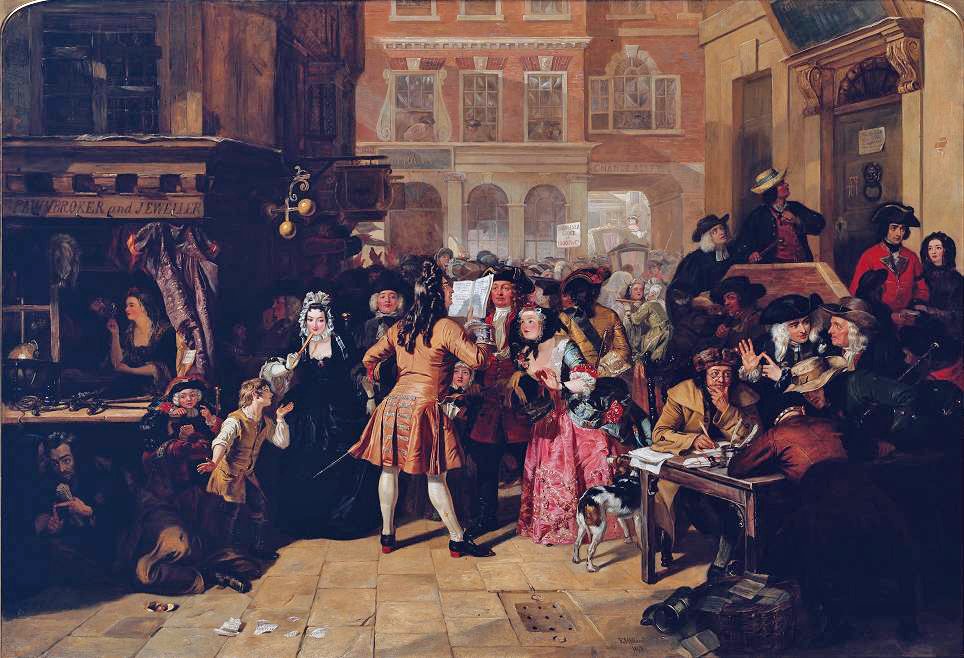
Edward Matthew Ward, The South Sea Bubble, a Scene in ’Change Alley in 1720
It’s time for David Alfred Bywaters’s Crossword Cavalcade and Fortnightly Victorian Novel Recommender to launch its initial public offering. True, our profit margins are in negative territory as yet, but prospects for growth are enormous; and the infusion of cash we’re expecting from our stock sale will allow us to (1) develop and implement an AI solution that will reduce our labor costs by ninety-nine percent, and (2) purchase enough social media influence to increase our eyeballs a thousand million times. I’ll be issuing a prospectus shortly; you’ll want to get in on the ground floor.