David Alfred Bywaters's Crossword Cavalcade & Fortnightly Victorian Novel Recommender. Every Saturday! Either a new language-torturing puzzle or an old novel by an unjustly neglected Victorian author. Why waste time on other amusements?

Novels

Novel 175: Jane Octavia Brookfield, Influence (1871)
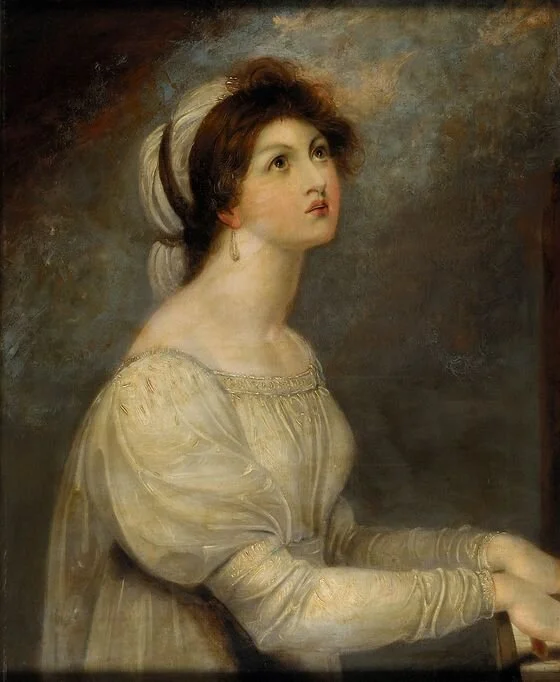
Richard Westall, Lady Hamilton (as St Cecilia)

An ambitious, intellectual woman seeks to arrange her friends’ lives.


Jane Octavia Brookfield (1821-1896), in the 1840s a very special friend of William Makepeace Thackeray, wrote four novels many years later, of which this is the second.  Oddly clumsy in some ways (especially in its narrator’s intrusions), it nonetheless has some vivid, interesting characters.

“A novel of character which, if not deeply exciting, or suggestive of any new aspects of feminine human nature, is original in plan, and not ineffectively executed.”  Athenaeum, January 21, 1871

“Influence at once makes itself felt as a book of character. There is no danger of confounding it with the ordinary run of novels, there is no danger of forgetting it. . . .  The conversations are well managed, and, though there is no pretence at a plot, the story is interesting.   Altogether, Influence is a good novel.”  Spectator, May 20, 1871

Download this week’s novel:
v.1 http://access.bl.uk/item/viewer/ark:/81055/vdc_00000003F6E4#?c=0&m=0&s=0&cv=4&xywh=-329%2C-123%2C2895%2C2158

v.2 http://access.bl.uk/item/viewer/ark:/81055/vdc_00000003F6EA#?c=0&m=0&s=0&cv=4&xywh=-316%2C-100%2C2906%2C2166

Novel 174: Lucy B. Walford, Cousins (1879)

Edwin Longsden Long, The Cousins

Three sisters react to the return of their wealthy and distinguished cousin from India.


This novel provides a generous sampling of its author’s characteristically deft social comedy (see Novels 018, 066, 121), despite a sometimes annoying plot.

“There is a resemblance in the manner of handling to Miss Austen’s manner, especially in the first volume; and when it is said that Cousins does not come too discreditably out of the comparison, we need not say that a very high compliment is thereby paid to the author.” Academy, July 26, 1879

“It is, in part at least, a very good novel—one of the best that we have read for a long time.  The situation . . . upon which it turns is . . . novel and . . . has great capabilities. . . .  Its great attraction lies in the delicacy of the character drawing, in the charming domestic sketches in which it abounds, and in the natural and easy dialogue which is so rare an accomplishment with novelists.  The first volume, which is far the best, will remind many readers of Miss Austen’s work, and it would be impossible to give it higher praise.” Manchester Guardian, August 18, 1879

Its “success is, in our judgment, decided”; it is “as careful and honest as it is modest and pure.   The purpose of the story is kept in view throughout; there are no tricks of style or language, and there is no padding.” Saturday Review, August 30, 1879

Download this week’s novel:

v.1 https://archive.org/details/cousins01walfo

v.2 https://archive.org/details/cousins02walf

v.3 https://archive.org/details/cousins03walf

Novel 173: Harold Frederic, March Hares (1896)

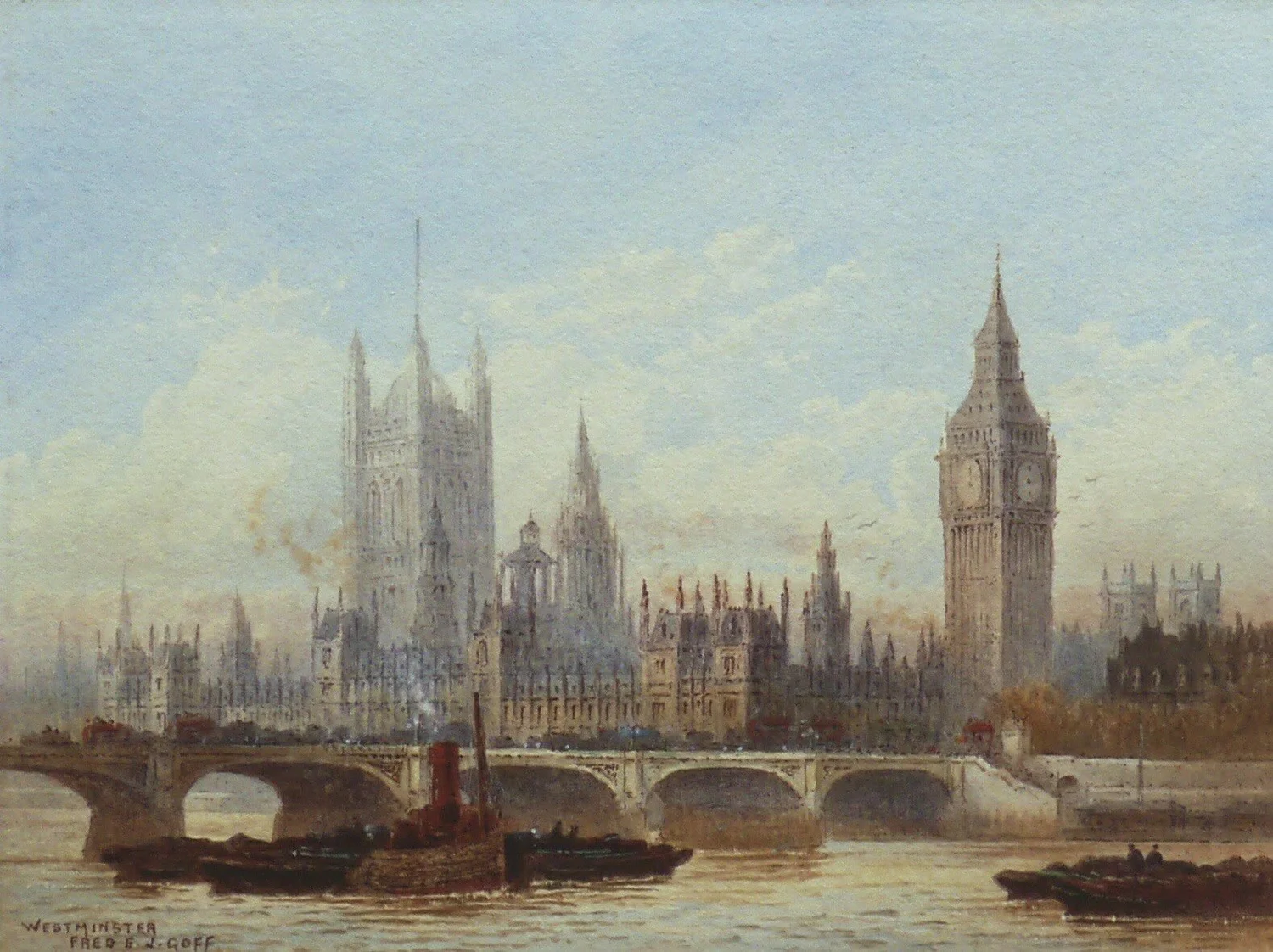
Frederick Edward Joseph Goff, Westminster and Westminster Bridge from the River

Two unhappy young people meet by chance on Westminster bridge.


Best known for The Damnation of Theron Ware (1896), expatriate American journalist Harold Frederic (1856-1898) wrote ten  other novels before his death in middle age, one of them this brief, light-hearted love story set in London.

“We can thoroughly commend the book as an easily read piece of fancy.” Athenaeum, July 4, 1896

“Mr. Harold Frederic gives the reader of ‘March Hares’ a shock of delightful surprise. . . .   he is captivating, amusing, a playful companion.”  His characters “are simply human beings flung into the grotesque whirl of such a sequence of situations as only a riotous imagination could devise, but which such a keen intelligence as Mr. Frederic’s finds no difficulty making thoroughly natural.  We use the word intelligence, because . . . Mr. Frederic seems to be exercising the mere gymnastical faculties of his mind, whipping along the dialogue with so much animation, so much fun, so much ingenuity, that the effect of the tale is not unlike that of the conversation of original and clever people. . . .  It has art of the genuine sort, not mere silly craftsmanship and pretense, but the dignified art which means a quiet mastery of the subject in hand.  There are few novelists to-day who could have taken such a gossamer theme as that of ‘March Hares’ and left it so well worked out as it has been in the present case.”  New York Tribune, December 20, 1896

Download this week’s novel:

https://archive.org/details/marchhares00fred

Novel 172: Catherine Gore, The Banker’s Wife (1843)

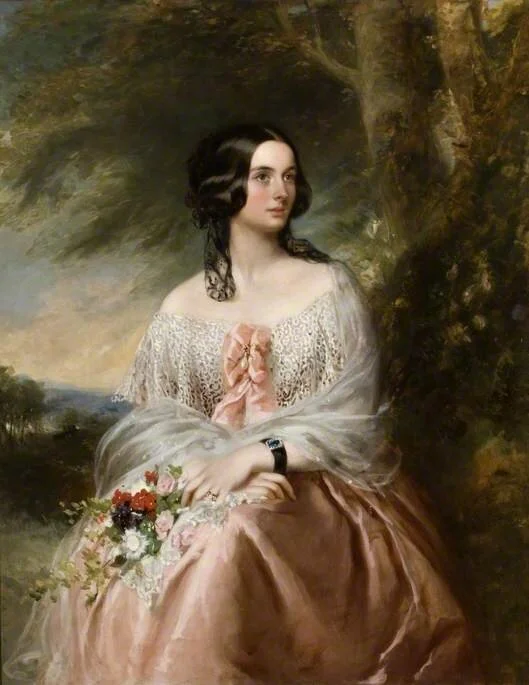
Richard Buckner, Emily Lady Isham

A scheming banker has little sympathy for his family.


Here is another excellent novel by Gore (see Novels 012, 072, 118), filled as usual with shrewd social satire.

“A very clever, and what is more, a very readable novel; clear, rapid, fluent, abounding in pointed sentences.” Spectator, September 16, 1843

No living author “possesses greater power in the delineation of character.”  Sunday Times, September 17, 1843

“The ‘name’ of its writer, first as  that of a woman, and secondly as that of a popular ‘novelist,’ will long keep it out of the hands of those ‘grave and reverend signors,’ who are the chief dispensers of that reputation which they cannot compass for themselves, and who . . . will never be satisfied that a woman has been gifted with faculties of observing . . . nature.” Morning Post, October 1843

Download this week’s novel:

v.1 https://archive.org/details/bankerswifeorcou01gore

v.2 https://archive.org/details/bankerswifeorcou02gore

v.3 https://archive.org/details/bankerswifeorcou03gore

Novel 171: Cecil Clayton, Azalea (1876)

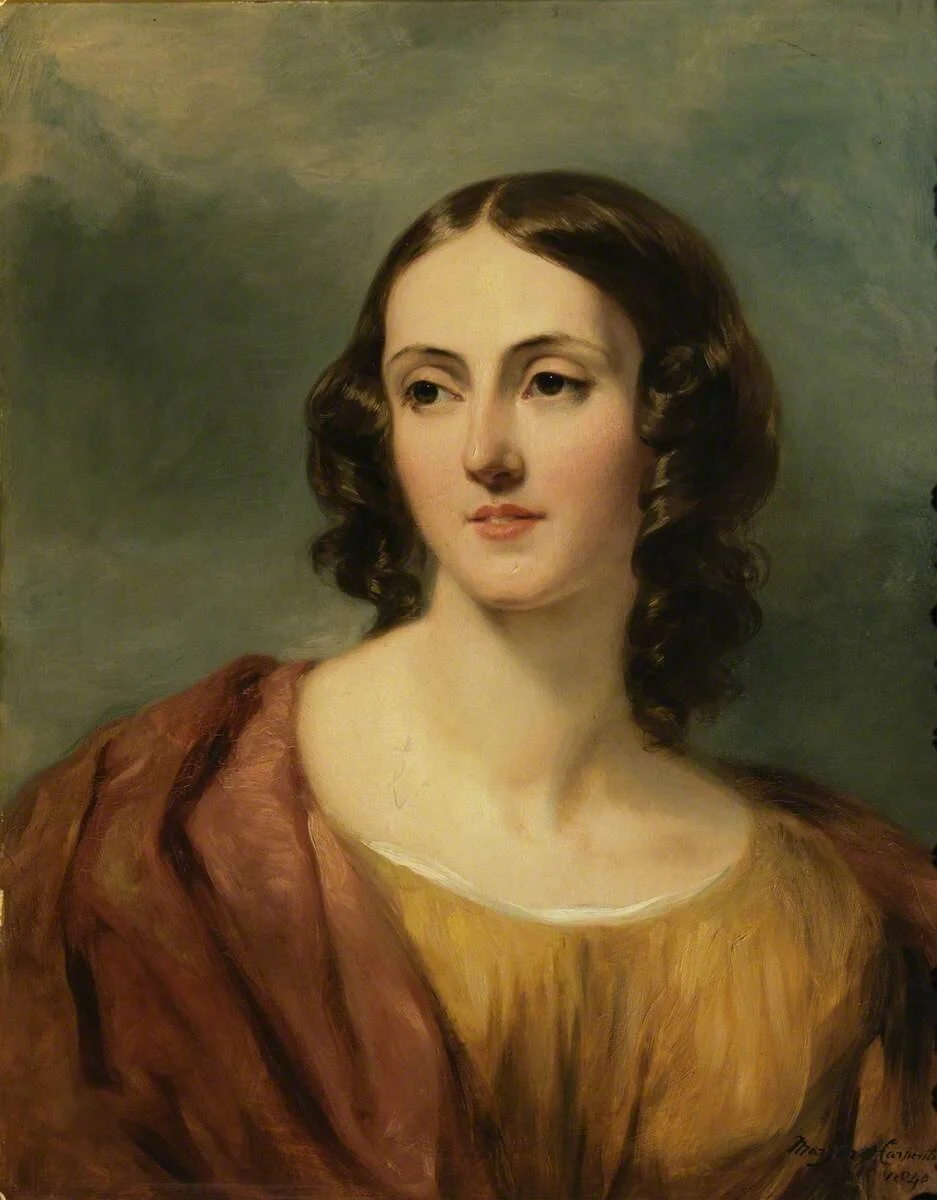
Margaret Sarah Carpenter, Lady Harriet Hamilton

A girl, raised to the age of twelve in the Italian Alps by the widowed daughter of a Jewish silk-merchant, is on her mother's death adopted by her English uncle.


About Cecil Clayton nothing is known, except that two novels appeared under this name, Effie’s Game in 1873 and this one three years later.  It has some excellent characters, a good style, and a pleasantly untroubled plot, as though the author were too soft-hearted to inflict much pain on her (or his?) creations.

“Azalea is a story which, without having anything new either in plot or characters, is distinctly easy and pleasant to read, in consequence of its thoroughly cultured and well-bred tone.” Academy, September 9, 1876

“People whose nerves have been shaken by overwork or anxiety, people who wish to forget that there are such things as passion and suffering in the world, should read this smoothest of all smooth tales, and enjoy the society of the innocent persons.  The worst characters in Azalea are sometimes flippant or a little peevish, but their failings are never allowed to interfere with the tranquil happiness of the hero and heroine.” Saturday Review, September 16, 1876

Download this week’s novel:

https://books.google.com/books?id=o2tTPrSSiosC&newbks=1&newbks_redir=0&dq=azalea%20cecil%20clayton&pg=PA7#v=onepage&q=azalea%20cecil%20clayton&f=false

Novel 170: M.E. Braddon, Only a Clod (1865)

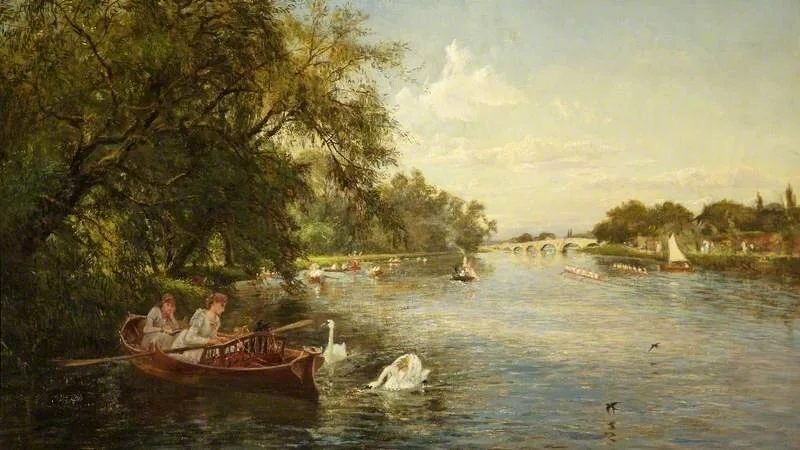
Charles James Lewis, On the Thames

A common soldier inherits a fortune from a miserly uncle.


Here is yet another novel by the great Braddon (see Novels 004, 061, 115).

“Miss Braddon . . . tells her story with a brisk straightforwardness, and the working is compact and consistent.  And it is no small or common talent to be able to construct an interesting tale, and then to tell it in good language, without affectation or egotism. Several of the characters are very well sketched, but in the beautiful heroine Miss Braddon has done more than draw a mere colourless outline.  A good-humoured, simple-hearted, and spoiled young lady is easily drawn, but to change her gradually, and without melodramatic violence of nonsense, into something very different, requires more than mere smartness and ordinary skill”; her growth is “described with great ingenuity and force.”  Saturday Review, May 27, 1865

“Only a Clod . . . is a fresh proof of the vigour and fertility of the mind which produced . . . ‘Aurora Floyd’ . . . and ‘The Doctor's Wife’. . . .  As a whole . . . the book will be eagerly read as a powerfully written and admirably constructed story.” Manchester Guardian, June 13, 1865

Download this week’s novel:

http://solo.bodleian.ox.ac.uk/permalink/f/89vilt/oxfaleph014579096

(Right-click (or control-click, if you have a Mac) on the three “view digitized copy” links to download the novel’s three volumes in pdf form)

Novel 169: Arthur Locker, Sweet Seventeen (1866)

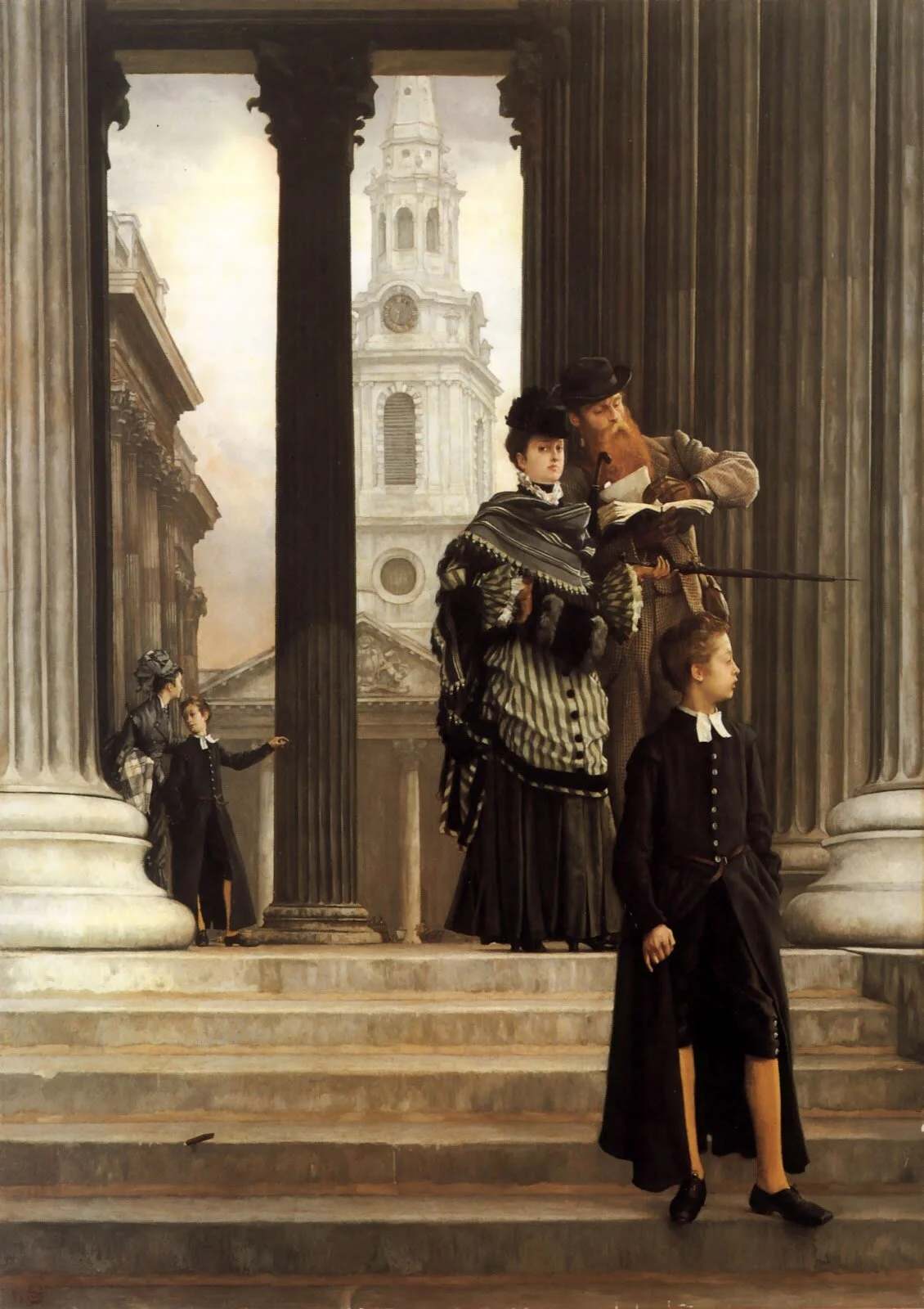
James Jacques Joseph Tissot, Visitors to London

An orphan girl, adopted by a London doctor, has rival lovers.


Arthur Locker (1828-1893), a journalist and editor, published five novels between 1863 and 1874.  This one begins in Australia, where the author spent some years, but is mostly set in middle-class London.

“Those writers of prose fiction who season their pages with mysterious crime and repulsive vice, should study the modes by which Mr. Locker captivates the imagination of his readers with scenes alike humorous and innocent.  Instead of making them endure his characters by rousing a morbid curiosity as to the sequel and result of a startling commencement, he leads them to enjoy his story by inspiring them with personal interest in its characters.  From first to last the book is fresh with nature and unconstrained pleasantry.  The actors are neither tame nor commonplace; the incidents bear no resemblance to the conventional arrangement of story-tellers; and yet the drama impresses us with a sense of its fidelity to human nature and society in such a manner that we seem to encounter old friends and familiar faces in every scene. . . .  The world described is that of the middle and lower grades of our great middle-class—the world of professional men and merchants, clerks, and petty tradesmen; and with never-flagging humour does Mr. Locker set forth the ways and tempers of the various persons who are made to illustrate this comparatively humble life.”  Athenaeum, November 10, 1866

“The author . . . has produced one of the most agreeable, if not one of the most instructive, tales of fiction of the season.  It is graceful and unpretending.  It discloses no profound philosophy, displays no erudition, professes no high moral aim, but amuses and delights by the natural exhibition of character under varied circumstances and unexampled situations. . . .  Mr. Locker weaves his love story with gentle tissues.  There are no wild flights of passion, no desperate deeds of vengeance, nor suicides; all is natural, fluent of feeling that is subdued and rational, and issuing in results probable, pleasing, and in harmony with the means employed.  One of the charms of Mr. Locker’s novel is its realism, with sufficient sentiment and fancy to link the real with the ideal.”  Morning Post, December 11, 1866

Download this week’s novel:

v.1 http://access.bl.uk/item/viewer/ark:/81055/vdc_0000000458D0#?c=0&m=0&s=0&cv=4&xywh=-116%2C0%2C2833%2C2094

v.2 http://access.bl.uk/item/viewer/ark:/81055/vdc_0000000458D6#?c=0&m=0&s=0&cv=4&xywh=-119%2C0%2C2848%2C2104

v.3 http://access.bl.uk/item/viewer/ark:/81055/vdc_0000000462BA#?c=0&m=0&s=0&cv=4&xywh=-111%2C0%2C2842%2C2101

Novel 168: Mrs. Alexander, Which Shall it Be? (1866)

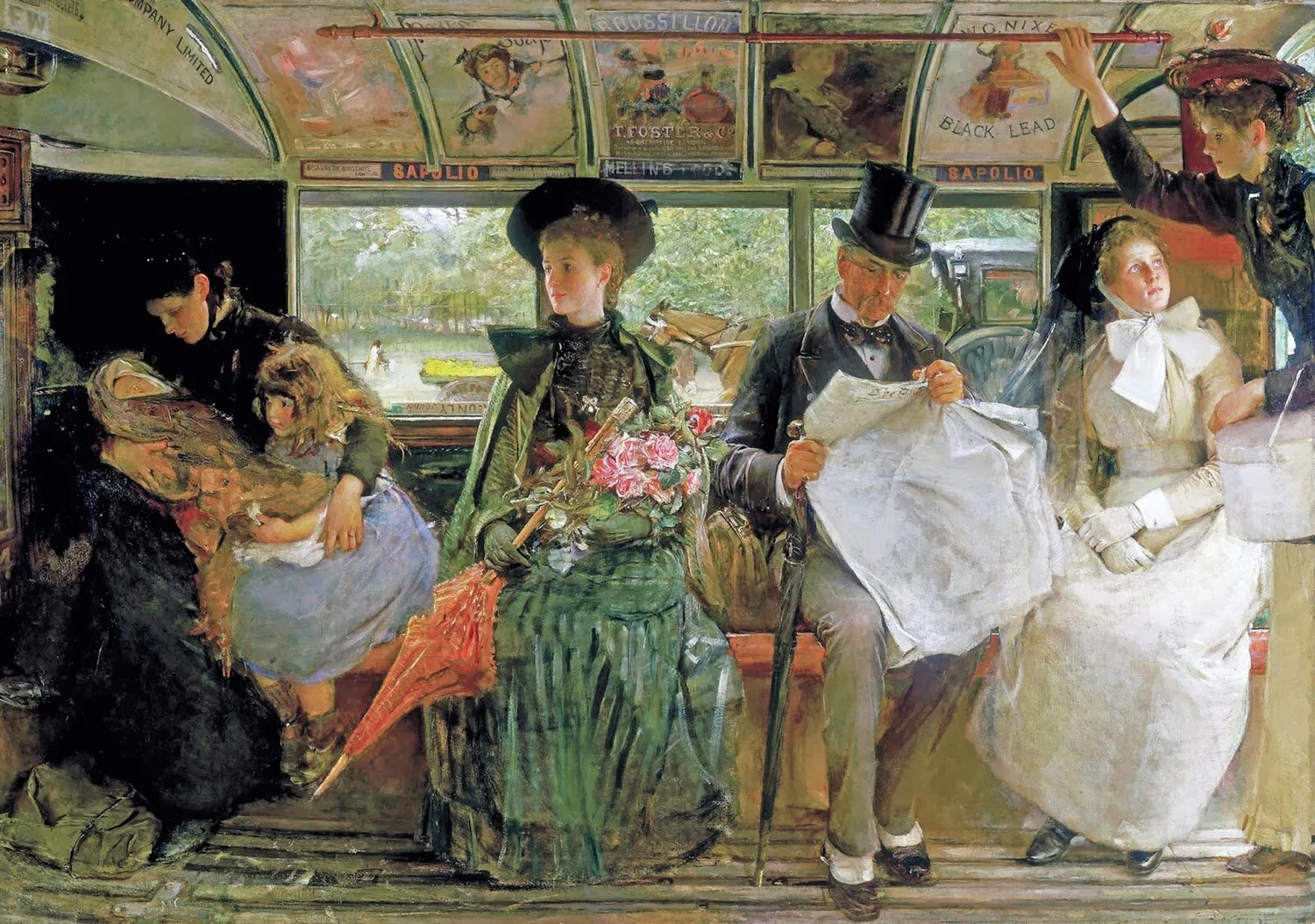
George William Joy, The Baywater Omnibus

An orphaned virtuous young lady seeks to make her way despite her relatives’ selfish unhelpfulness.


Here is another novel by “Mrs. Alexander” (see Novels001, 063, 113) with her usual vivid characters, dramatic situations, and gratifying if impossible plot.

“No one can read this book without being struck by the more than ordinary ability that it displays. . . .  It is . . . written with a fluency, an ease, a knowledge of literary manipulation, and a ripeness of worldly wisdom that would seem to indicate the practiced hand of a mature writer. . . .   There are many observations scattered about, too, which show that the author has had unusually rich opportunities for studying life in various phases.  There is a knowledge of the bitter ways and clever makeshifts of poverty, as well as of the parade and hollow friendships springing up like mushrooms in a night round unexpected wealth . . .; while many of the characters are careful life-studies. . . .  It deals with difficult questions with the quiet boldness of a Voltairean of the nineteenth century. . . .  The character of Madeline throughout is of great psychological power.”  Saturday Review, September 22, 1866

“A novel of much interest and power. . . .  The work is remarkable for the fidelity of its pictures of domestic life, both English and French, which convey to the reader an irresistible impression of probability and reality, and of being presented by an eyewitness. . . .  The story is full of incident and well-drawn character.  ‘Which Shall It Be?’ is a novel of great literary and constructive merit, and evinces penetrating observation of character as well as lively descriptive power.  As a story it excites vivid interest from the beginning, and sustains it to the end.”  Examiner, October 12, 1866

Download this week’s novel:

http://solo.bodleian.ox.ac.uk/permalink/f/89vilt/oxfaleph014211328

(Right-click (or control-click, if you have a Mac) on the three “view digitized copy” links to download the novel’s three volumes in pdf form)

Novel 167: Elliott Graeme, A Novel with Two Heroes (1872)

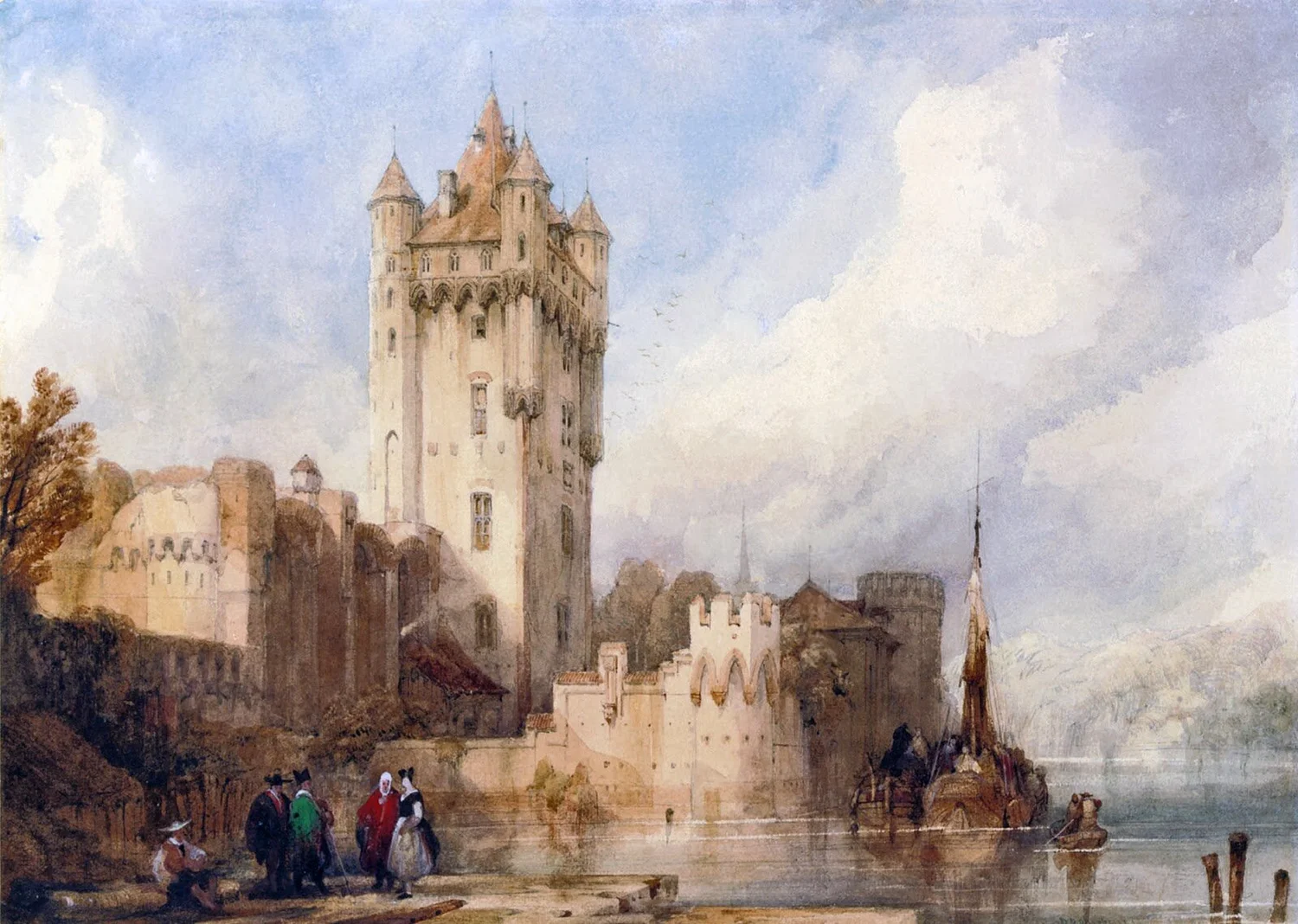
David Roberts, Kurfürstliche Burg, Eltville, on the Rhine, Germany

A young German music student befriends an English student at a German university.


About Elliott Graeme, nothing appears to be known except that, in addition to this one novel, he (or she: contemporary critics use both pronouns) also wrote a biography of Beethoven.  The oddly rambling plot here suggests unfamiliarity with, or indifference to, contemporary novelistic convention, but the characters and settings are well realized.

“A decided literary success.  The story is written in a lively and agreeable style.”  Athenaeum, March 16, 1872

“We doubt not many of our readers will lay aside the book with regret; for the pourtrayal of character and detail of German home-life is sufficiently vivid to make us think we are parting with old friends.  The language used is felicitous, and the author is by no means deficient in humour.”  Musical Standard, June 1, 1872

“Above the average even of good novels.  It is clever and amusing, free from sensationalism, though full of interest, and of interest which touches many of the deeper chords of life.”  Spectator, June 15, 1872

Download this week’s novel:

v.1 http://access.bl.uk/item/viewer/ark:/81055/vdc_00000004CED8#?c=0&m=0&s=0&cv=0&xywh=-1098%2C-1%2C3632%2C2342

v.2 http://access.bl.uk/item/viewer/ark:/81055/vdc_00000004CEDE#?c=0&m=0&s=0&cv=0&xywh=-1111%2C0%2C3649%2C2352

Novel 166: Edward Dutton Cook, Hobson's Choice (1866)

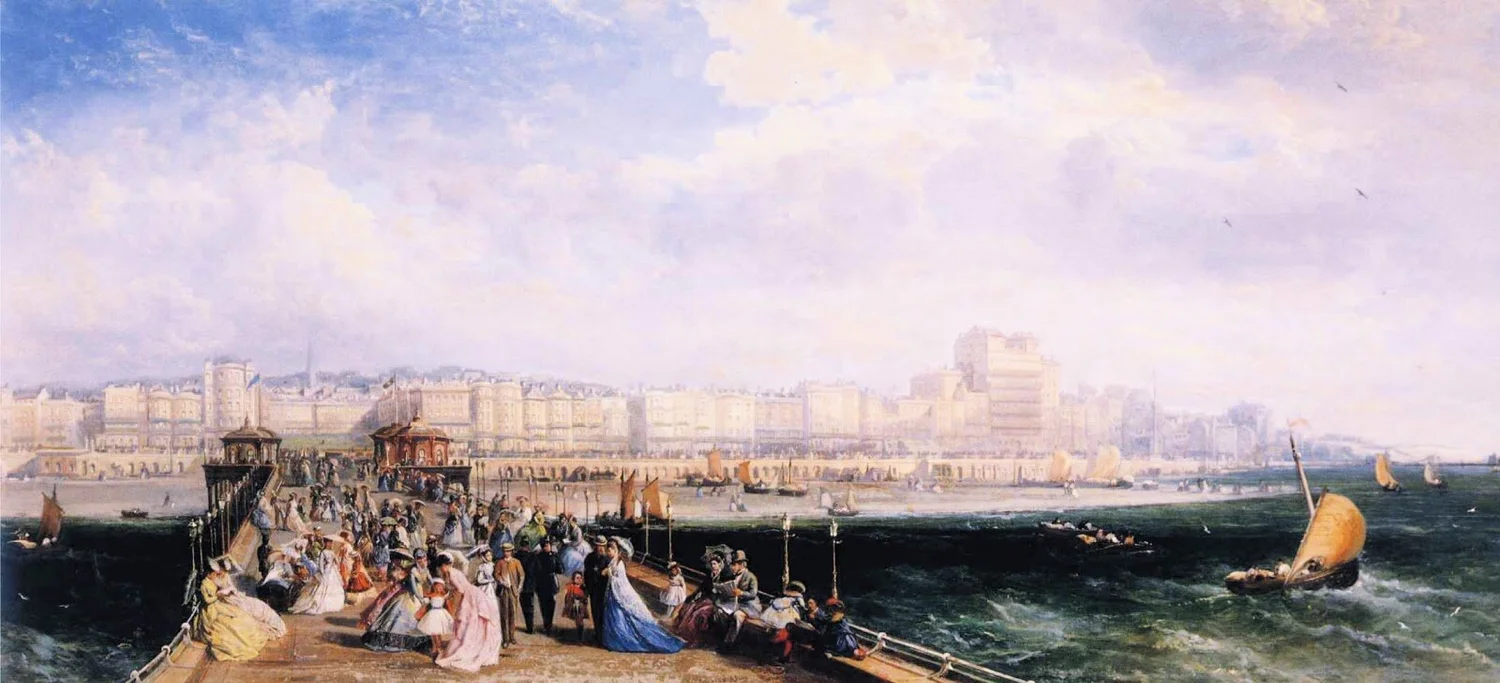
James Webb and Charles Earle, Brighton Pier

A bachelor barrister goes to visit his aunt—and his heiress cousin—at a seaside town.


Here is another lively novel by Cook (see Novels 040, 111), this one relatively brief.

“An afternoon spent on Hobson’s Choice will be spent pleasantly, and produce no small crop of apparently causeless laughs in secret places afterwards, as the better passages return suddenly to the memory.”  Spectator, December 29, 1866

“A single volume of light and sparkling prose, that may be read through in a railway journey.”  Athenaeum, January 26, 1867

Download this week’s novel:

http://access.bl.uk/item/viewer/ark:/81055/vdc_00000003A13A#?c=0&m=0&s=0&cv=0&xywh=-547%2C-127%2C2522%2C2533

Novel 165: Sir Arthur Hallam Elton, Herbert Chauncey (1860)

Walter Field, Men were Deceivers Ever

A faithless lover is secretly pursued by a vindictive father.


Sir Arthur Hallam Elton (1818-1883), a baronet and member of Parliament, wrote only two novels, of which this is the second. The characters are interesting, the style good, and the plot involving, though it ends with odd abruptness, seeming to hint at a sequel that never came.

“We congratulate Sir Arthur Elton and the public” on his “brilliant success. . . .  Among the distinguishing merits of the novel . . . are the freshness and artistic construction of the story.  It is full of variety, yet its unity is perfectly preserved, unbroken by a single episode.  Its interest increases in intensity with an even progression from the first chapter to the last.”  Spectator, August 4, 1860

“There is a largeness and simplicity in the conception of the plot, which is worked out with facile dialogue and in a narrative that never flags.  There are no tedious descriptions, no second-hand moralities, all is action and passion well presented.”  Examiner, October 13, 1860

Download this week’s novel:

v.1 https://archive.org/details/herbertchaunceym01elto

v.2 https://archive.org/details/herbertchaunceym02elton

v.3https://archive.org/details/herbertchaunceym03elton

Novel 164: Amelia Perrier, A Good Match (1872)

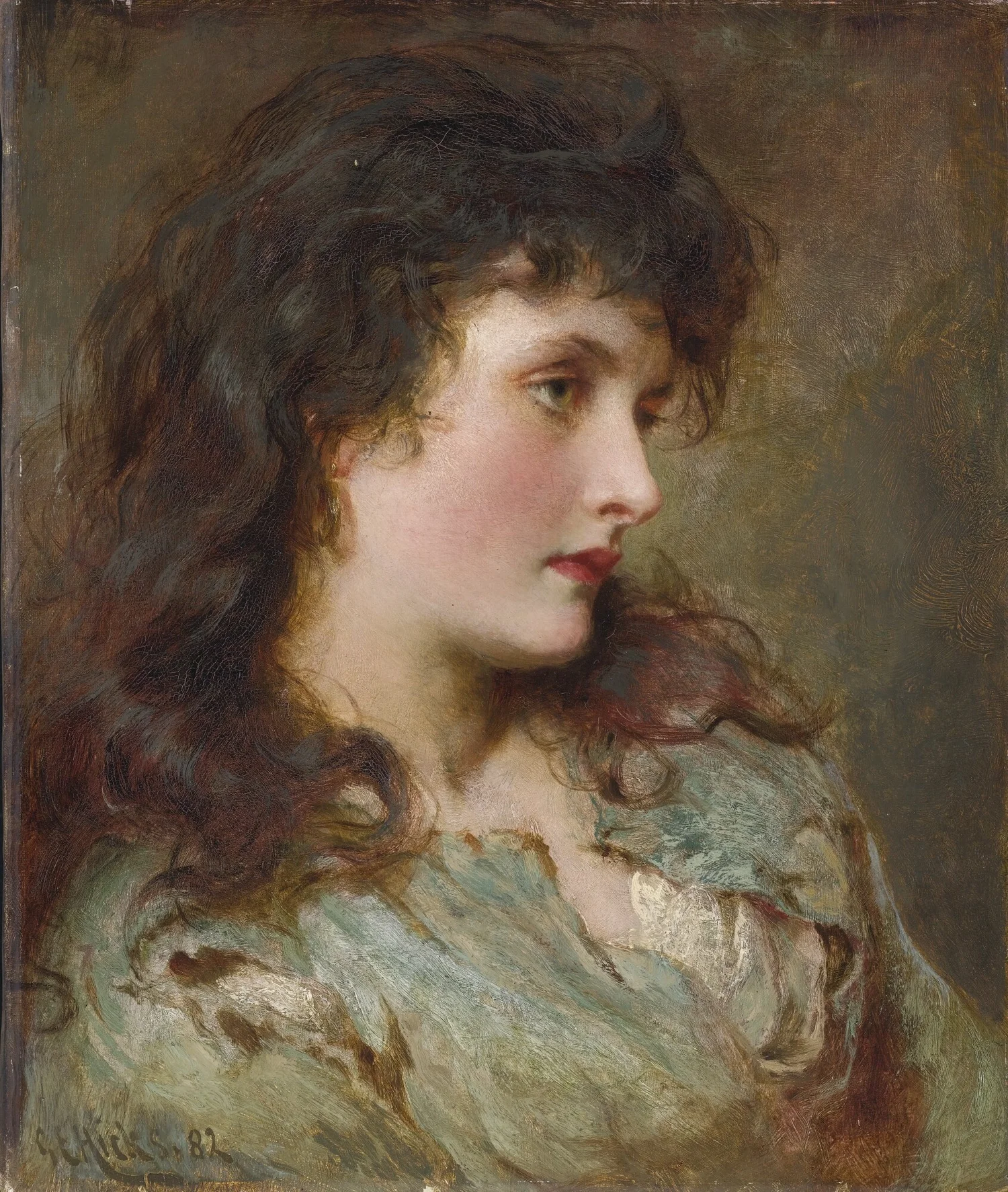
George Elgar Hicks, Maud

A spirited young lady resists her cruel baronet uncle’s plan to marry her to a wealthy pork-dealer.


Amelia Perrier (1841-1875) wrote two novels during her sadly brief career, of which this sprightly social comedy, featuring a refreshingly assertive heroine, is the second.

“‘A Good Match’ is very brisk and vivacious, and sparkles with arch humour.  Its heroine . . . tells her own story with a keen sense of fun in its recital. . . .  The charm of the story is its freshness, vigour, and dash. . . . The two volumes bristle with little keen, sharp sayings.  But beyond the charm of manner there is a deeper and truer charm . . . which is the thorough unaffected contempt of the writer for all that is base and cruel and mean.”  Examiner, June 22, 1872

“Miss Perrier’s pen is perfectly unlaboured; she writes with ease, and apparently, out of a merry heart, in which the humour is untainted by cynicism; and it is a relief to sit down with two little volumes like these—trifling though the story is—after wearing through novels and tales innumerable, wrought, with much painstaking ability, out of their authors’ profound misconception of their own ability. . . .   It reads like what it pretends to be, the autobiography of a healthy-minded, handsome girl, too courageous to be cowed by the kicks and cuffs of unloving relatives.” Spectator, November 2, 1872

Download this week’s novel:

v.1 http://access.bl.uk/item/viewer/ark:/81055/vdc_00000004D724#?c=0&m=0&s=0&cv=0&xywh=-889%2C-125%2C3203%2C2480

v.2 http://access.bl.uk/item/viewer/ark:/81055/vdc_00000004D72A#?c=0&m=0&s=0&cv=4&xywh=-71%2C-147%2C2766%2C2142

Novel 163: Justin McCarthy, Miss Misanthrope (1877)

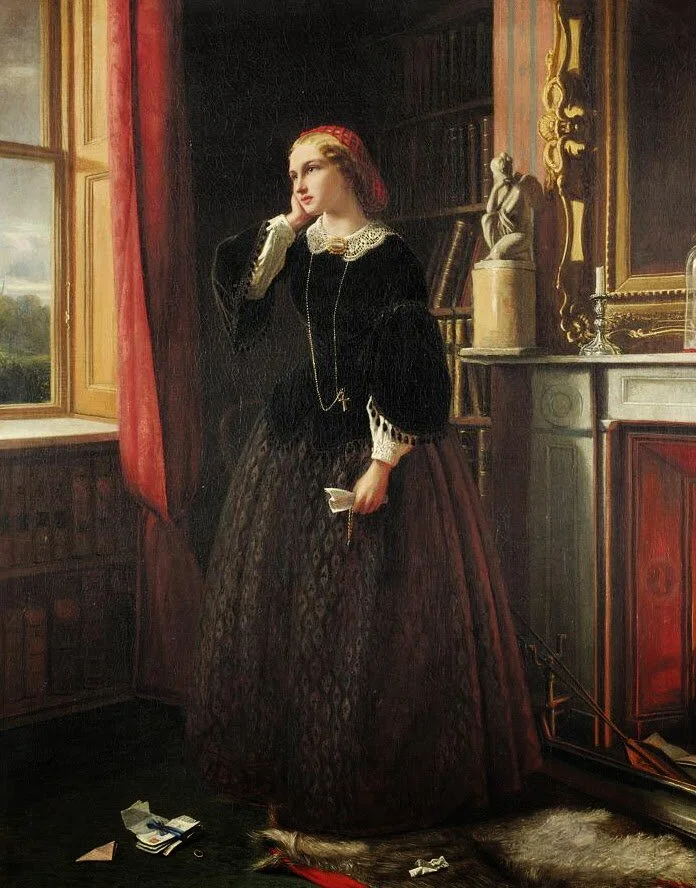
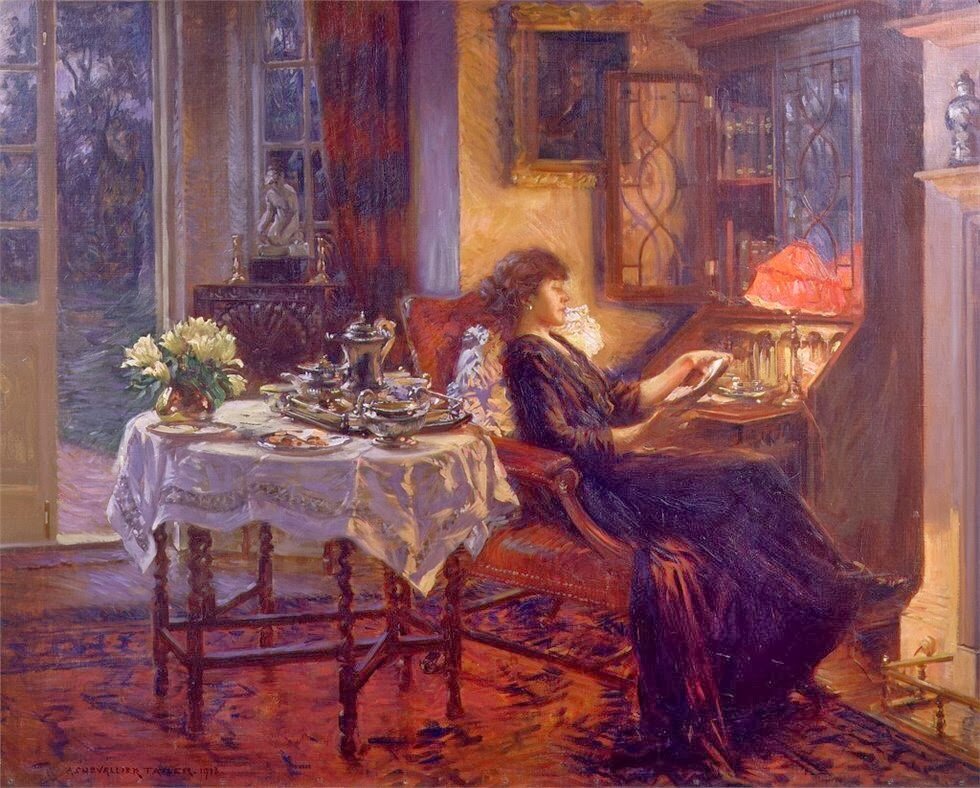
Albert Chevallier Tayler, The Quiet Hour

A virtuous young lady moves to London, determined to live there a life of cultured independence.


Here is another novel by McCarthy (see Novel 059), with a variety of vivid characters and  some amusing incidental satire on poetic modernism.

“These two volumes . . . contain some of the most felicitous studies of character that we have seen for a long while. . . .  We should say that intelligence—free, kindly vision—(with high conscientiousness and much goodness of heart) was Mr. McCarthy’s strong point as a novelist.  He always understands; and he makes his readers understand.  He has, also, plenty of kindly humour. . . .  He has given us a brilliant and thoughtful novel:  which may also be treated, if the reader pleases, as an essay of rare intelligence and fine humour, illustrated by social studies of great fidelity, wholly free from any taint of cynicism or high-flying sentiment.”  Contemporary Review, December 1, 1877

“Miss Misanthrope is indeed, to our thinking, a work which has some very striking merits. . . .  The characters are fresh and consistently kept up. . . .  The author displays a singular talent in dealing with mixed motives, and exhibiting without any tiresome display of analytical power his just observation of the working of ordinary as well as unusual natures. . . .  Those who care for a keen—one might almost say a brilliant—chronicle of the fashions and follies of the times, the satire of which is just enough dashed with tenderness, are certain to read Mr. McCarthy’s novel with pleasure.”  Saturday Review, January 12, 1878

“It is difficult to know where one should begin one’s praise of this brilliant and charming book. . . .  which is at once vigorous in conception, brilliant in execution, pure in sentiment, and faultless in design.”  Examiner, January 26, 1878

Download this week’s novel:

https://archive.org/details/missmisanthrope00mcca

Novel 162: Edward Eggleston, The Faith Doctor (1891)

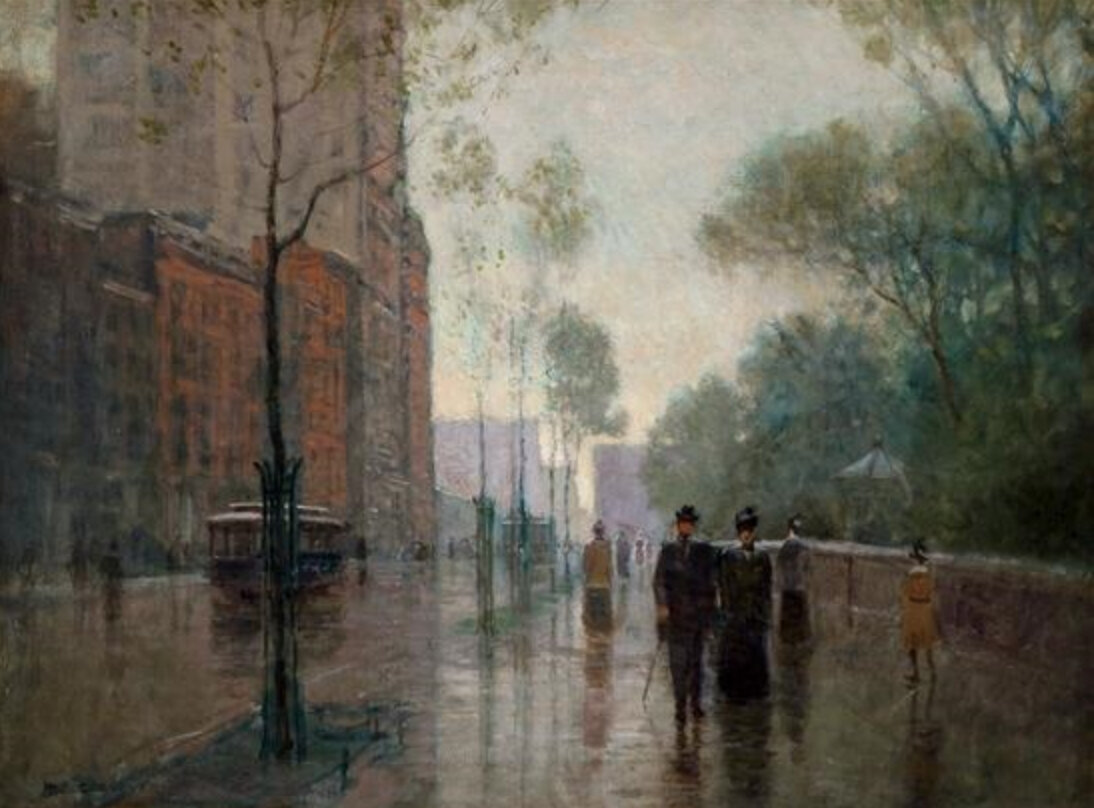
Paul Cornoyer, A Rainy Day in New York

A fashionable young banker falls in love with an earnestly Christian woman.


Edward Eggleston (1837-1902) was a Methodist minister, a magazine editor, and a historian as well as a novelist; he wrote a dozen or so works of fiction in various genres.  This one, in its vivid portrayal of 1880s New York, its nuanced delineation of complex characters, its careful, plausible plot, its apt and witty style, is a sadly forgotten masterpiece.

“As a study of American life . . . The Faith Doctor is a strikingly clever book. . . . One breathes the very air of New York while following the rapid movements of the story; and the impression which it leaves upon the mind is that of having talked with all manner of interesting people, on topics that will keep one thinking.”  Academy, January 9, 1892

“This is a really admirable novel. . . .  There are excellent social sketches, and more than one character drawn with a delicate skill which would do credit to any writer of fiction. . . .  The writing throughout is of very good quality.  The Faith-Doctor isworth reading for its style, its wit, and its humour, and not less . . . for its pathos.” Spectator, March 19, 1892

Download this week’s novel:

https://archive.org/details/faithdoctorstory00egglrich

Novel 161: Sir Henry Stewart Cunningham, Late Laurels (1864)

Alfred Elmore, Much Ado About Nothing

A restless, flirtatious young lady makes trouble between her neighbors.


Here is another novel by Cunningham (see Novel 020).  The style is bright and the characterization subtle.  (There is also some political satire, which no doubt had more point in 1864 than it does now.)

“As pleasant a tale as readers not vowed to a predilection for sensation novels could desire.”  Athenaeum, June 4, 1864

“The style is always pure, and often brilliant, and the dialogue displays considerable mastery of . . . light repartee.”  Westminster Review, June 1864

Download this week’s novel:

v.1 http://access.bl.uk/item/viewer/ark:/81055/vdc_000000043C2C#?c=0&m=0&s=0&cv=0&xywh=-883%2C-126%2C3234%2C2504

v.2 http://access.bl.uk/item/viewer/ark:/81055/vdc_000000043C32#?c=0&m=0&s=0&cv=0&xywh=-847%2C-123%2C3174%2C2457

Novel 160: Mrs. Henry Wood, Roland Yorke (1869)

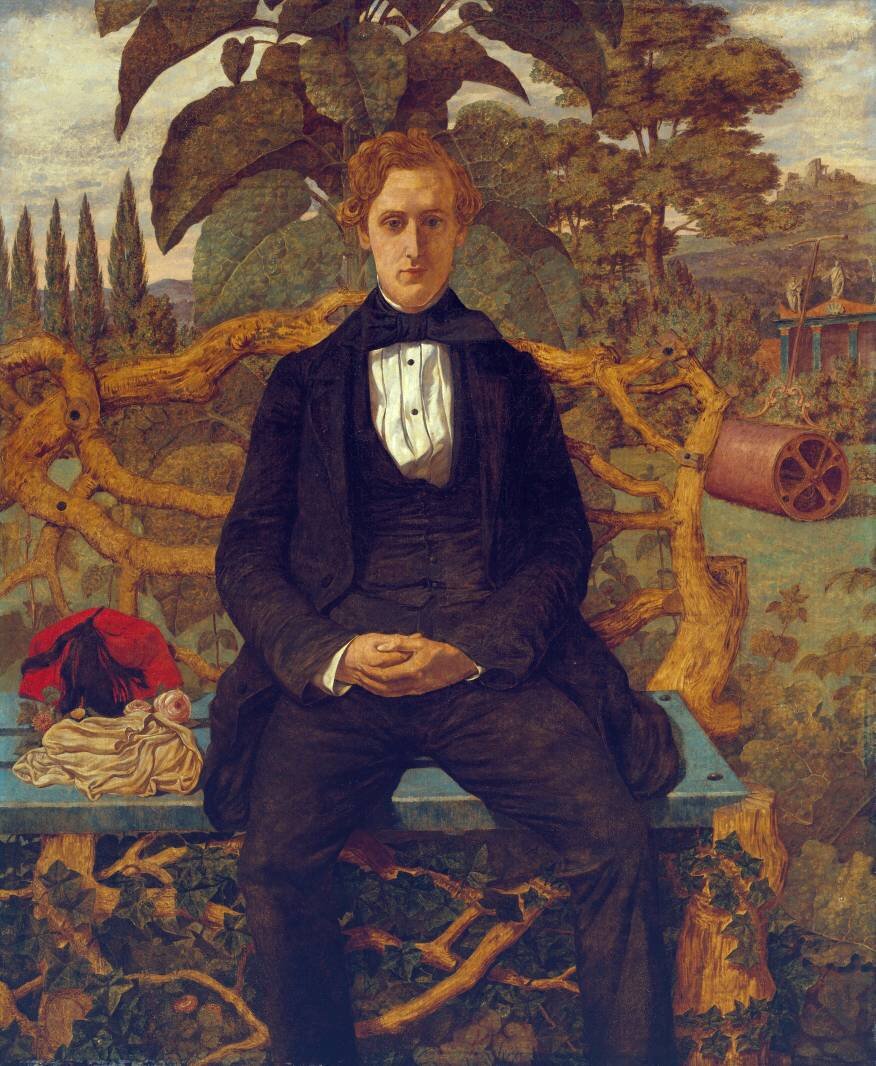
Richard Dadd, Portrait of a Young Man

A man is murdered; several characters are suspected in turn.


Here is the sequel to last week’s novel, The Channings, featuring (in addition to a few members of its exemplary title family)  its scapegrace anti-hero, back from Africa and plunged in the midst of a murder mystery.  It includes also a virtuous novelist killed by a bad review in a journal called The Snarler.

“A murder is started, pursued, worried, treated in fact like a hunted criminal.  Anxious to find its proper home, it seeks refuge, first under a flimsy disguise of suicide, then in the arms of this or that innocent person.  The most unlikely persons are pitched upon inevitably by the reader, and the real author of the disaster is untouched by suspicion up to the very last moment.  We must, in fairness, give Mrs. Wood credit for much care and ingenuity in keeping us in the dark so long. . . .  There is something of original conception in the character of Roland Yorke.”  Athenaeum, October 16, 1869

“It says a good deal for Mrs. Wood’s powers of narration that her story should show so smoothly as it does, interwoven as it is with a tissue of extravagances  and incongruities.” Saturday Review, March 5, 1870

Download this week’s novel:

https://archive.org/details/rolandyorkeseque00wood

Novel 159: Mrs. Henry Wood, The Channings (1862)

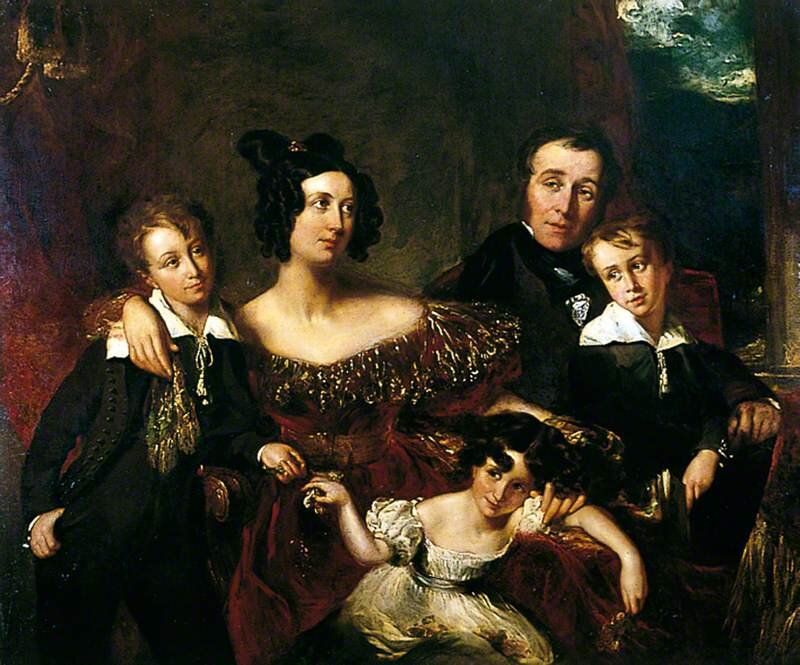
John Partridge, The Clough-Taylor Family

An exemplary family struggles against misfortune in a cathedral town.


Here is another novel by Mrs. Wood, with many of the same qualities, good and bad, as East Lynne (see Novel 077).  Among its minor characters is a mischievous choirboy named Bywater.

“It can never be read without profit both by parents and children. . . .  The merit . . . lies in the detail, and the extreme truthfulness and simplicity in which it is related. . . .  It is impossible not to read every word with interest; and we feel that we know every character intimately, and feel real regret at parting with them.”  Athenaeum, April 26, 1862

“It is pleasing, and readable, and well-contrived. . . .  Very few of the purveyors of fiction could write as good a book.”  Saturday Review, May 10, 1862

Download this week’s novel:

v.1 https://archive.org/details/channings01wood

v.2 https://archive.org/details/channings02wood

v.3 https://archive.org/details/channings03wood

Novel 158: Annie Edwardes, Ought We To Visit Her? (1871)

John William Godward, Ionian Dancing Girl

An Englishman, newly inheriting the family estate, returns after many years on the Continent with his ballet dancer wife.


Annie Edwardes (1830?-1896) wrote some 21 novels, many featuring heroines who, like the one here, defy Victorian social convention.

“Mrs. Edwardes understands and describes man very well indeed; and woman and her nature she understands something more than very well.”  Pall Mall Gazette, November 21, 1871

“This is the brightest book we have read for some time. . . .  With little plot and less descriptive writing, it is full of sparkle, and point, and sub-acid humour, and sketches of character.”  Spectator, November 25, 1871

Download this week’s novel:
https://archive.org/details/oughtwetovisith03edwagoog

Novel 157: Noell Radecliffe, Wheel within Wheel (1861)

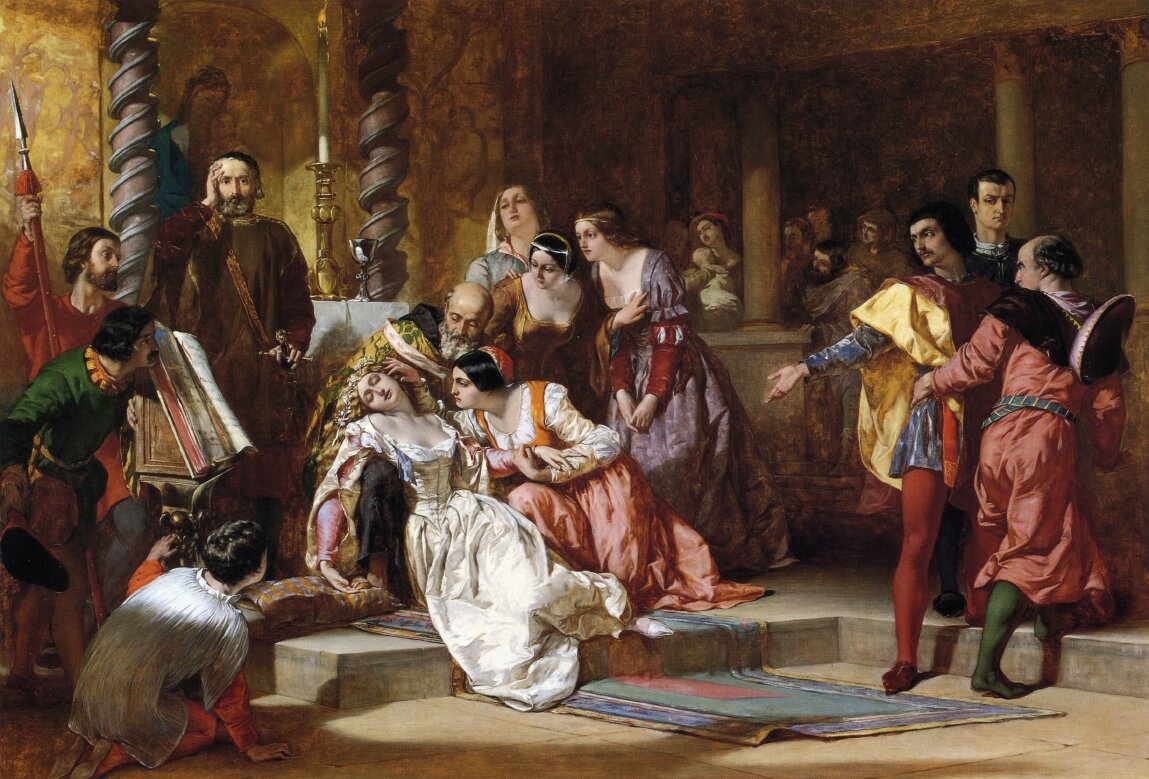
Daniel Maclise, Title Unknown

A woman loves a man who regrets an entanglement with a married woman.


Here is another masterpiece by the unknown Radecliffe (see Novels 005, 105); its carefully finished plot, lively but nuanced characters, and incisive style are all typical of its author.

“It is written throughout with a remarkable smoothness and evenness;  . . . its characters are, in general, well conceived and consistently carried out, and both its hero and heroine, without being at all unnatural, are sufficiently out of the common way to inspire more than common degree of interest.  The construction of the story, however, is, we are inclined to think, the point which does the author most credit.  This is, as might be expected from the title of the book, of a more than usually complicated nature; and we are compelled at once to admire the ingenuity which has led to its conception, and the singular skill by which so great a multiplicity of distinct interests and incidents are made to converge to the final catastrophe.” Spectator, May 5, 1861

“A lively, brisk novel” written “with apparently great ease, and very considerable correctness of style.” Critic, May 11, 1861

Download this week’s novel:
v.1 http://access.bl.uk/item/viewer/ark:/81055/vdc_000000049E36#?c=0&m=0&s=0&cv=4&xywh=-459%2C-107%2C3367%2C2237

v.2 http://access.bl.uk/item/viewer/ark:/81055/vdc_00000004C158#?c=0&m=0&s=0&cv=0&xywh=-1223%2C-128%2C3825%2C2542

v.3 http://access.bl.uk/item/viewer/ark:/81055/vdc_000000049E3C#?c=0&m=0&s=0&cv=4&xywh=-492%2C-121%2C3424%2C2275

Novel 156: W.E. Norris, My Friend Jim (1886)

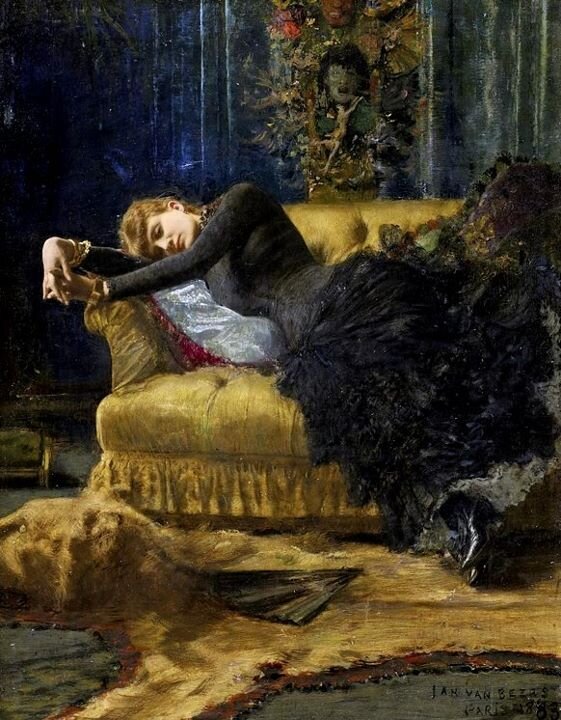
Jan van Beers, Portrait of a Young Woman

A ruthless rector’s daughter lets nothing interfere with her social and material ambition.


Here is yet another novel by that most unjustly neglected of unjustly neglected novelists, W.E. Norris (see Novels 002, 054, 104).  This one features an amusingly bad anti-heroine.

“A capital sketch . . . of some phases of modern English life . . . told in an admirable way. . . .  Since Thackeray wrote, no British novelist, Trollope and one later writer excepted, present such amusing and delicate social cynicism, such fidelity to human nature, or handle such a diamond pointed pen when holding up the weakness and folly of mortal man.” Independent, September 30, 1886

“Mr. Norris does not crowd his canvas, his presentment of life is veracious and sober, his environment is clearly, often brilliantly, delineated, his characters are persuasively human and unheroic.”  Saturday Review, October 16, 1886

“To those who appreciate finished style, quietly cynical humour, and consistent art in the rapid delineation of varied character, it can hardly fail to afford a treat.”  Observer, December 26, 1886

Download this week’s novel:
v.1 https://archive.org/details/myfriendjim01norr

v.2 https://archive.org/details/myfriendjim02norr