
This puzzle is based on my experience of farm life, which is drawn almost entirely from children's books with animal sounds.
Download this week’s crossword:
Solve this week’s crossword online:
Your Custom Text Here

James Charles, On a Sussex Farm
This puzzle is based on my experience of farm life, which is drawn almost entirely from children's books with animal sounds.
Download this week’s crossword:
Solve this week’s crossword online:

Sir David Wilkie, Pitlessie Fair
Harriet Martineau (1802-1876), a prominent political economist and social critic, wrote only a few works of fiction, of which this is the longest and most ambitious. It has great faults, a painful lover’s misunderstanding plot among them, but equally great virtues, especially its terrifyingly life-like evocation of group injustice.
“The reader must bear with some prosiness and some triviality in the outset of the tale” but “he is secure of finding . . . something better than mere amusement—namely, that pleasure which opens, elevates, and humanizes the mind. In short, equally for its tendency and its truth, this tale is a valuable present to the middle classes.” “Nothing can be more true in its village tone, than the picture of society at Deerbrook.” Athenaeum, April 1, 1839
“The story of Deerbrook is simple and most natural, both in its conception and its working out; the characters are as forcible, and at the same time as original, as any thing so strictly true can be; and the scenes are those of the every-day life of the middle classes of society.” New Monthly Magazine, May, 1839
“A story of domestic life; a story of the affections, the passions, and the incidents of a country village” which “is wrought out with a quiet vigor and a masterly fidelity to Nature and to Man. We see in it not our neighbors merely, but ourselves. Every page is radiant with the portrayal of the suicidal insanity as well as loathsomeness of malice, of envy, of tale-bearing, of anger, and of ill-will.” New-Yorker, July 1, 1839
Download this week’s novel:
v.1 https://archive.org/details/deerbrooknovel01mart
v.2 https://archive.org/details/deerbrooknovel02mart
v.3 https://archive.org/details/deerbrooknovel03mart

John William Waterhouse, Circe Offering the Cup to Odysseus
Do you worry that online media are creating illusory bonds and instilling obsessive habits that rob you of your authentic self? Of course you do! But not this website: on the contrary, I’m here to put you on your guard.
Download this week’s crossword:
Solve this week's crossword online:

A puzzle of mine will appear this Wednesday, August 1, in the Wall Street Journal.

James Tissot, Autumn on the Thames
Emily Eden (1787-1869), daughter of a baron and sister of an earl, wrote only two novels, of which this quiet, pleasant work of social comedy is the second, though the first to be published.
“A piece of real life, sketched by a spectator full of shrewd sense and a genial spirit of fun.” Spectator, August 6, 1858
“The purpose of this book, in so far as it has a purpose, is to teach us to take life easily and frankly . . . that we should not be too much pleased at speaking to persons of superior rank, nor too anxious to avoid those who may be below us”; the story is slight, but has “sparkling dialogue . . . good subsidiary characters, and . . . cheerful and habitual good sense.” Saturday Review, August 27, 1858
“Character painting so entirely unpretending in its manner, and so perfect of its sort, as that which gives to this novel its value as a work of art, is not often to be found.” Examiner, August 27, 1858
Download this week's novel:
https://archive.org/details/semidetachedhous00eden
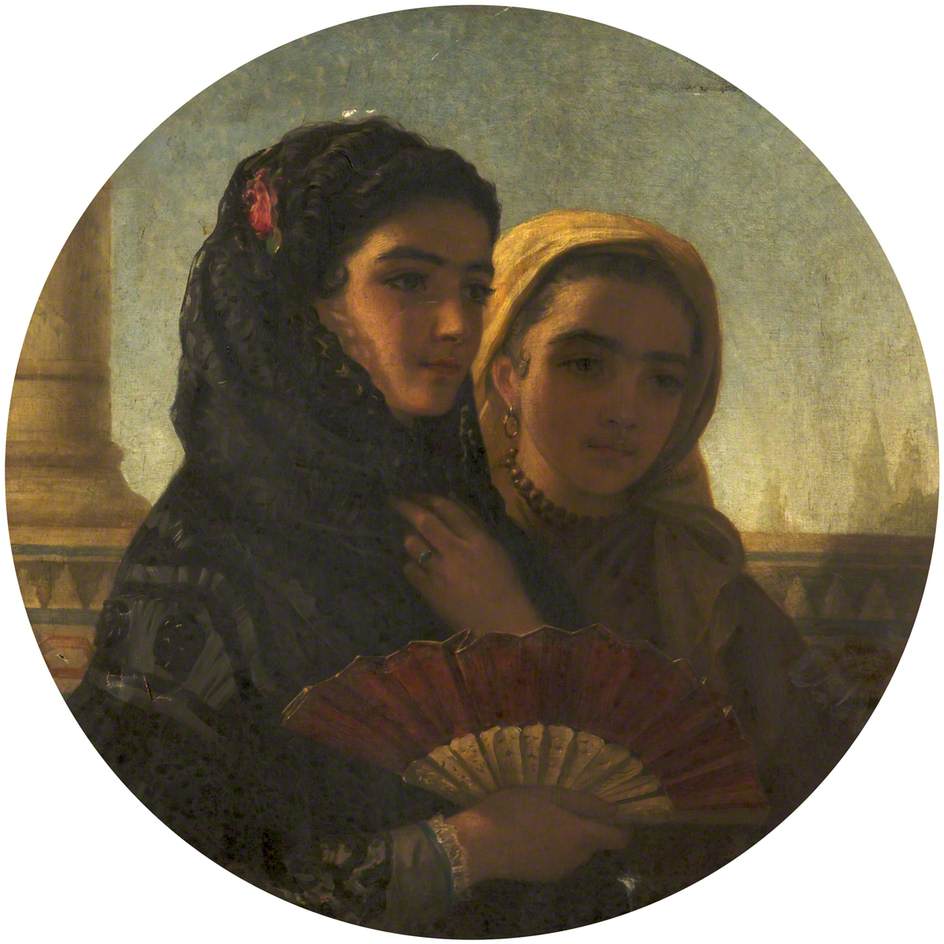
Edwin Longsden Long, Spanish Girls
I’ve always been annoyed by the saying that this puzzle is built on; maybe after you solve it, you will be too. By the way—this puzzle is a pangram: every letter of the alphabet is represented. I don’t usually care about such things, but when I found I was only one very famous basketball star away, I thought—“why not?” Don't worry—he’s so very famous even I have heard of him, and I confess I’ve never sat through a whole basketball game live or televised. I have nothing against the sport particularly, but I can’t endure the sound of those squeaking shoes.
Download this week’s crossword:
Solve this week’s crossword online:

Thomas Sully, Fanny Kemble
Nothing is known of Mrs. E.J. Burbury, author of only this single novel. She appears to have tried to fit into it every noteworthy experience she ever had, whether working in theater (the miserable conditions of which, especially for women, are vividly portrayed), or driving through Oxford by moonlight. It makes for fascinating reading, despite some mawkishness.
The author has a “clear appreciation of humour and of pathos—a firm hand in noting down the boundary lines and salient features of character, and a constancy . . . to the . . . purpose of her story.” Athenaeum, November 11, 1851
"It is refreshing to take up a romance and to find it is not altogether an unmitigated profitless ‘love story’. . . . Mrs. Burbury’s style is vigorous and effective, and the scenes she depicts, the characters she delineates, and the conversations she supposes, bear the stamp of a truthfulness, a penetration, and a depth of feeling, which would do honour to one who had been longer before the public. That part of the story which relates to the theatrical career Florence is with repugnance compelled to adopt . . . is handled in a fearless and masterly style.” New Quarterly Review, January, 1852
Download this week’s novel here:
http://solo.bodleian.ox.ac.uk/OXVU1:LSCOP_OX:oxfaleph014284777

Richard Doyle, Under the Dock Leaves
We’ve come to my 6th and final magic-spell-based puzzle. I made a 7th, featuring “Mythballs” (legendary dances) and “Doctor Why” (pointless British sci-fi series)—but I’ve decided to spare you the pain and myself the embarrassment. An 8th, with the revealer “ibex,” never got past the early planning stages.
Download this week’s crossword:
Solve this week’s crossword online:

A puzzle of mine will appear next Wednesday, July 18, in the Wall Street Journal.

William Powell Frith, The Family Lawyer
Anthony Trollope (1815-1882) is too well known to require introduction here; in fact he ought not to be here at all, except on the theory that, though not forgotten, he is nonetheless not often given his due, as the greatest of all novelists. Anyway I have included him so as to complete my set of literary Trollopes. Cousin Henry exhibits in brief what makes Anthony Trollope the greatest of all novelists: his full and accurate representation of human nature. He shows here the complicated workings of a commonplace mind bent on justifying an act of selfish injustice.
“The analysis of character is so exhaustive, and makes us so familiar with all his ins and outs, that we get to feel as if we were in some way to blame for him, or as if we ourselves might possibly have been Cousin Henry in (we hope) some very remote state of being.” Spectator, October 18, 1879
“The minute dissection of commonplace characters has long been the special feature of Mr. Trollope’s writings. The present story excels both in minuteness and commonplace.” Athenaeum, October 18, 1879
“His insight into the making and constitution of a poor creature is comprehensive and masterly.” Saturday Review, October 25, 1879
Download this week’s novel here:
v.1 https://archive.org/details/cousinhenrynovel01trolrich
v.2 https://archive.org/details/cousinhenrynovel02trolrich

Sir Joseph Noel Paton, The Quarrel of Oberon and Titania
The more I think about the national anthem, the more annoyed I grow. Take just the half-line “Whose broad stripes.” Try to say it ten times rapidly. Can’t do it? Neither can I. It’s hideously cacophonous: "dstr" is not a songlike sound cluster. And the words are not even true. The stripes on the U.S. flag are actually less broad than the stripes on most flags, just because there are more of them: 13; whereas, for example, on the French tricolor there are 3—which, since they’re vertically oriented, are very broad indeed. The ratio of height to width for the average flag is 3 to 5. So say your flag is 5 feet, or 60 inches, wide. If you’re French, your stripes are fully 20 inches “broad” (60/3). If you’re American, your stripes are not even 3 inches “broad” (36/13). The Union Jack, the enemy’s flag for Francis Scott Key, had broader stripes than that. If flag stripe-breadth is the measure of national merit, the U.S. falls sadly short. But like all bad poets, Key is not even thinking of what he means.
Download this week’s crossword:
Solve this week’s crossword online:

A puzzle of mine will appear next Thursday, July 12, in the Wall Street Journal.

George Dunlop Leslie, Riverside, Wallingford, Berkshire
Frances Eleanor Trollope (1835-1913) was T.A. Trollope’s second wife, and therefore sister-in-law to Anthony Trollope and daughter-in-law to Frances Milton Trollope; she was also the sister of Ellen Ternan, Charles Dickens’s special friend. She wrote a dozen or so novels between 1866 and 1892; here she delineates, with playful irony, a complex social environment made up of people who misunderstand themselves and each other.
“Mrs. Trollope has the family knack of investing commonplace life with dramatic interest”; “in the details of the drama, often both humorous and pathetic . . . the reader will find . . . evidence of considerable observation, expressed with unusual force.” Athenaeum, January 1, 1876
“Of the minor characters, who are many, the assertion may be sweepingly made that they are all good. Mrs. Trollope shows a really remarkable power of drawing character.” Academy, January 1, 1876
“There is a great deal of very nice and delicate work in this novel”; the title character is “extremely well done.” Saturday Review, January 8, 1876
“Very much above the ordinary run of novels” with “three sketches of character that must be pronounced masterly.” The title character “is natural and consistent, a perfect specimen of the compatibility of winning manners and faultless temper with thorough badness of heart.” Graphic, February 12, 1876
Download this week’s novel here:
v.1 https://archive.org/details/acharmingfellow01trolgoog

John Simmons, Fairy Lying on a Leaf
As to 18 Down, and Wednesday’s holiday—would you be interested in my opinion of our national anthem? The music is good, the words are beyond awful. The tortured syntax! The stilted diction! And the whole thing about a flag’s decorative pattern (is there anything broader about the stripes, or brighter about the stars, than one finds in the stars or stripes of other countries’ flags? and if not, can’t we be proud of something actually worth being proud of?) and the not-all-that-interesting fact that said flag didn’t catch on fire during some battle or other. Maybe a bipartisan Congressional majority can find something reasonably anthemish by Robert Frost or Emily Dickinson or John Greenleaf Whittier or somebody, and we can retire this unmeaning doggerel?
Download this week’s crossword:
Solve this week’s crossword online:

Evelyn de Morgan, The World's Wealth (The Crown of Glory)
Cecilia Frances Tilley (1816–1849), Frances Trollope’s daughter, Anthony and T.A. Trollope’s sister, Henry Milton’s niece, wrote only one novel before dying of consumption in her early thirties. Though marred somewhat by religious lecturing, Chollerton exhibits the family facility with character, plot, and style.
A “specimen of the lesser novel”: the “story sufficiently probable; the characters natural . . . the style easy, and rather elegant.” Spectator, August 15, 1846
Though of the objectionable class of “controversial fictions,” this is “beyond measure the best”: “the plot is well constructed, the incidents flow naturally one from another, the characters are conceived vividly and sustained with skill.” And it is less “tainted with illiberality than any similar work we have seen.” Critic, October 24, 1846
Download this week’s novel:

Charles Altamont Doyle, A Dance Around the Moon
There’s an odd notion afoot, among some crossword editors and reviewers, and possibly some solvers, that if you do a thing to a letter once in a crossword—delete it, replace it, turn it upside down, whatever—you have to do the same thing to that letter every time it appears, at least in the theme entries, if not in the whole puzzle. Everywhere and always, but in this series in particular, I proceed in proud disregard of that notion. If a magician turns her scarf into a parakeet, do you blame her if every scarf in the building, or the world, does not likewise turn into a parakeet? Wouldn’t you rather it be just the one scarf?
Download this week’s crossword here:
Solve this week’s crossword online:

Robert Smirke, The Rival Waiting Women
Henry Milton (1784–1850), Frances Trollope’s brother, Anthony and T.A. Trollope’s uncle, wrote only two novels, of which this is the first. It amusingly combines farce and melodrama.
He is like his sister in providing “the same literal truth in the descriptions of common life; the same tendency to caricature in the humorous, and to melodramatic exaggeration in the serious parts.” The Spectator, May 2, 1840
“His talent is equal for the serious or the comic, the one, however, sometimes verging into the melodramatic, the other occasionally approaching the burlesque.” The Morning Post, May 9, 1840
Written in “an easy and agreeable style,” the novel shows a “lively sense and good humour, . . . excellent knowledge of ordinary life,” and “nice discrimination of character in its ludicrous as well as its quiet aspects.” The Examiner, May 31, 1840
Download this week’s novel:
v.1 https://archive.org/details/rivalry01milt
v.2 https://archive.org/details/rivalry02milt
v.3 https://archive.org/details/rivalry02milt

John Simmons, Titania Sleeping in the Moonlight Protected by her Fairies
10 Across was difficult to clue, in that there seems to be no one name for those little pads or screens with up and down arrows that you have to poke at in order to make some machine—the oven, the refrigerator, the furnace, etc.— do more or less of something. Does anyone prefer poking and poking at these arrows to simply turning a 10 Across? How do these idiotic design trends get started? And how can we stop them?
Download this week's crossword:
Solve this week’s crossword online:

A puzzle of mine will appear next Wednesday, June 20, in the Wall Street Journal.

George Elgar Hicks, Mother and Baby
Thomas Adolphus Trollope (1810-1892) was Frances Milton Trollope’s first son and Anthony Trollope's older brother. The plot of this novel heats up after a slow beginning; its bad characters are memorable studies in self-deception, led as they are by banal, routine desires into extravagantly evil behavior.
The characters are “natural but by virtue of their mediocrity. . . . Virtue is mediocre in [Trollope's] hands, and the contrast between it and vice is marked only by the degree in which the latter falls below the mean”; still the novel is “well written, and superior to the common run of novels in originality and interest.” Athenaeum, July 29, 1871
“A well constructed, interesting story”; “one of the chief charms . . . is the humorous portraiture with which it abounds.” Graphic, August 5, 1871
“In spite of many scenes of considerable humour and not a little pathos,” the “coarse vice” portrayed in the novel “left in our mind . . . a most unpleasant recollection.” Saturday Review, August 26, 1871
Download this week’s novel here:
v.1 http://access.bl.uk/item/viewer/ark:/81055/vdc_00000003F87C
v.2 http://access.bl.uk/item/viewer/ark:/81055/vdc_00000003F882
v.2 http://access.bl.uk/item/viewer/ark:/81055/vdc_00000003F876

Richard Dadd, Puck
This is the first of six “It’s Magic” puzzles, all illustrated with Victorian fairy paintings. You will wonder how you ever endured the prosaic dullness of quotidian reality without such opportunities for escape into a world of magical make-believe.
Download this week’s crossword:
Solve this week’s crossword online:

A puzzle of mine will appear next Thursday, June 14, in the Wall Street Journal.
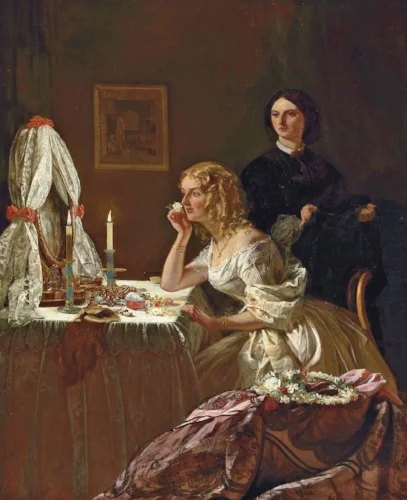
Augustus Leopold Egg, The Toilet
Frances Milton Trollope (1779-1863), mother of Anthony Trollope, Thomas Adolphus Trollope, and Cecilia Frances Tilley, and sister of Henry Milton, and mother-in-law of Frances Eleanor Trollope, wrote over 30 novels between 1835 and 1856. Here she provides a good comic plot and an entertaining variety of characters, especially the deliciously repulsive heroine.
“The principal portraitures of people, and sketches of manners, drawn by Mrs. Trollope, are so human and natural, that they ever come pleasingly home to the feelings of her readers.” Literary Gazette, April 2, 1842
“Mrs. Trollope never objects to peep into the pantry, to gossip with a comfortable old housekeeper, or to intrigue with an astute lady’s maid, and here she is particularly strong in life below stairs.” Her plot “will excite a strong interest.” Athenaeum, April 9, 1842
“Excellent as Mrs. Trollope has always proved herself in pourtraying human character, its varieties and eccentricities, she has been more than usually successful in her delineation of the Ward of Thorpe-Combe. . . . The attention of the reader is never allowed to flag, or to become weary.” Gentleman’s Magazine, July. 1842
Download this week’s novel here:
https://books.google.com/books?vid=BL:A0017528094 (1-volume Paris ed.)

Frank Holl, Newgate: Committed for Trial
To continue the quotation begun in 37 Down: Hamlet asks, “Who would bear the whips and scorns of time, / Th’ oppressor’s wrong, the proud man’s contumely, / The pangs of despised love, the law’s delay, / The insolence of office, and the spurns / That patient merit of th’ unworthy takes”—— if it weren’t (as Hamlet might, but doesn’t, go on to ask) for the opportunity to insert absurd phrases about such topics into crossword puzzles? I've already touched on some of them; I mean to cover them all eventually. Today I take up not exactly “the law's delay,” but litigation in general, one of civilized life’s most unpleasant possibilities.
Download this week’s crossword:
Solve this week’s crossword online:

Next Thursday (June 7), a puzzle of mine will appear on this fine new website: The Puzzle Society Crossword, by David Steinberg. On the associated blog will also appear a comment of mine, directing the reader here, to my own website—so, if you go there, it will be easy for you to come back.

Hubert von Herkomer, Clematis
A quiet middle-aged man falls in love with a beautiful but strangely childlike young woman.
Mary St. Leger Harrison (1852-1931) was the daughter of novelist and reformer Charles Kingsley. Under the pseudonym Lucas Malet, she wrote some 16 novels beginning in 1882; this one, amid more commentary on the human condition than might seem altogether necessary, presents vivid characters in helpless conflict.
“In these days of hurried workmanship it is a welcome contrast to encounter a story which combines imagination, observation and finish in such a high degree. This is no sketch, but a whole gallery of portraits which have not suffered from the author’s elaborate method, but only gained in lifelikeness”; even if “the author, especially in her moralizing moods, is too uniformly, and perhaps consciously, clever.” Athenaeum, June 6, 1885
The novel’s style has “a quiet self-confidence and reserved power”; the author is “vivid and effective in her descriptions, and telling in her portraitures”; but “there is a morbid strain running through it; one is tempted to ask whether the imagination which conceived and executed this book has not a touch of inflammation.” Literary World, July 11, 1885
“It is poignant, grievously pathetic, a fateful, disheartening book, but it is unquestionably clever. . . . Everything in ‘Colonel Enderby’s Wife’ is clever--the talk, the author’s pessimistic reflections, the arrangement of incident . . . and above all the delineation of character.” Westminster Review, October, 1885
Download this week’s novel:
http://solo.bodleian.ox.ac.uk/OXVU1:LSCOP_OX:oxfaleph014443744