
The arc of history bends towards today’s crossword.
Download this fortnight’s crossword:
Solve this fortnight’s crossword online:
Your Custom Text Here

Henry Perronet Briggs, The Progress of Civilisation
The arc of history bends towards today’s crossword.
Download this fortnight’s crossword:
Solve this fortnight’s crossword online:

George Paul Chalmers, Girl in a Boat
For Edwardes, see Novels 158, 212, and 270.
“A very pretty story indeed, very well told, with incidents which are both plausible and natural”; for those who “like the true novel of comedy as it was before sensationalism triumphed.” Spectator, November 10, 1866
The heroine is “a bit of fresh and original painting.” Saturday Review, November 10, 1866
A somewhat contrasting view:
“A brisk, lively, and thoroughly readable tale, belonging to a low school of romantic art” marred by “false theory and Bohemian sentiment.” Athenaeum, November 17, 1866
Download this fortnight’s novel:
https://solo.bodleian.ox.ac.uk/permalink/44OXF_INST/35n82s/alma990147660440107026
(Right-click (or control-click, if you have a Mac) on the “view digitized copy” links to download the novel’s three volumes in pdf form)

Cecil Gordon Lawson, Battle Scene Outside a Town
Things are getting tense here at David Alfred Bywaters’s Crossword Cavalcade and Fortnightly Victorian Novel Recommender. The homophone faction is no longer on speaking terms with the homonym faction, while the parsing faction is threatening to break off and start its own site. Meanwhile, on the novel side, the female-novelist recommenders have made common cause against the male-novelist recommenders, each side rejecting out of hand my calls for mutual civility and reasoned debate, on the grounds that the bigotry motivating the other side deserves no consideration. We have, in short, devolved into a state of hopeless partisan rancor. How has this happened? I blame social media, artificial intelligence, online pornography, capitalism, forever chemicals, digital currency, and food dyes.
Download this fortnight’s crossword:
340-Things-Are-Getting-Tense.puz
340-Things-Are-Getting-Tense.pdf
Solve this fortnight’s crossword online:
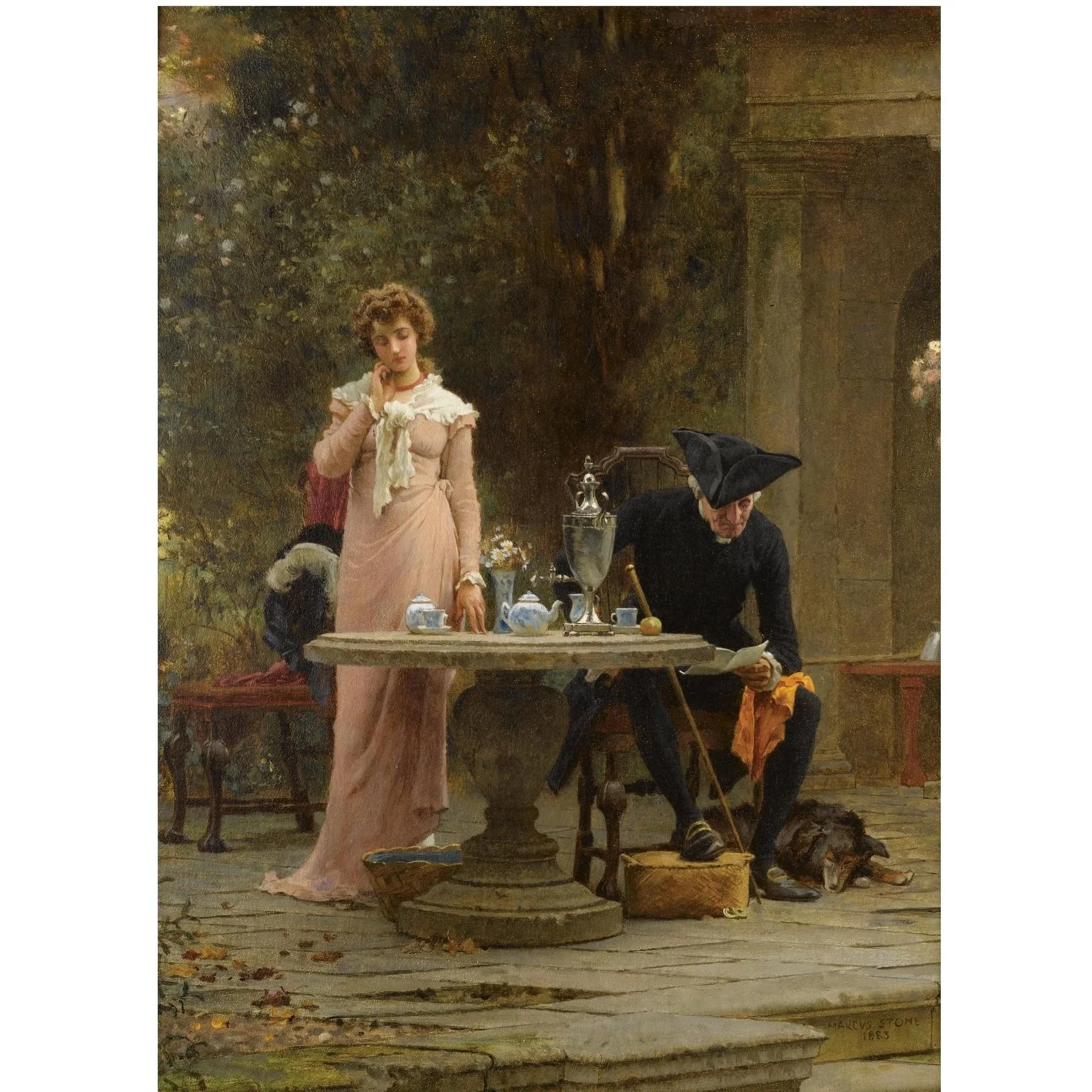
Marcus Stone, An Offer of Marriage
Josephine Mary Ward (1864-1932), a granddaughter of the Duchess of Norfolk, wrote some eleven novels between 1899 and 1932, of which this was the first.
“The description of an old Romanist county family is excellent. . . . ; a distinctly able book.” Athenaeum, April 8, 1899
“Mrs. Wilfrid Ward is in a position to write of Catholic society from the inside, and she has done so in a remarkable novel with a candour that will render her work attractive to thoughtful persons beyond the pale. . . . it is excellently written and every character is well drawn. Notable too is its absolute fairness, which leaves the reader to weigh the heroine’s scruple for himself, aided but not biassed by the author. . . . as a whole . . . a book that should make its mark.” Saturday Review, April 8, 1899
Download this fortnight’s novel:
https://archive.org/details/onepoorscruplese00ward/page/n7/mode/2up
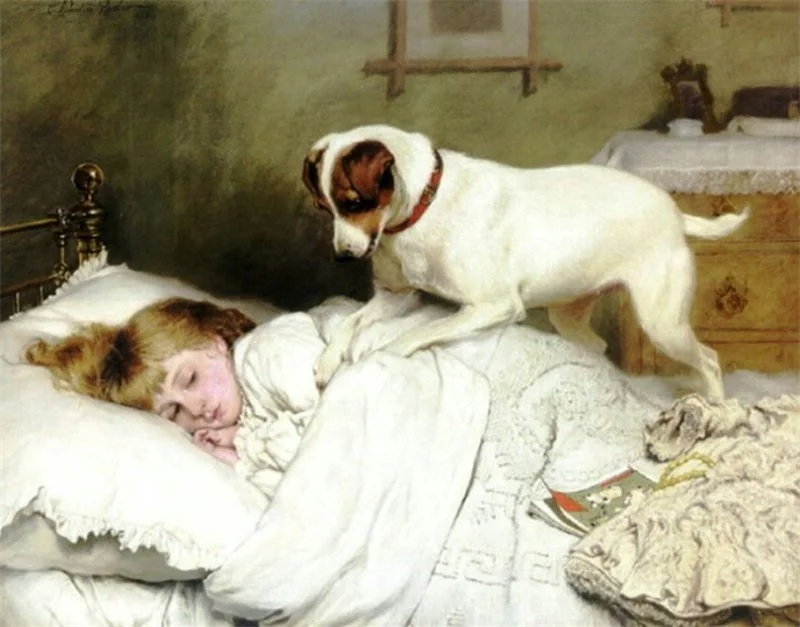
Charles Burton Barber, Time to Wake Up
I’d been wondering— Why is my every move being recorded by a network of hidden cameras? Why have all my writings, however private, been uploaded to secure online databases? Why are my innermost thoughts being monitored in underground laboratories? And then, the other day, while solving a crossword, and finding that, yet again, a word was clued exactly as I had clued it in an unposted crossword I had made not a week before, it struck me: an international cabal of crossword publishers, unwilling to give me proper credit either in money or in fame, was secretly tapping into my mind for crossword content. It all adds up! If you find yourself admiring a feature of somebody else’s crossword somewhere, you would do well to remind yourself that in fact it’s probably actually something I thought up already.
Download this fortnight’s crossword:
Solve this fortnight’s crossword online:

Hubert von Herkomer, Rocky Landscape with a Wayside Shrine
Frederic Edward Breton (1864-1902) wrote eight novels between 1893 and his early death, of which this was the third.
“The book is certainly written with ability, and it is the kind of story to remain in one’s memory.” Academy, July 13, 1895
“The plot is most uncommon and very cleverly worked out, and the writer never lacks power.” Saturday Review, August 24, 1895
Download this fortnight’s novel:

George Dunlop Leslie, Untitled
I’ve been so busy! Everybody wants me to do everything, because I’m so good at it! So, finding myself short of time for this fortnight’s crossword, I’ve had to settle for just some assorted answers, an untitled painting, and no more interesting introductory comment than this one.
Download this fortnight’s crossword:
Solve this fortnight’s crossword online:
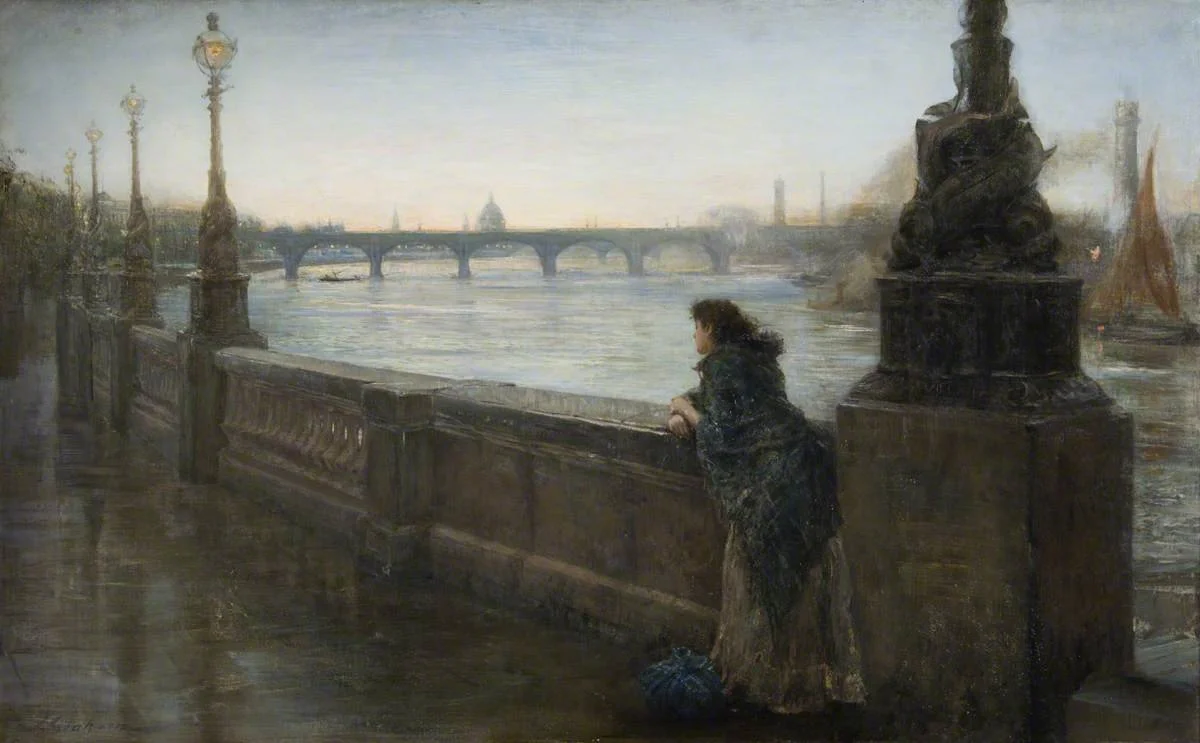
Thomas Graham, Alone in London
For Cook, see Novels 040, 111, 166, and 262.
The characters are “dashed off with spirit and coloured to the life. . . . This method . . . has a charm of its own. . . . The reader will find this style of storytelling as well and as cleverly executed as can reasonably be desired.” Athenaeum, December 5, 1863.
“Throughout amusing, the story is good, and is well and dramatically told. . . . It paints human nature fairly.” Westminster Review, January, 1864
v.1 https://archive.org/details/leo00cookgoog

John Martin, The Coronation of Queen Victoria
I meant to have this ready in time for Charles III’s coronation, back in May, 2023, but I felt it needed a couple years’ more polishing. So now its dedication is up for grabs. Perhaps you, reader, are heir-apparent to a monarchy, or know somebody who is? If so, drop me a line, and we can make a deal; I’ll settle for any minor position at the court (except groom of the stole).
Download this fortnight’s crossword:
Solve this fortnight’s crossword online:

Sir William Quiller Orchardson, Music when soft voices die, vibrates in the memory
For Payn, see Novels 011 , 081, 211, 255.
“The different actors are well placed upon the stage. There is much humanity” about them. Athenaeum, November 9, 1878
“The cheerfullest, springiest, oddest book conceivable; and it overflows with humour and rings with merriment”; the plot is “clever and new.” Spectator, November 30, 1878
“There is great brightness and freshness in the style. It is enlivened every here and there by happy turns of expression, and it sparkles with incidental and offhand observations that show genuine wit and humour. . . . A vein of comedy pervades the whole, giving its colour to more than one of the principal characters, and cropping up in some scenes that are excessively amusing.” Saturday Review, March 15, 1879
Download this fortnight’s novel:
https://archive.org/details/lessblackthanwer01payn
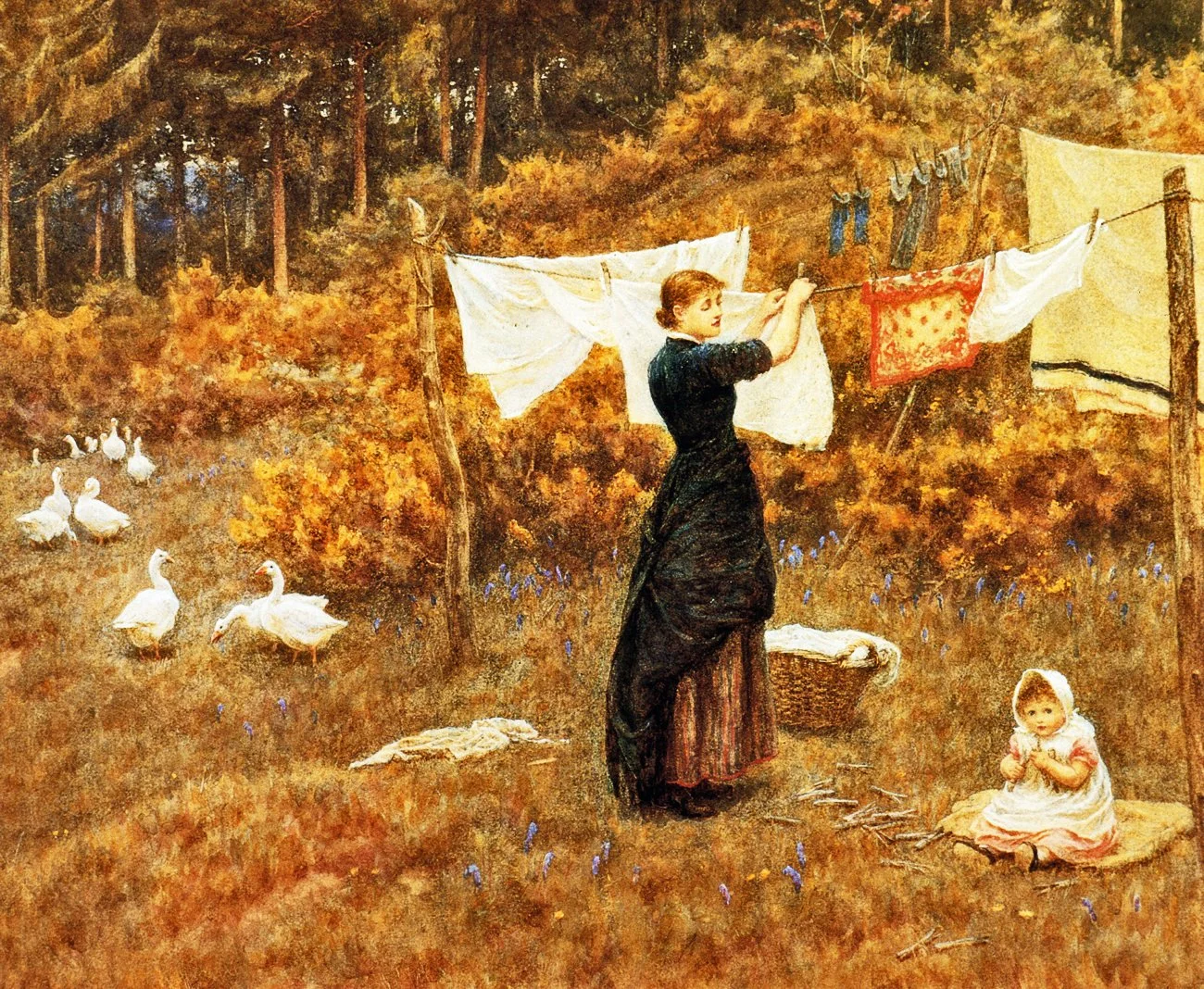
Helen Allingham, The Clothes Line
Have you ever noticed how certain words or phrases sound more or less the same—sometimes are even spelled the same—and yet have entirely different meanings? This phenomenon was recently brought to my attention, and I had a thought: what if one were to base a crossword on it?
Download this fortnight’s crossword:
Solve this fortnight’s crossword online:
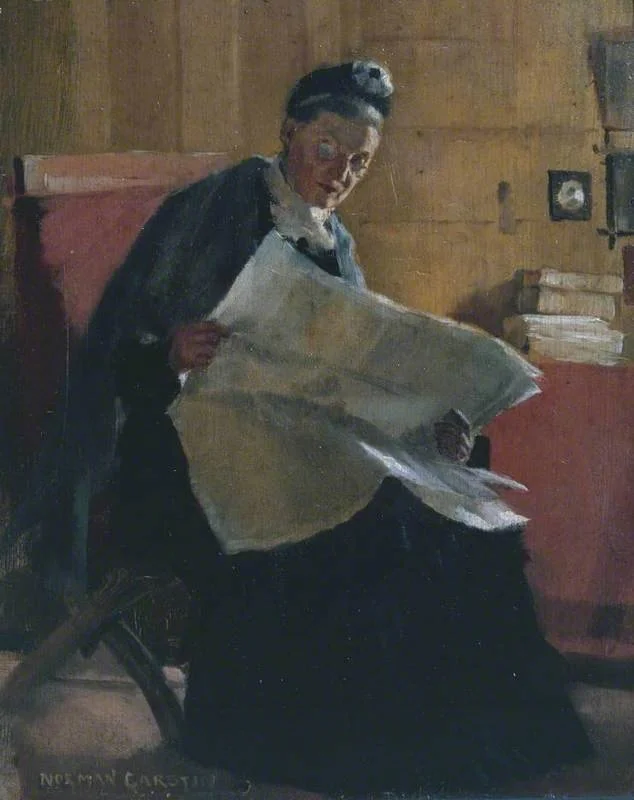
Norman Garstin, A Woman Reading a Newspaper
Elizabeth Robins (1862-1952) was born in Louisville, Kentucky, and raised by her grandmother in Zanesville, Ohio. Her mother, an opera singer, went mad; her husband, an actor, drowned himself. She worked as an actress first in America, then moved to London and established herself as a leading lady in the plays of Ibsen. In the twentieth century she became a prominent supporter of women’s suffrage. Amid all this, she found time to write several novels, among them this tragi-comic portrait of selfish literary pretense.
“A most excellent and powerful piece of work.” Athenaeum, August 25, 1894
The author is “evidently a literary impressionist who can succeed brilliantly in throwing off a vivid and dramatic conception of a group that interests him.” Spectator, August 4, 1894
A contrasting view:
“Surprisingly clever in its way, being direct and simple” but “exaggerated”: “the tables are turned on the ‘new woman’ with a vengeance, and with a degree of hot-headed malice and a lack of logic worthy of the ‘new woman’ herself in her newest aspect.” New York Times, August 6, 1894
Download this fortnight’s novel:

John Collier, Love Me, Love My Dog
I used to have a dog. I loved him, and he loved me. But since he left this sad world, I’ve found dogs annoying: the little yappy dogs next door yapping their little yaps all the yappy day, the muscle-y dogs lunging at me on the sidewalks, the sweatered and bootee-ed stroller dogs that complicate my efforts to regard their owners with the respect I try to confer on all humankind—they annoy me. Now, my old dog had his bad habits. He would leave his scent everywhere. He would shed all the time. He would try to kill the plumber. But he had a deep, rich voice, respected pedestrians, would have scorned to wear bootees—was, in short, just a better dog than the dogs of other people nowadays. This puzzle is dedicated to his memory.
Download this fortnight’s crossword:
Solve this fortnight’s crossword online:
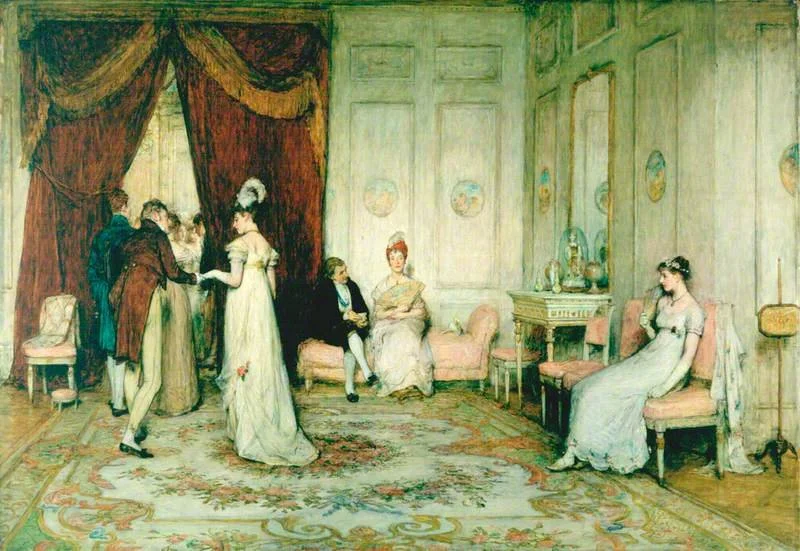
Sir William Quiller Orchardson, A Social Eddy (Left by the Tide)
For Walford, see Novels 018, 066, 121, 174, 227, and 279.
“Bright and pleasant reading,” with “abundant interest and movement.” Athenaeum, October 10, 1891
It is “certain to be enjoyed”; Walford “has a good deal of . . . persistent and interested wakefulness of sympathetic observation” which gives “a charm to the apparently charmless commonplaces of ordinary life.” Spectator, October 31, 1891
Download this fortnight’s novel:
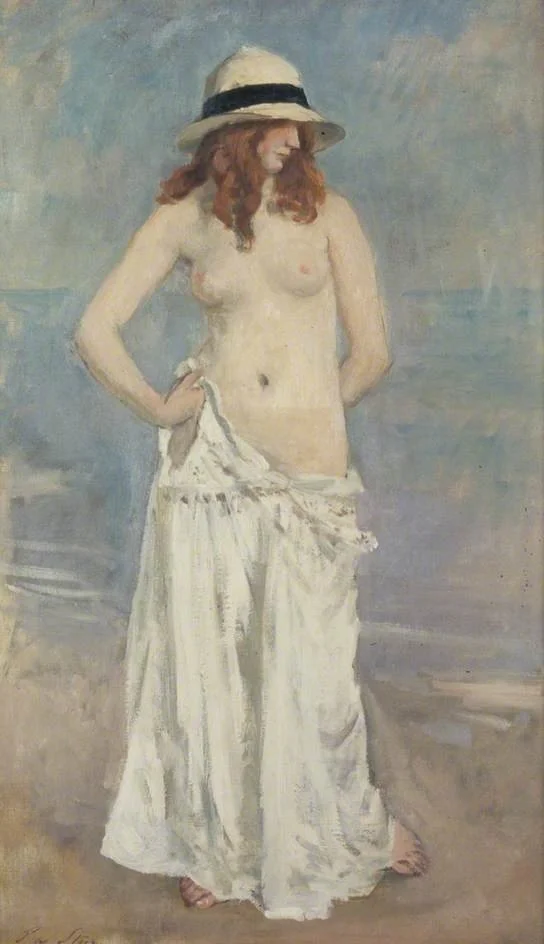
Philip Wilson Steer, The Panama Hat
What the world needs now is a mad hatter—not the Lewis Carroll tea party attendee with a broken watch and an insoluble riddle, but a maniacal putter-on of hats, a superhuman being whose mission it is to make everybody wear a hat, just like everybody used to do, before the modern obsession with being casual put an end to this wholesome practice. In the happy past, we didn’t have to look at the hairlines of strangers, and, since our eyes were pleasantly shaded by hat brims, we didn’t have to wear the sunglasses that now make us seem to each other hatefully dead-eyed and cruel. Who knows how much of the social conflict that our society has endured since the 1960s is just a side-effect of soulless stares and disagreeable haircuts?
Download this fortnight’s crossword:
Solve this fortnight’s crossword online:
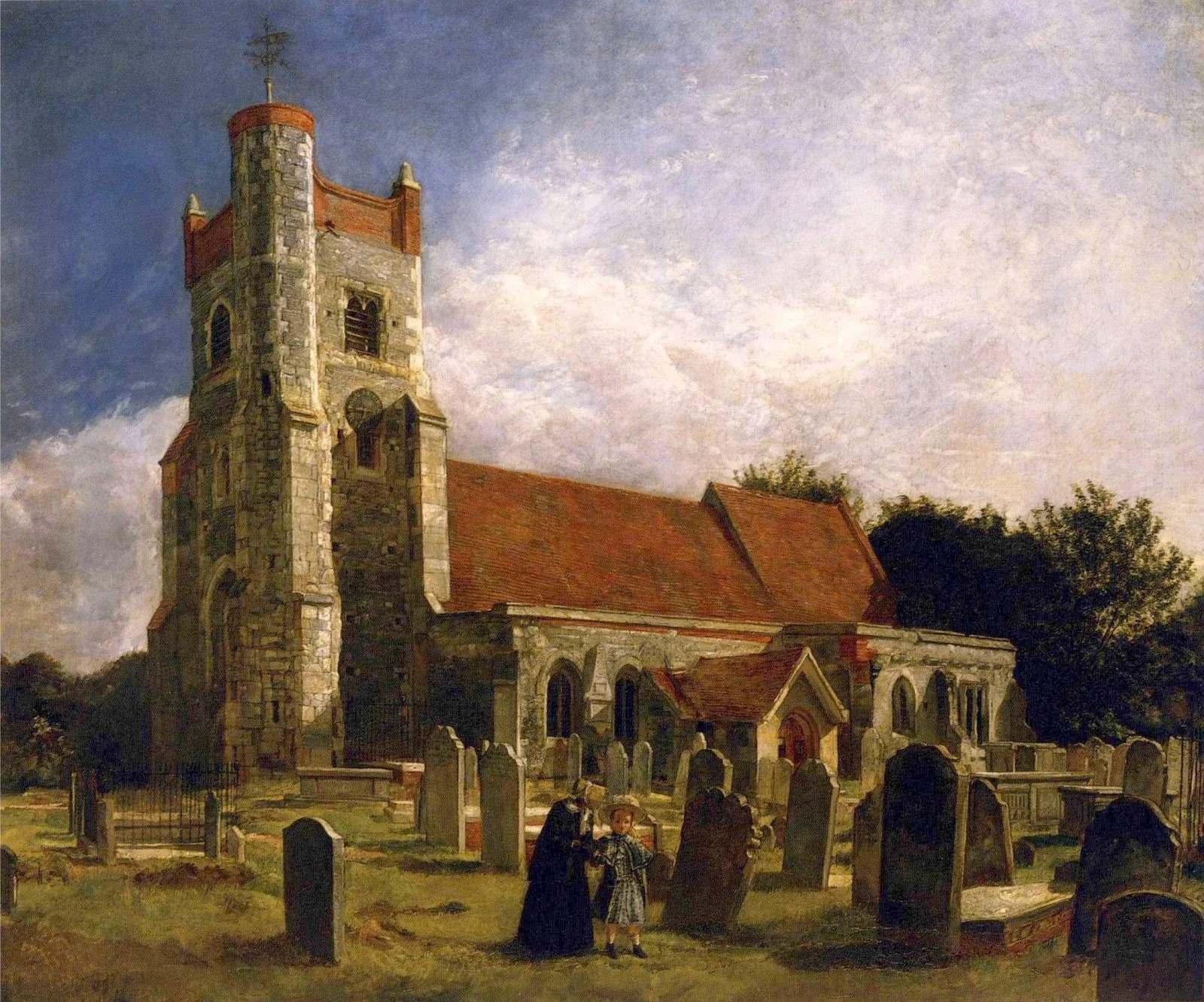
William Holman Hunt, The Old Church at Ewell
For Braddon, see Novels 004, 061, 115, 170, 222, 223. and 280.
“One of the saddest stories that we have read”; the characters are “thoroughly human, and, at the same time, thoroughly pitiful.” Athenaeum, July 26, 1873
“A painful story, and confused in its rendering of character,” but “there is a certain quality of intention in the characters of this book which carries the reader over the faults and dreary bits.” Saturday Review, August 23, 1873
For this fortnight’s novel, download
v.1 https://archive.org/details/strangerspilgrim01brad

Sir David Wilkie, The Confessional
This puzzle comes with an important disclaimer: the “shrift” it provides is not effective as a means of remitting sin or conferring absolution. If that’s what you want, you need a priest.
Download this fortnight’s crossword:
Solve this fortnight’s crossword online:
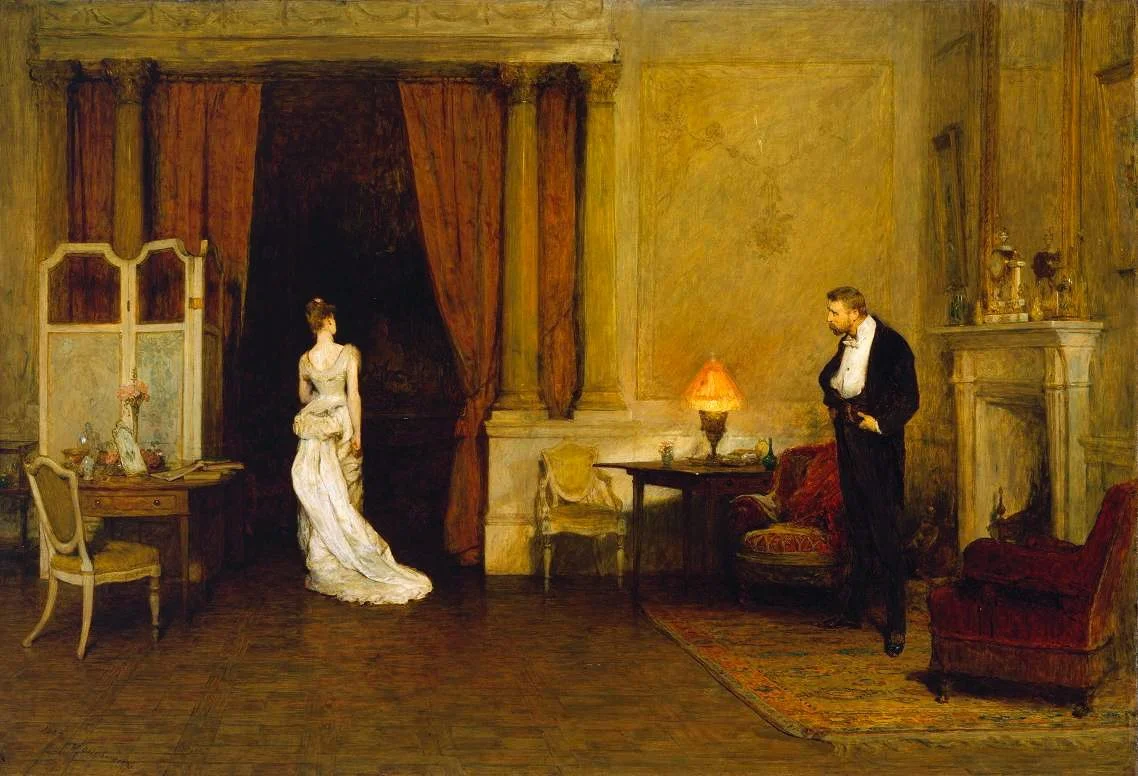
Sir William Quiller Orchardson, The First Cloud
For Trollope, see Novels 029, 079, 138, 189, 190, 191, and 269. The reviews of this one were not particularly favorable.
“Though it excites little interest and furnishes little entertainment, it is agreeably written, and contains a sufficient number of pleasing scenes and descriptions to render it very readable.” Spectator, November 30, 1839
“Mrs. Trollope no doubt draws forcibly, but there is a rigidity in her characters which removes them from ordinary life.” Literary Gazette, November 30, 1839
“A very inferior novel . . . dull and disagreeable; . . . nothing so preposterous as the one-faulted husband ever existed.” Morning Post, December 6, 1839
v.1 https://archive.org/details/onefaultnovel01trolrich

Robert Walker Macbeth, Our First Tiff
Are you feeling unhappy? Do you wonder whether you’re missing out on life? Do you fear you’ve failed to reach your full potential? Plentiful examples in film and fiction have a solution for you: get divorced! If you’re single, get married, then get divorced! If you’re divorced, get remarried, then get redivorced! Try again and again until you’ve divorced the right person. Then you’ll be happy.
Download this fortnight’s crossword:
Solve this fortnight’s crossword online:
A crossword of mine will appear next Saturday, July 5, in The Wall Street Journal

Thomas Benjamin Kennington, The Wedding Dress
For Hart, see Novels 006, 140, and 239.
“The incidents are slightly improbable, but cleverly strung together. . . . The sooner the story is dramatized the better, for after reading the book we want to see the play.” Boston Globe, March 7, 1876
“An impossible story, with some very painful incongruities, and not a few betrayals of intellectual feebleness on the part of the author. And yet we imagine that there are many respectable three-volume English novels without half its brightness, and ingenuity, and readableness; many novels, of apparently much more thought, without anything like the natural quality, the insight, and even the poetry of this entertaining little book.” Scribner’s, May, 1876
The heroine’s charm is such as to “disarm any critical faculty which the reader may possess, which is fortunate, as otherwise sensible persons might feel obliged, in justice to themselves, to declare it was all nonsense all together.” Athenaeum, September 2, 1876
Download this week’s novel:
https://solo.bodleian.ox.ac.uk/permalink/44OXF_INST/35n82s/alma990147383550107026
Quisque iaculis facilisis lacinia. Mauris euismod pellentesque tellus sit amet mollis.