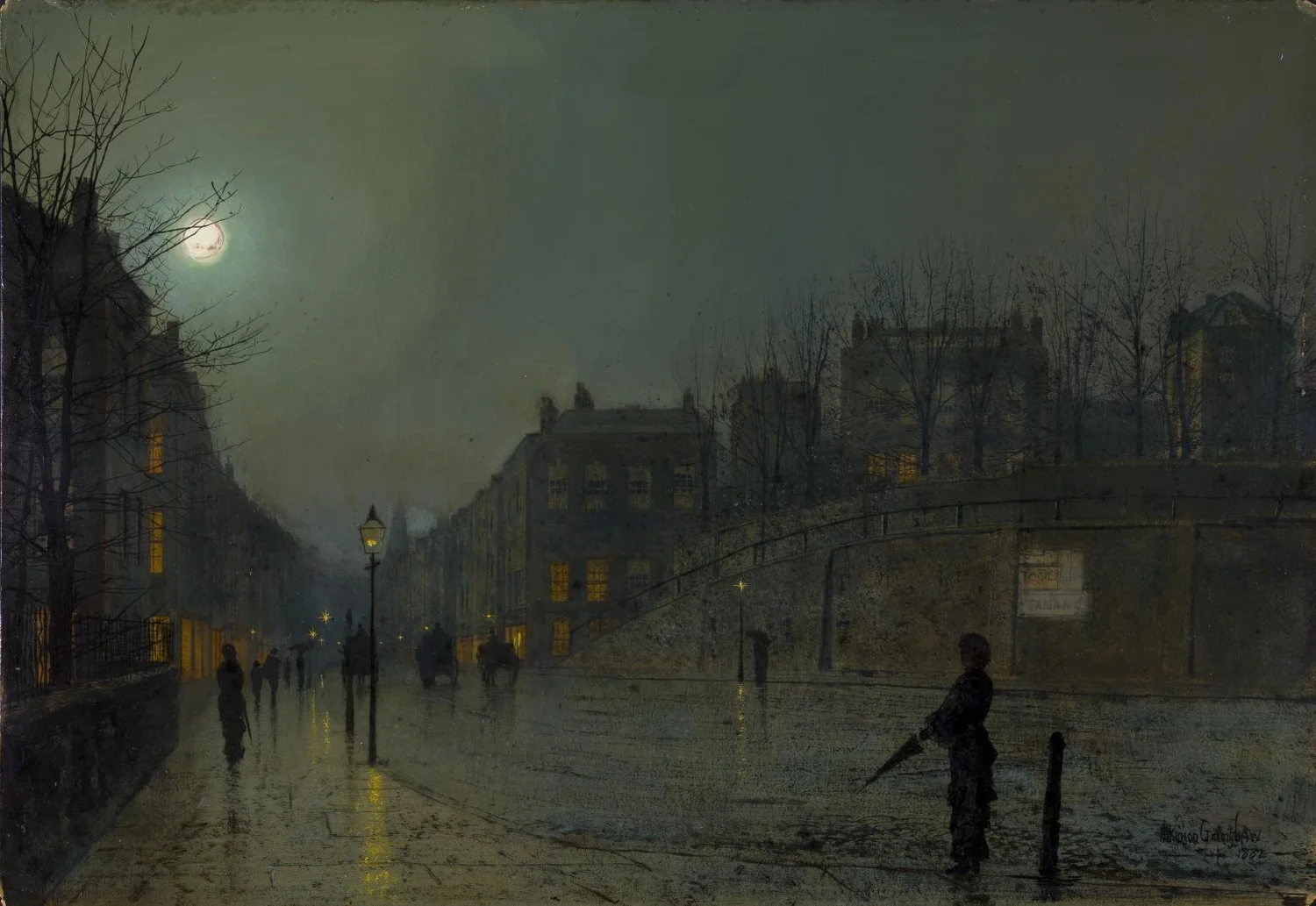
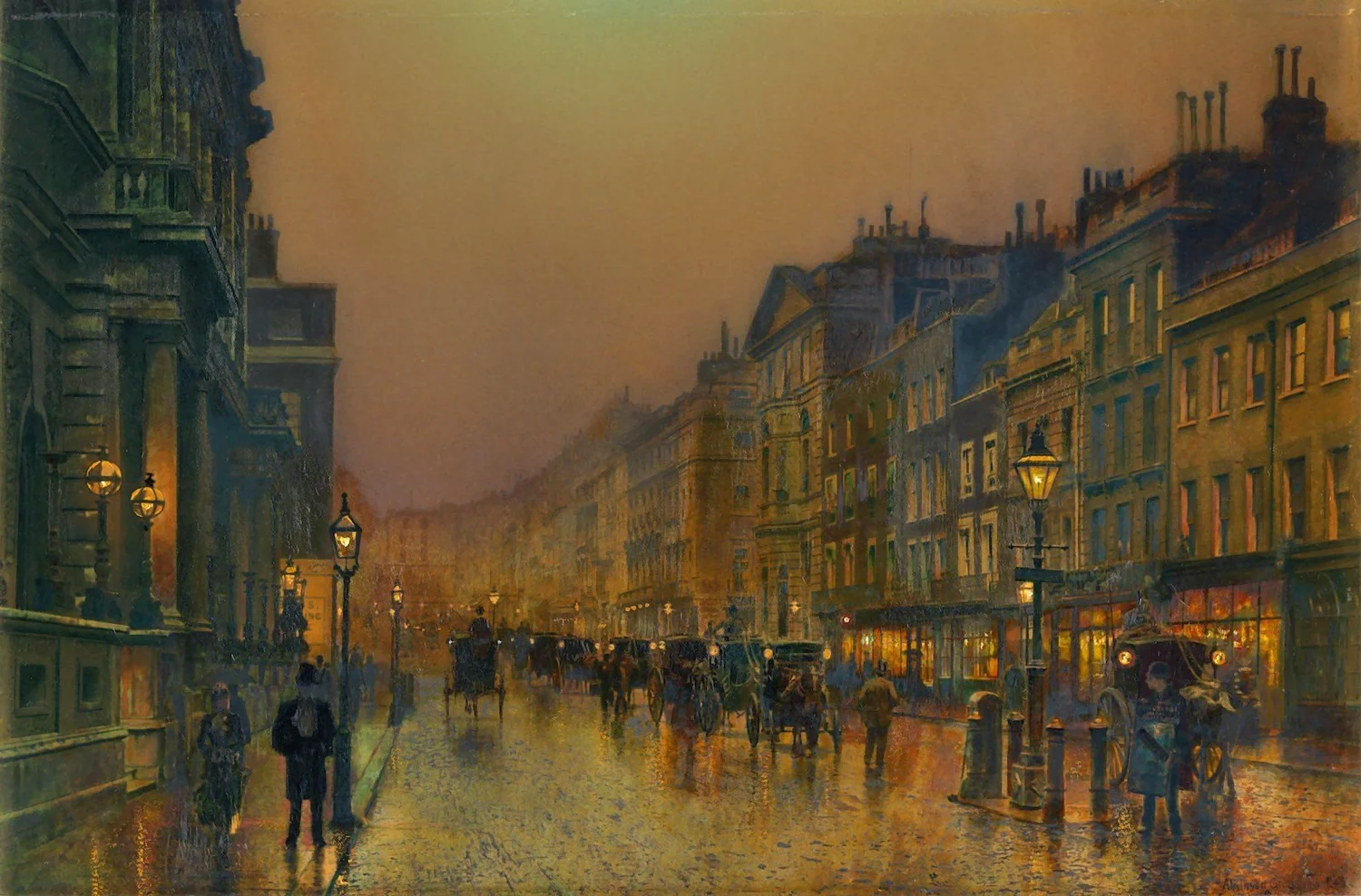
John Atkinson Grimshaw, View of Heath Street by Night
A frustrated inventor is unhappy in his job as jeweler’s agent.
Here is another novel by Payn (see Novels011,081,211), who is as entertaining as ever.
Payn “relieves the artifice of his stories with a good deal of human nature, generally of the genial kind, and is gifted with humour of the irrepressible order.” Spectator, November 13, 1880
“Mr. Payn’s fertility of invention and freshness of style are wonderful.” Saturday Review, November 27, 1880
“A well contrived story, full of incident, and sufficiently intricate to mystify the reader.” Athenaeum, December 11, 1880
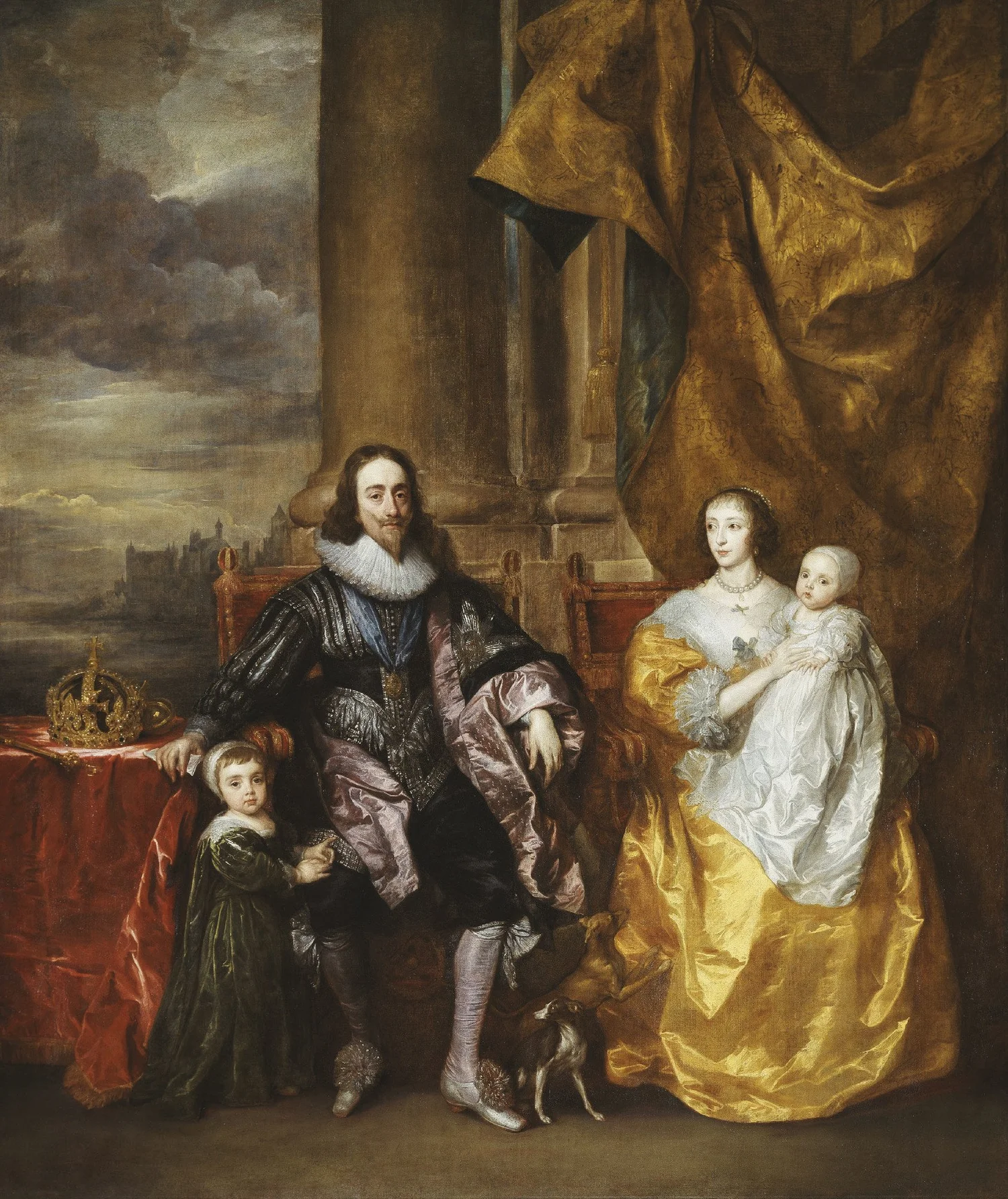
Sir Anthony Van Dyck, Charles I and Henrietta Maria with their Two Eldest Children, Prince Charles and Princess Mary
Are you seeking adventure, daring solver? You’ve come to the right place! You’ll find it in the attached puzzle!—that is, if you redefine the word “seeking” (dividing it into two parts and interpreting the first part as a homophone), and apply the result to common phrases so as to arrive at new phrases having to do with things like carpet installation and insurance. And if that doesn’t sound like adventure to you, well, maybe you haven’t come to the right place after all.
Speaking of C-kings, that’s the future Charles II at the knee of Charles I in this week’s painting; and here’s a timely bonus question for you:who is Charles II’s brother’s daughter’s cousin’s cousin’s second-cousin’s son’s grandson’s son’s brother’s niece’s son’s son’s son’s brother’s daughter’s eldest son?
(This week’s crossword, and the post introducing it, have been much improved by generous solver Charles Montpetit. Any genealogical miscalculations are, however, my own.)
Annie Thomas (1838-1918) wrote some 70 novels in 40 years and became perhaps the most critically vilified of all Victorian novelists. Referring to her routinely by her married name, Mrs. Pender Cudlip (as though they scorned to be taken in by her title pages), the reviewers excoriated her twice yearly for her supposed outrages against style and morality. “The English is slipshod and the story uninteresting, . . . the whole tone is petty, coarse, and vulgar throughout,” said The Academy ofA Narrow Escape (1875); “Two as worthless volumes as we have read for some time,” said The Athenaeum of The Maskleynes (1875); “There is certainly no pleasure, and we cannot think there is any profit, in reading a novel of this kind, it is so thoroughly cynical in conception and execution,” said The Spectator, of Blotted Out (1876); and so on, for novel after novel, year after year. This one appeared early in her career, before the pattern was established; in fact its reviews were fairly positive—and well deserved: its representation of the ambivalence of several of its characters toward each other is subtle and convincing.
“The characters being real, the reader will find his interest powerfully excited.” Spectator, June 15, 1867
“There is a lightness of touch, a delicacy of finish, and a general refinement which makes this novel pleasanter than its predecessors. . . . The merit of the book consists in the interest turning upon the play of character rather than incidents.” Athenaeum, July 6, 1867
Heart’s ease! It’s a purple flower! It’s an Elizabethan song! It’s a Victorian novel! (Novel 003) And now, at last, it’s a crossword puzzle! As Shakespeare puts it:
When griping grief the heart doth toss,
And doleful dumps the mind oppress,
Then puzzles made of words that cross
With speedy help do lend redress.
An unselfish young lady tends her alcoholic father, comatose mother, and three younger sisters.
Harriet Jane Trelawny (1821-1879) published only one novel, this one, just before her death in her late fifties. It’s a pity she didn’t start earlier or live longer, as this is a very good novel, in its quiet way, even if, like last week’s, it features that durable Victorian type, the self-sacrificing sister.
“It is a domestic story of a superior kind. . . . The language is pure, and this is the more satisfactory because the narrative is not stiff and awkward, but has the freedom too often secured at a sacrifice of grace, if not correctness. . . . The author . . . can reproduce the natural manner, expressions, acts, and expedients of ordinary men and women.” Athenaeum, October 25, 1879
A contrasting view:
“Sister is by no means an ill-meant effort, and shows a good deal of misdirected cleverness. The author has unfortunately tried to copy two bad models at the same time—the garrison-flirtation novel and monster-of-self-sacrifice old-maid story.” Academy, December 6, 1879
A virtuous young lady, engaged to one man, falls in love with another.
Isabel Goldsmid wrote two brief books—this one in 1839, and a Christmas story, “Shadows and Sunshine,” in 1850. The latter begins “Christmas!—hallowed Church, blessed home festival!”—and so it would seem unlikely that its author is the Isabel Goldsmid (1788-1860) who married her first cousin, Sir Isaac Lyon Goldsmid, a leading banker and social reformer known among other things for advancing the cause of Judaism in Victorian England. But I haven’t found any traces of any other Isabel Goldsmid. The novel offers a first-person narrator (introduced by a censorious editor) who oddly combines romantic sentiment and detached amusement.
“The single volume before us has many claims to our indulgence. . . The tale is a boná fide love-story, feelingly told.” Literary Gazette, March 23, 1839
“The subject chosen by our authoress . . . is as old as the world itself . . . yet the handling and the general arrangement evince an original genius. There is a quiet humour and shrewd observation in many parts which speak of an acquaintance with varied society, and the power of turning opportunities to account. That important social qualification, good-humoured satire, appears to be her leading characteristic, yet there is much of real feeling touchingly expressed.” Morning Post, April 2, 1839
A (somewhat) contrasting view:
“The incidents . . . are hackneyed, but the authoress has wisely kept clear of all the clap-traps of superhuman generosity, and impossible reconciliations. She has painted life, not exactly as it is, but that portion of it to be found in the vale of tears and shadows.” Athenaeum, April 2, 1839
That’s right! I recycle! I separate cans, bottles, and paper. I break down the boxes and I tear the labels off the cans. I even tear the little plastic windows off the business envelopes and the pasta boxes. And, like other people who use yard signs, bumper stickers, banners, tee shirts, and other such means to announce their possession of basic virtues, I thought everybody would be glad to know this about me. You are glad, aren’t you? Of course. So here’s a crossword for you, in my honor.
Here is another novel by Paul (see Novels025,136,198), featuring as usual carefully realized scenes of ordinary life.
“A pleasant, graceful book, written moreover in an earnest spirit.” Examiner, January 5, 1856
“A good and agreeable specimen of this kind of story; with sufficient variety of interesting occurences and well-drawn persons, a knowledge of society if not of life, and an unhackneyed moral.” Spectator, January 5, 1856
A (slightly) contrasting view:
“‘Dorothy’ is an excellent little story. There are no exciting incidents nor highly-wrought sentiments, but a great deal of excellent delineation of character. . . . A little more dash and vivacity and a greater variety of incident would be desirable in the author's future stories. ‘Dorothy’ is too still and uneventful to interest the general reader as much as the talent it displays merits.” Athenaeum, January 26, 1856
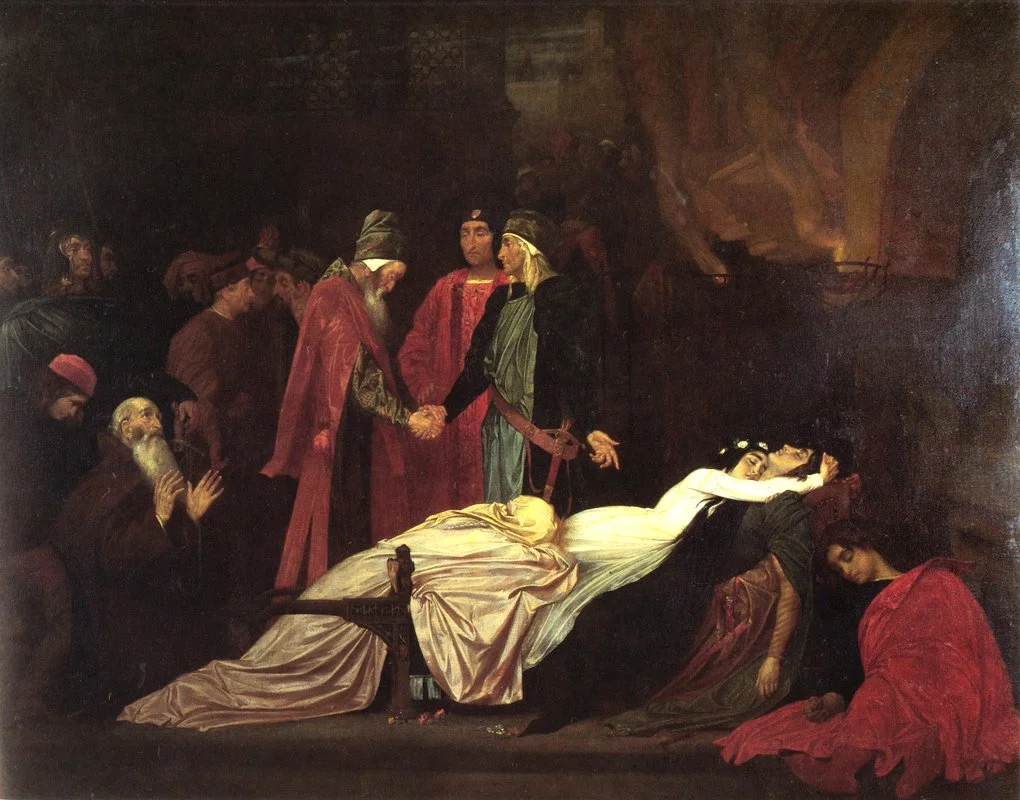
Lord Frederic Leighton, The Reconciliation of the Montagues and Capulets over the Bodies of Romeo and Juliet
Many people enjoy belonging to a group bound by a sense of grievance so that they can rage happily together, usually against some other similarly bound group that can rage in turn back at them. This is fun in itself; it can also lead to solid personal gain, as one’s route to success is eased by one’s fellow enragees, who form a sort of mutually-supportive grievance collective, or ring of ire. We here at David Alfred Bywaters’s Crossword Cavalcade and Weekly Victorian Novel Recommender belong to no such ring; we’re happy with everybody and everything in this fortunate world, including other people and their rage, to which we here pay a small tribute.
A young aristocrat is unexpectedly forced to make his own way in life.
Ulick Ralph Burke (1845-1895), barrister and historian of Spain and Mexico, wrote two novels, of which this was the first. His somewhat rambling plot gives him plenty of scope for satiric representation of English and Anglo-Indian society.
“The plot is interesting and well constructed, and there is a pleasant variety in the dramatis personae. . . . The style, too, is crisp and occasionally epigrammatic. . . . The characters . . . have . . . a distinct individuality.” Athenaeum, November 15, 1879
“We are indebted to Mr. Burke for a good novel, and a wholesome hero.” Spectator, December 6, 1879
A (somewhat) contrasting view:
“Beating the Air is not a strong book, but it is well meant, and, in its mild way, is far from being unpleasant.” Academy, November 22, 1879
We here at David Alfred Bywaters’s Crossword Cavalcade and Weekly Victorian Novel Recommender work tirelessly to express ourselves as clearly and concisely as possible. As a result, we are always having to haul away great piles of excess verbiage; however, we are careful to dispose of it in an environmentally responsible manner. Much of it we donate to academic and philanthropic institutions, whose need for this commodity is insatiable. But this week we’re experimenting with the possibility of recycling.
One daughter of a country squire in the Lake District longs to see the world; the other is content to stay at home.
Margaret Roberts (1833-1919) wrote nearly thirty novels between 1857 and 1897; this is one of the last. The heroine’s self-indulgent father is an especially well-done character.
Roberts “always gives us good work and always casts an unfailing charm over what she writes.” Manchester Guardian, May 10, 1892
“As a whole the sketch is worthy of the delicate hand” of the author. Academy, June 18, 1892
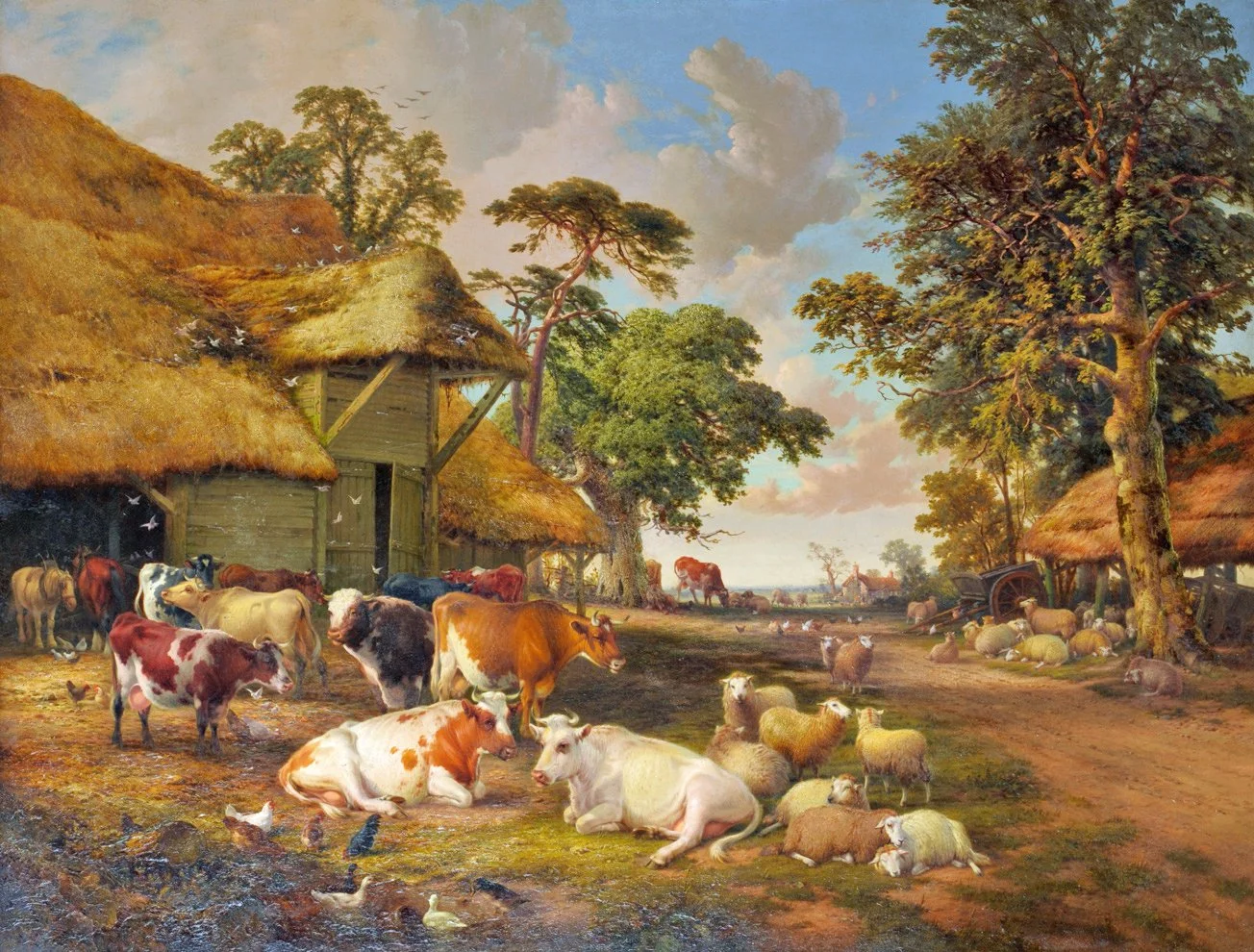
Thomas Sidney Cooper and Thomas Creswick, Farmyard Scene in Summer
Short-sighted solvers might be inclined to scoff at 60 Across in this week’s puzzle. But so did short-sighted critics scoff at Picasso’s cubes, at Rothko’s daubs, at Pollock’s drips—and who had the last laugh? When crosswords cease to make any sense at all, solvers will look back at 60 Across, and its relative nearness to sense, with a kind of bitter nostalgia, while future cultural historians will hail its ground-breaking, boundary-smashing departure from the dull routine of sense-making that had previously held puzzledom in its thrall. But go ahead and scoff—if you don’t mind the prospect of posterity’s scoffing at you.
A virtuous young widow is left at the mercy of her late husband’s unscrupulous uncle.
Lieutenant-General Sir Edward Bruce Hamley (1824-1893), the younger brother of last week’s novelist, likewise supplemented a military career with literary efforts. This, his only novel (serialized in 1850, issued in book form in 1853-54), features, in addition to some sentimental ladies and gentleman officers, an amusingly bad alcoholic gambler.
“‘Lady Lee’s Widowhood’ is unquestionably one of the wittiest and pleasantest things that the press of our day has given to the public. . . . It furnishes the largest return of enjoyment for twenty-five cents that can be found in any bookstore in the country.” Southern Literary Messenger, December 1853
A (somewhat) contrasting view:
“This is a pleasant book. . . . The characters (with the exception of Colonel Bagot Lee) are not very complex specimens of human nature, but they are brightly coloured, and drawn with spirit. The character of Colonel Lee is of a higher class, and well worked out. . . . The story . . . drags somewhat at times, but it is withal a bright, healthy book, with a dash of hearty humour in it.” Athenaeum, February 18, 1854
This is a sort of sequel toPuzzle 188, but even more likely to produce in the solver not only sighs, but rolls of the eyes, shrugs of the shoulders, and other activities that increase blood flow, oxygen absorption, and synaptic transmission. Studies have claimed to disprove the theory that regular crossword-solving can delay the onset of dementia, but those studies did not employ the crosswords available here at David Alfred Bywaters’s Crossword Cavalcade and Weekly Victorian Novel Recommender.
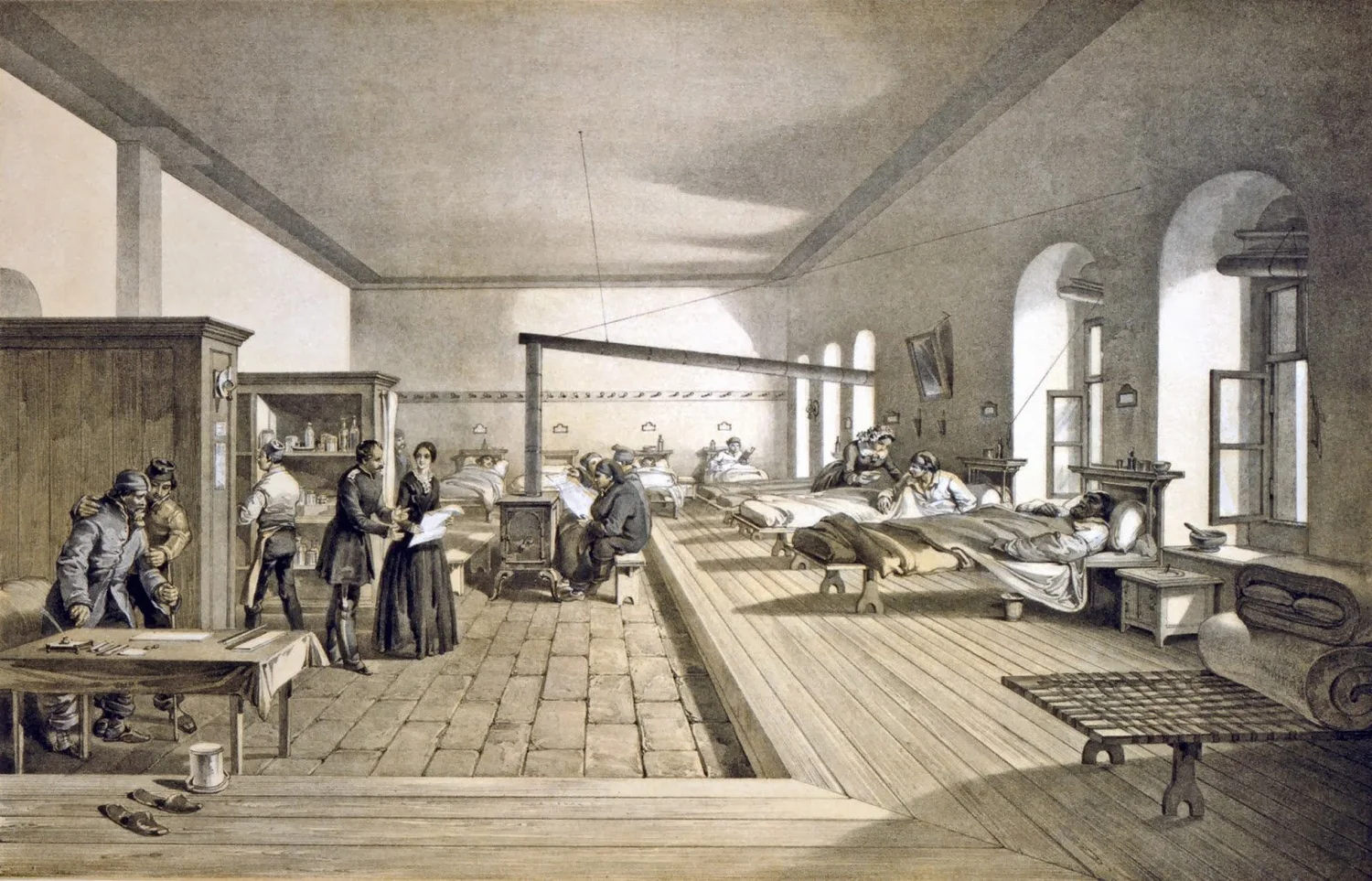
William Simpson, One of the Wards of the Hospital at Scutari, 1856
A gentleman grows interested in a poor girl, then fights in the Crimea.
Major-General William George Hamley (1815-1893), having retired from the army in 1872, wrote three novels between 1878 and 1882, of which this is the second. Its conflicted, morally developing hero and the less glorious side of Victorian army life are both well represented.
The “real interest of the book” consists in “the style and thought, sometimes almost too elaborately allusive, in the well-drawn sketches of military life in the Crimea and elsewhere” and in “the very best exemplification of the undesirable type of elderly military man we have ever met with—at least in fiction.” Examiner, May 24, 1879
“What with fun, love, and adventure, there is no flagging in the book from first to last, and General Hamley is to be congratulated on having written an extremely entertaining novel.” Saturday Review, June 14, 1879
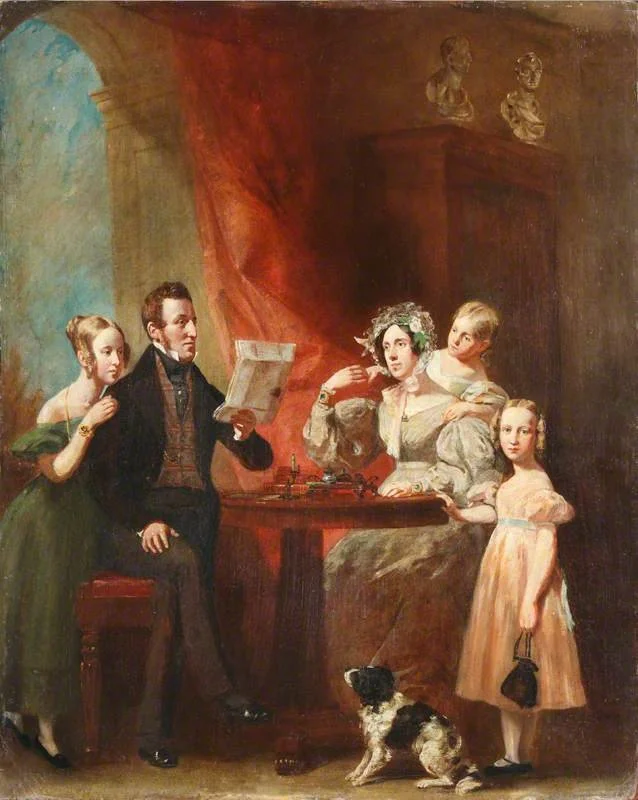
George Hayter, The Town Clerk of Brecon and His Family
Don’t let the title worry you—you can solve this puzzle, as you can all my puzzles, with the whole family gathered admiringly around you—unless, that is, you want to protect your progeny, during their impressionable years, from witnessing serious violations of linguistic norms.
Two genteel sisters, one virtuous, one beautiful, are left in poverty, to make a living as seamstresses.
For Marsh-Caldwell, see Novels069,187. Despite the obvious didactic purpose of the contrast between the novel’s sisters, its characters are lifelike and its plot involving.
“We like the tale for its delicate shading of individual characters chosen from the most every-day life.” Literary World, August 3, 1850
The author “has depicted, with her usual vigorous and truthful colouring” the wretched lives of seamstresses. Critic, November 15, 1850
A (somewhat) contrasting view:
“‘Lettice Arnold’ is the work of a woman—a woman who has great facility of composition, and considerable imagination, but little judgment. It is literally ‘stuffed full’ of prejudices, especially against light literature as it is produced in France”; but it “is well written; and . . . it is one of the few novels which can be perused with pleasure and resumed without pain.” Observer, November 4, 1850
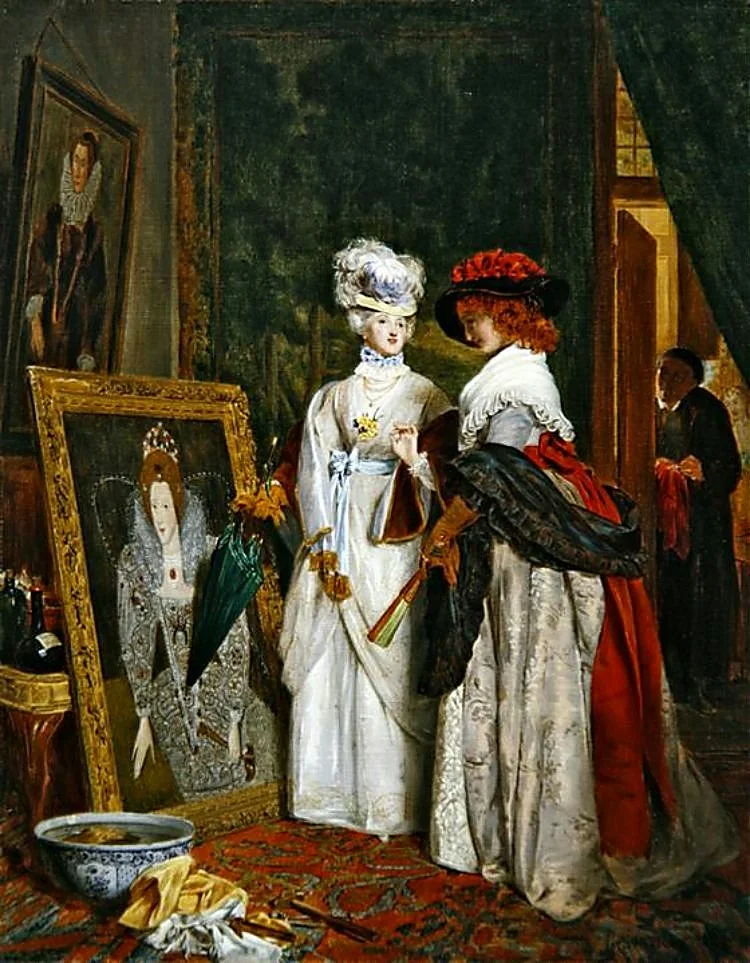
John Callcott Horsley, Critics on Costume, Fashions Change
After five weeks of unrelenting cruciverbal depression, it’s time for a change of pace; and that’s exactly what this week’s puzzle provides. Of course, you’ll nonetheless find in it all the usual qualities of puzzles on this site: norm-shattering formal innovation, the latest in culture, and a daring willingness to speak truth to power. (Also some wordplay.)