For Eleanor Frances Poynter see novel145. This, apparently the last of her works, has little plot, but much careful character analysis.
“The story is perhaps the misfortune of the book, but the characters, situations, and conversations are handled with surehandedness and strength.” Bookman, December 1892
“Very interesting, on the whole, and extremely well written.” Critic, January 14, 1893
Life is, of course, when you think about it, a do-and-die situation. But this is just a crossword, and one of the great things about crosswords is that you don’t have to do them, that your doing or not doing a crossword will never matter to anybody in any way, will never lead to any extrinsic reward, or punishment, of any kind. And doesn’t that make you want to do one right now?
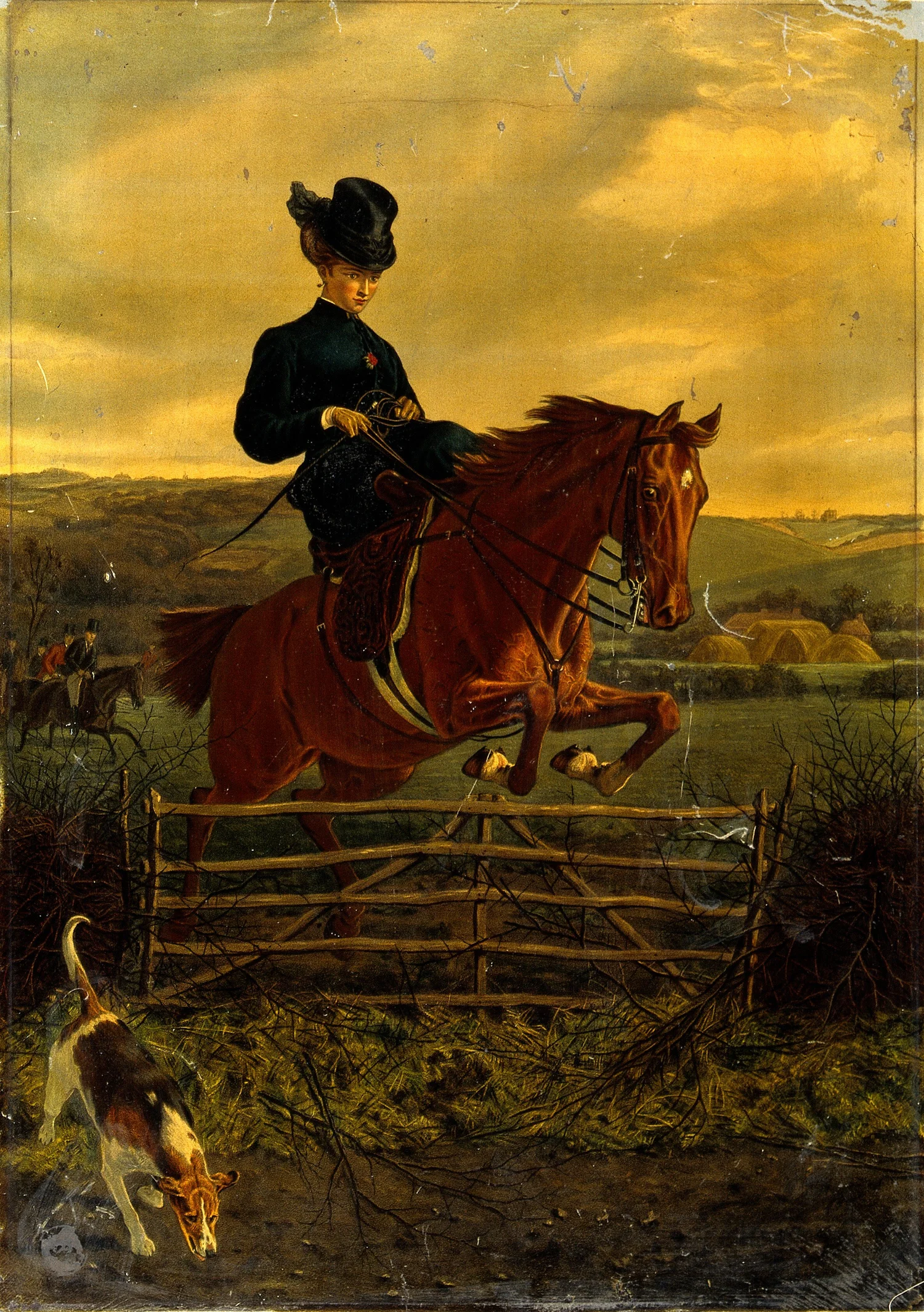
Charles Burton Barber, An Elegantly Dressed Horsewoman Jumping Over a Gate
In Scotland, a self-made millionaire’s daughter and niece fall in love with the same man.
Charles Gibbon (1843-1890) wrote some 30 novels beginning in 1864. This one features, in addition to some stock Victorian-novel figures (the ill-bred, wealthy industrialist, the self-sacrificing virtuous young lady, the young lover enraged by a misunderstanding) two carefully delineated and thoroughly interesting main characters.
Gibbon “has imagined the extraordinary fluctuations of” a main character’s “feelings . . . with remarkable felicity, and has drawn them with great skill. . . . It is an excellent and a very rare thing when the interest of a novel decidedly increases as it goes on.” Academy, September 9, 1875
The novel “should do much to give him a high place among delineators of character. . . . Besides containing several very masterly studies, it is full of humour, of quaint, wise, remark, and may be taken as a reliable picture of life in the district where the scene is laid.” Spectator, October 2, 1875
I know many of you are wondering about my identity—my race, and gender, and age, and sexual orientation, and all that. If you think my name implies something about some of these, you’re wrong: “David Alfred Bywaters” has no more existence than Betty Crocker or Mr. Clean. In fact these puzzles are made by a diverse collective of organically-fed artisans, working in a carbon-neutral environment with hand-crafted crosswording materials. That’s why they’re so good for you!
This puzzle should properly appear in 2023, the next year in which July 15 falls on a Saturday—but by then I may be gone, or you may be gone, or some competing constructor may have given the theme an inferior treatment. So here it is now: just make a note to yourself to solve it again in 721 days.
A new clergyman comes to a country town, which is ruled by his predecessor’s wife.
Richard Orton Prowse (1862-1949) wrote at least a dozen novels between 1892, when this one appeared, and 1934. Though somewhat marred by an implausible lovers’ misunderstanding, it provides a chilling portrayal of unthinking, self-congratulatory enforcers of social norms.
“A neatly and cleverly constructed story of life in a country town” with “skillfully handled characters. The story will repay perusal.” Academy, July 16, 1892
“Decidedly pleasant and readable,” with some “delicate, subdued touches of humour” reminiscent of Jane Austen. Saturday Review, July 16, 1892
Today’s crossword concludes this year’s series. The final entry presents a mirror-image counterpart of the first—just one of the more obvious manifestations of the intricate structure of meaning that informs this web site; and a good point of entry for scholars hoping to tease out its multiple, richly interwoven strands of semiotic implication.
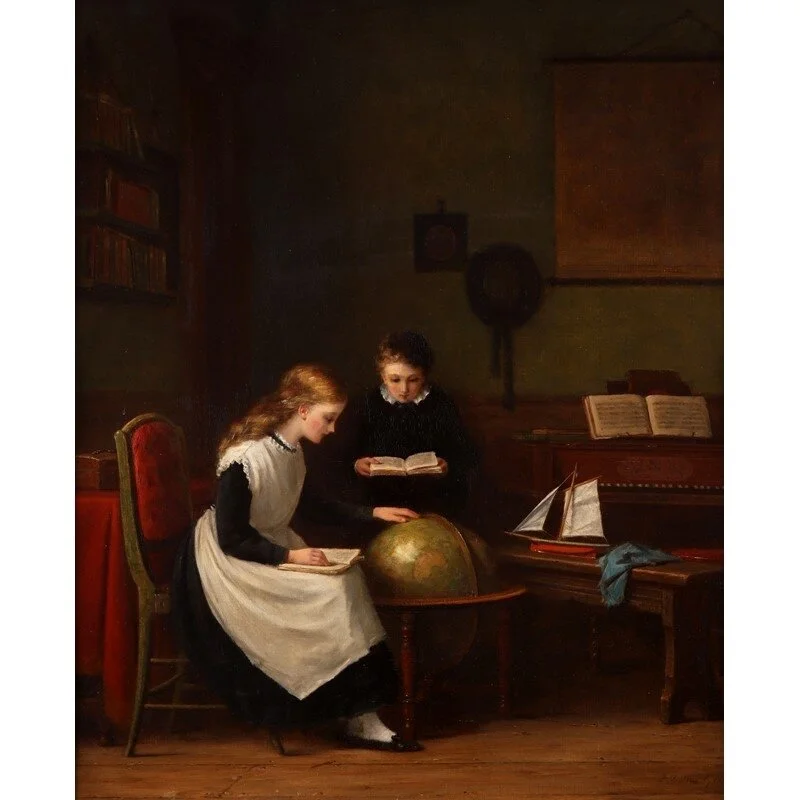
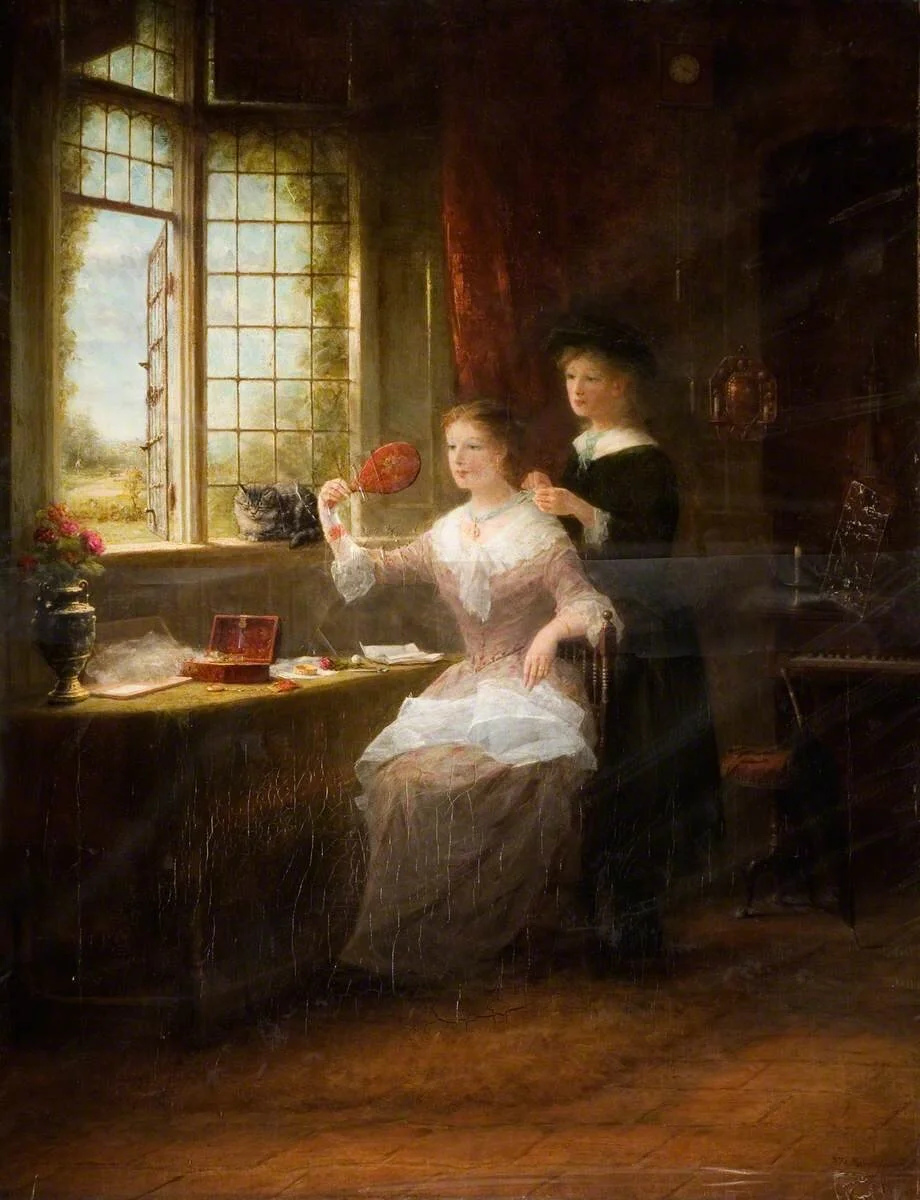
Frederick Daniel Hardy, Two Children Studying with a Globe and Piano
The former Widow Barnaby tours the United States.
Trollope spent some years in the United States, first at an anti-slavery community in Tennessee, then in Cincinnati, where she tried and failed to found a profitable retail business. She turned these failures to account in her first published work, The Domestic Manners of the Americans (1832), which established her literary reputation. She draws again on this material in her final installment of the Widow Barnaby trilogy.
“No writer of the present day possesses a quicker perception of the ridiculous, and a keener eye for detecting the weaknesses and defects in individual or national character, than Mrs. Trollope. To this add an almost masculine vigour of expression, and earnestness of purpose which leads her by the shortest route to the point at which she would arrive, a thorough contempt for the hypocritical conventionalities of society, and you have the key to a very remarkable literary paradox which exists with regard to this author’s works, namely, that although the majority of readers profess to dislike them, there are few contemporary writers who have acquired a greater degree of celebrity. . . . The fact is, she studies less the prejudices of her readers than the fidelity of her pictures. She shrinks not to paint nature as she finds it, to expose those hideous evils which rankle and fester beneath the decently disposed robes of society. . . . Here she . . . exposes the frightful moral taint which pervades society in all the southern states where the abominable system of slavery exists.” Sunday Times, August 13, 1843
We can “assure the reader of a hearty laugh at the versatile faculties of roguery wherewith the leading characters of the tale are endowed. Mrs. Trollope is never as much at home as when dealing with the foibles of her very good friends of the ‘model republic.’ Amidst a great deal of caricature, the most judicious friends of the Americans would admit that there is much in her writings which may serve for hints of a most useful kind.” Morning Post, August 23, 1843
Hoo boy it was hard to find theme answers for this puzzle, especially since Sutton Hoo was ineligible, because of its association with offensive weaponry and violent death, two of the many things I’m trying to stamp out by not putting them in crossword puzzles (another is “medical malpractice,” which, along with “Woody Allen,” and “bisphenol-A,” I’ve managed to keep out of all my puzzles to date).
The further adventures of the former Widow Barnaby, after her remarriage.
The saga continues.
“The sketches of life and society are often characteristic and amusing.” Literary Gazette, March 14, 1840
“‘The Widow Married’ will amuse all who are not over nice; and we are not sure that Mrs. Trollope ever hit off two portraits happier and more guiltless of caricature than those of the sisters Perkins.” Athenaeum, April 4, 1840
“It is a picture and an exaggerated one, but still a picture of some very disagreeable and immoral people.” Sunday Times, April 5, 1840
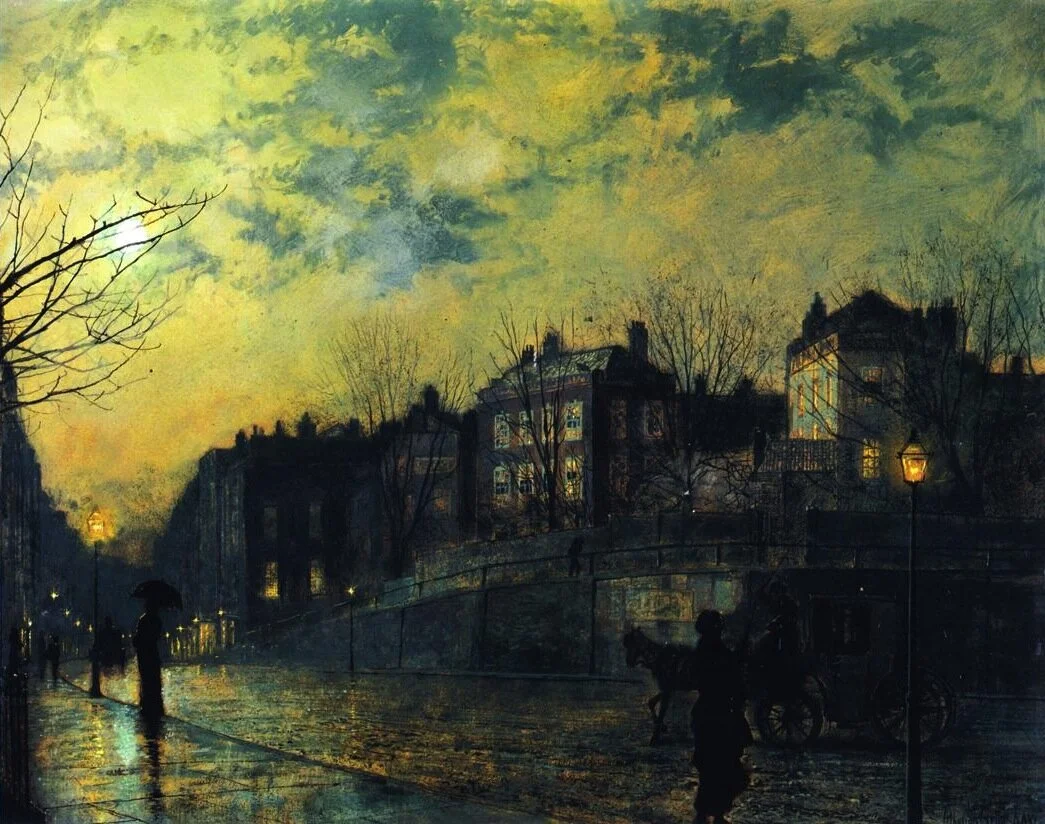
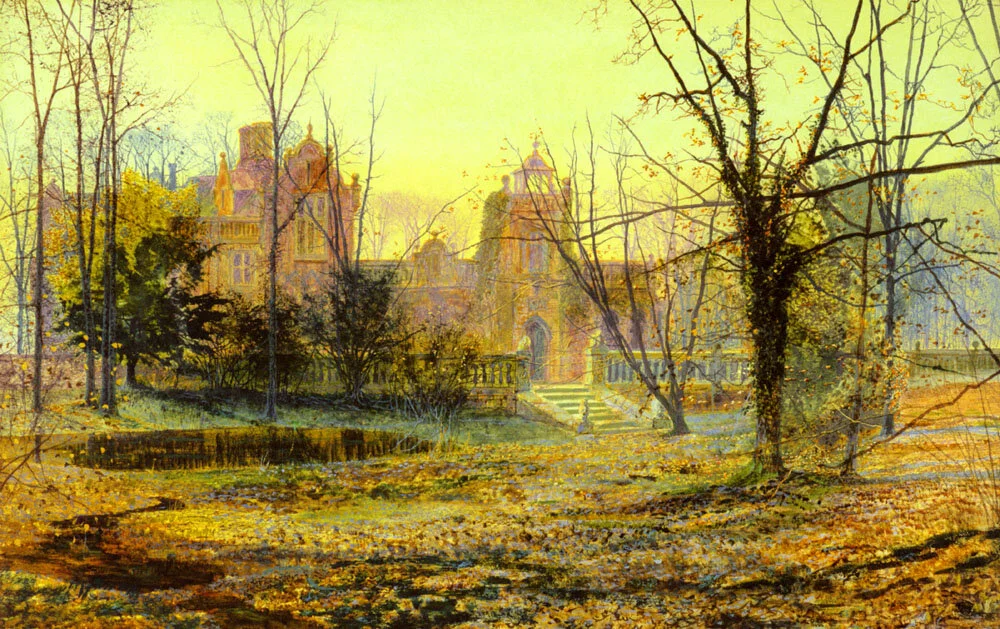
John Atkinson Grimshaw, Evening, Knostrop Old Hall
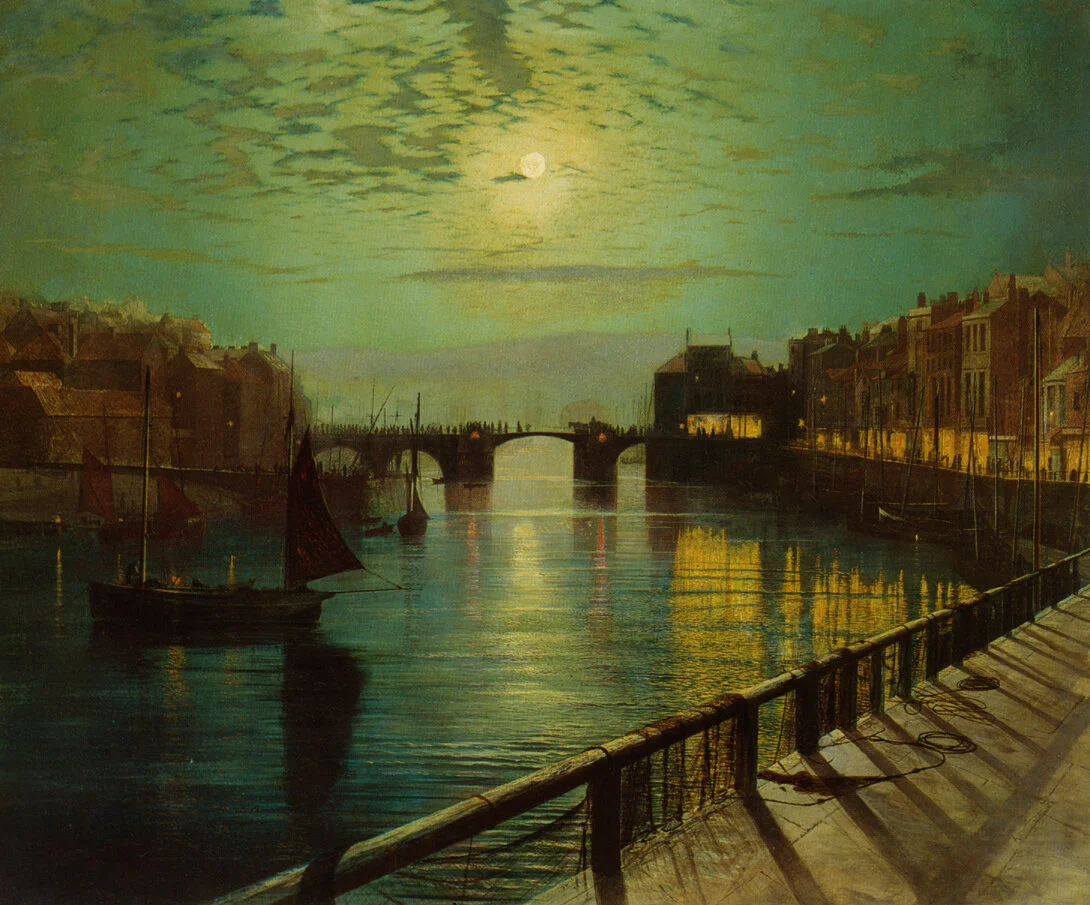
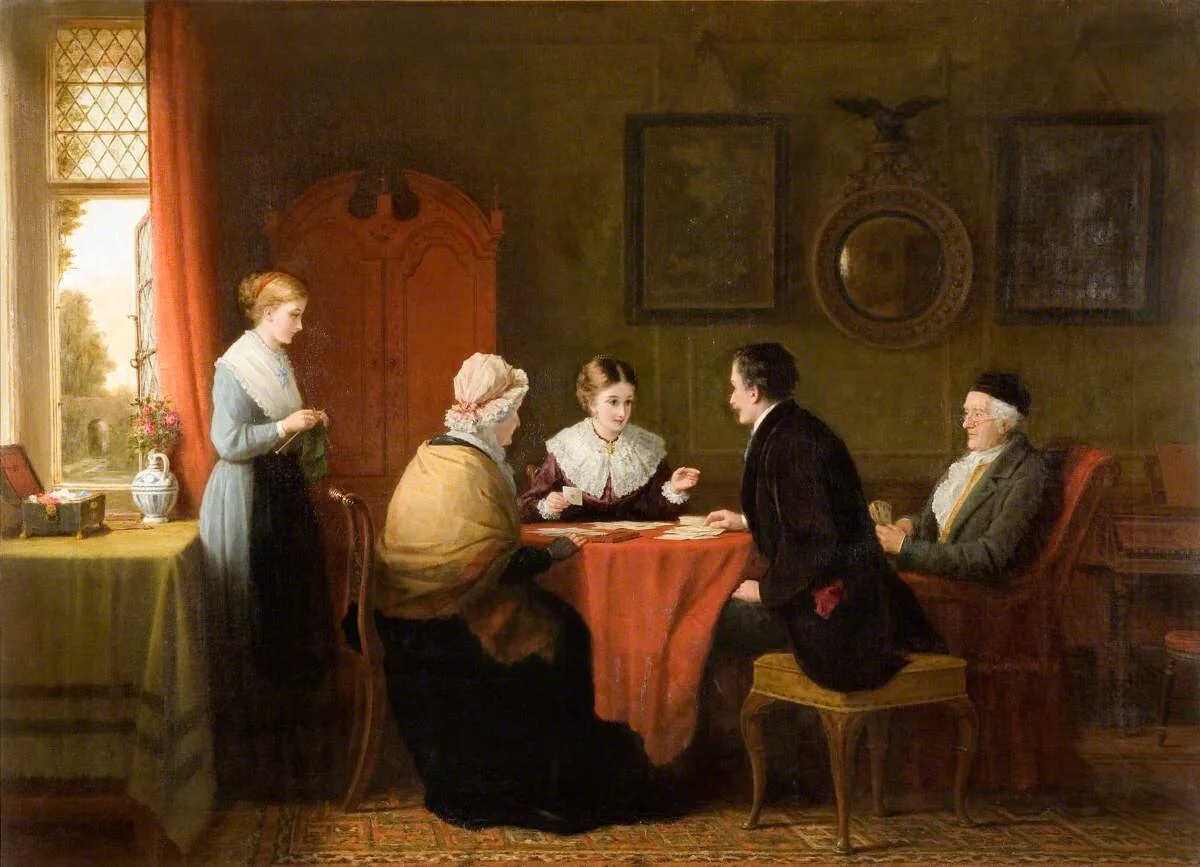
At the beginning of every summer I’ve featured on this website a ground-breaking, norm-shattering series of crosswords. Three years ago I engaged in a six-part existential meditation-in-crosswords on the nature of being (Crosswords 029-034). Next, in a four-part series (Crosswords 081-084), I examined the deep syntactic structures that underlie our language, determining not just how we make meaning, but what we can mean. Last year I sounded a warning in three puzzles against the encroachment of decadence in our society (Crosswords 135-137). And last week I embarked on an exploration, which continues today, of the essence of comedy—illustrated with paintings by John Atkinson GrimsHAw whose titles also contain the consecutive letters HA. Interspersed with these will be recommendations for the nine volumes of Frances Trollope’s laughter-inducing Widow Barnaby trilogy, illustrated with paintings by Frederick Daniel HArdy.
A self-assured social upstart makes her way in the world.
For Trollope, see Novels029,079,138. This is the first installment of a trilogy featuring the title character.
Readers “will be presently enchained in the interest of the tale; for Mrs. Trollope’s usual merit—that of directness of purpose, and a strong belief and interest in her own subject—does not forsake her in the present instance. . . . The tale proceeds naturally, cheerfully, steadily, till the third volume is half over; when a harlequinade of forced combinations and improbable adventures commences. . . . The Widow’s earlier achievements are a genuine and amusing comedy. . . . The account of her earliest exploits . . . is almost worthy of the authoress of ‘Pride and Prejudice:’ higher praise we scarcely know how to give.” Athenaeum, January 5, 1839
“To be sure the writer’s vulgarism, prejudices, and forced combination of melo-dramatic circumstances . . . mar the character of the work; but more than one of the personae dramatis, especially ‘The Widow,’ are originals, and yet truth-speaking portraits. The localities where the story developes itself, such as Clifton, Cheltenham, are capitally sketched, with all their provincial ambitions, scandals, and shabbiness.” Monthly Review, March, 1839
One of the great satisfactions of the crossword—the sense of understanding something that has confused or mystified us—is provided as well by the conventional Victorian novel. And this is so satisfying a satisfaction because it’s what life itself so often, so implacably denies us. Where did this go? Why did that happen? What’s the point of everything? We don’t ever get to figure it out. But we do get to figure out that the governess was actually the evil baronet’s daughter by his first wife, and that 49 Down is GMBH.
A millionaire philanthropist is haunted by one long-ago act of dishonesty.
William J. Locke (1863-1930) wrote some 40 novels, several successful plays, and a great many short stories. This novel is particularly good at representing the main characters’ mutual misperceptions.
“Character and plot are most ingeniously wrought and the conclusion, when it comes, is fully satisfying.” Spectator, December 7, 1901
“The plot is fresh and ingenious, and it is worked out with a simple directness of style, a resourcefulness of detail, and a fine idealism . . . uncommon enough.” Bookman, January, 1902
Here’s a joke! Q: “What do you give irregular armies?”—A: “PX-Lax” Get it? Ha ha! I just thought that one up. Funny, huh? No? Well, don’t worry, it has nothing whatever to do with the puzzle below.
A virtuous young man loves an even more virtuous young woman, but is encumbered with a not-so-virtuous father.
Here is another novel by Marsh-Caldwell (see Novel069), uninhibitedly moralistic, but expert in plot and character.
“Though this tale is more tedious in its preamble—more precipitous in its conclusion than can be accredited” it “contains scenes” no other author “could have written so well. Few will be able to escape from her new story when once they have entered on it: few will question the vitality of some of its characters, and the force of some of its situations.” Athenaeum, January 12, 1850
“The characters are sketched with great talent, the incidents are described with vigour and effect, and, above all, the workings of the heart are wrought out in earnest, passionate language.” New Monthly Magazine, February, 1850
Every human endeavor attracts an in-group: people who know what’s up, and who’s who, and how to signal to each other over the heads of the ignorant crowd. So it is with crosswords. And are you wondering who sits at the center of the crossword world, posing smugly as the arbiter of cruciverbal fashion, setting trends, attracting unearned admiration, inspiring fear of unearned contempt? Well, I’ll tell you: it’s me! I’m so far in that most solvers barely know about me; only the cognoscenti truly appreciate me. Maybe you’re one of them? If so, enjoy the attached puzzle, and sneer confidently at those dull-witted, commonplace solvers who still think the New York Times is cool.
Florence Wilford (1836-1897) wrote some sixteen novels between 1858 and 1895, many of them for children or young adults. This one, though it does not directly attack Victorian social constraints, nonetheless vividly represents their destructive effect on talented women.
“A clever woman’s plea for clever women, made in a quiet and feminine manner, and yet ably and humorously turning the tables. . . . It is well and gracefully done.” Saturday Review, January 9, 1869
“Admirably worked out”; the heroine’s character is “delineated in all its true nobility, with really exquisite insight”; “a fine study of character under special circumstances.” Spectator, October 8, 1892
Yes, we’re taking the easy way out again. Someday I’ll stuff my puzzles full of things you’ll feel bad about not knowing. Someday I’ll make my theme answers turn corners, and double back on themselves, and run outside the grid, and use the black squares in odd ways, and otherwise require all sorts of reinterpretation, so that, though they look like random assemblages of letters in the grid, they turn out (once you’ve discovered the trick) to be the names of celebrities you ought to admire. Someday. But not today.