After five years in Baluchistan, a man returns to Scotland to pursue the woman he loves, now widowed.
Oswald John Frederick Crawfurd (1834-1909), aside from writing some ten novels, was British consul at Oporto from 1866-1890.
“A very good story, told with skill, taste, and what in music is called brio. . . . The talk is excellent, various, natural . . . ; characteristic, so that we know the talkers, and make mental portraits of them.” Spectator, July 5, 1884
“A capital novel. It is lively and sparkling throughout, and one can only regret that it is so short.” Athenaeum, July 5, 1884
I am often asked, “Why are your crosswords so much better than other people’s crosswords?” The answer—specialization! As I’ve said before, “I” am (is?) not a single person, but a collective, diverse in age, and race, and gender, and everything else imaginable, including skills. So there is a specialist for Down answers, and another, altogether different, specialist for Across answers; there are specialists for clues, for blocks, for partial phrases, for abbreviations. An entire department, with its own vice-president, handles the crosswordese. There is a letter-addition team and a letter-subtraction team, a punning team and a parsing team. Doesn’t this cost a lot? Sure it does! But you the solver deserve the best, and here at David Alfred Bywaters’s Crossword Cavalcade and Victorian Novel Recommender, the best is just what you always get.
Special thanks to test-solver Charles Montpetit for coming up with some of the theme material in today’s puzzle.
In a New England town plagued by labor troubles, a detective searches for a murderer.
Thomas Bailey Aldrich (1836-1907), editor of the Atlantic Monthly from 1881-1890, published a dozen or so works of fiction, in addition to much poetry and criticism.The Stillwater Tragedy features a murder mystery and a labor strike.
“The faithful potrayal of life in a manufacturing village; the distinct and vivid etchings of character; the graceful turns of fancy and humor; the simple and wholesome love affair; the naturalness, purity, and equipoise with which the story is told, all mark it as one of the best of Aldrich’s prose performances.” Louisville Courier-Journal, September 3, 1880
“The book is something much better than a novel of the familiar detective class. . . . the plot is not used as a mere framework on which to display the delicately drawn pictures by which Mr. Aldrich has long been known and admired; the incidents of the story are used not only to illustrate but to develop the characters of the chief personages. . . . The book has a symmetry of form and an evenness of texture which show the hand of the true artist.” New York Tribune, September 12, 1880
A contrasting view:
“It is all very clever, astonishingly clever. But it is a kind of cold, cynical brilliancy which in a short story may be very entertaining, but which in a novel soon palls upon one’s taste.” Scribner’s, November 1880
What with supply-chain issues and some strategic downsizing, our store of words has been sadly depleted. A long course of severe weather has shut down the mines from which we imported most of our homophones. And of course a small concern like ours can’t hope to compete with the big players while the global anagram shortage keeps driving up prices. So for now we’re going to have to make do with fewer theme answers and smaller words, such as you’ll find in today’s puzzle.
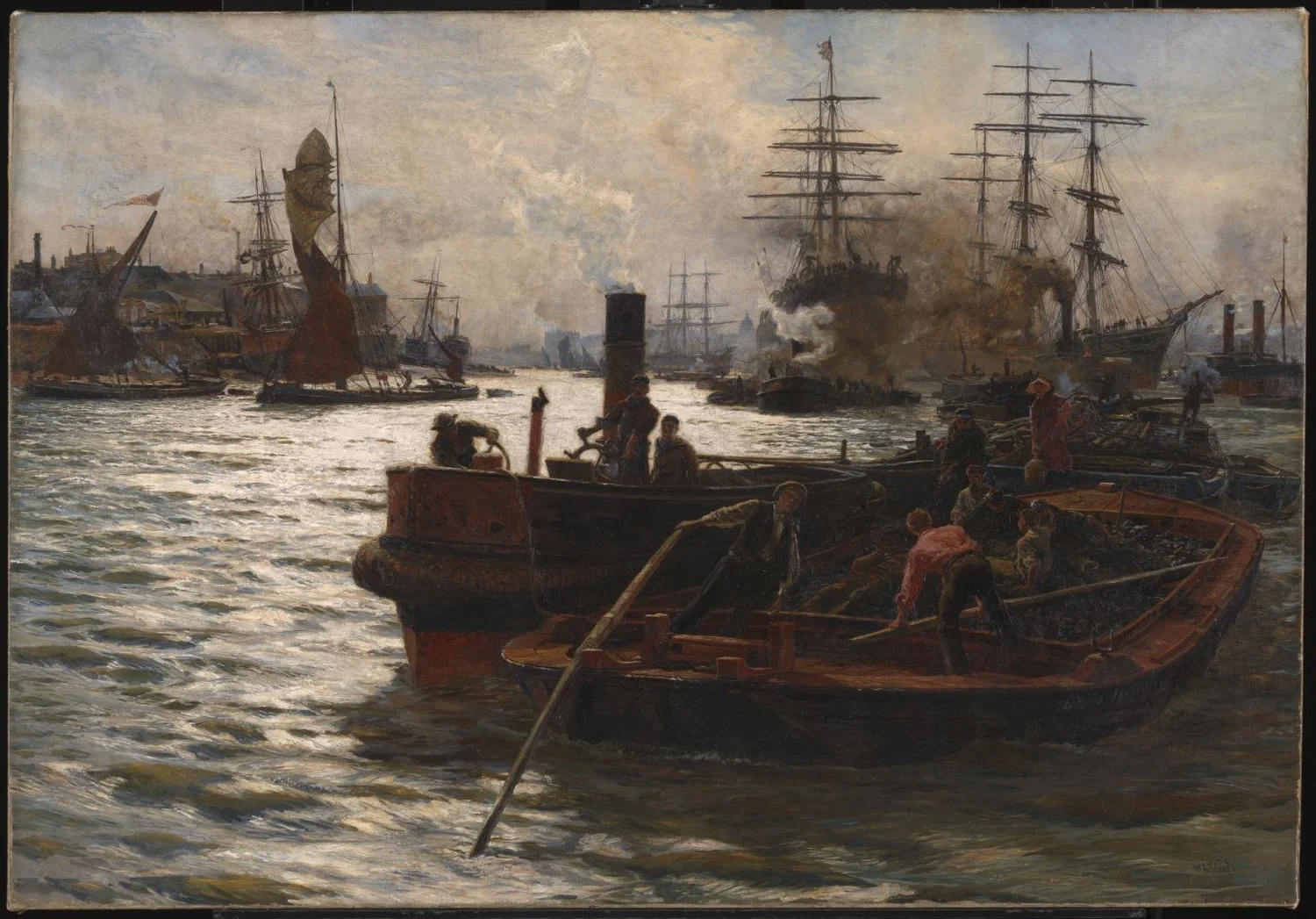
William Lionel Wyllie, Toil, Glitter, Grime and Wealth on a Flowing Tide
The poor nephew of a Scottish industrialist pursues a career in journalism.
I can discover nothing about Walter Whyte. Peter Hay Hunter (1854-1909), a minister in the church of Scotland, wrote some seven novels. This one is particularly interesting for its carefully realized setting, a badly polluted Scottish industrial town.
It is “both in point of conception and execution . . . above the average of the ordinary novel”; “the style is vigorous and unaffected” and the author “possesses a considerable fund of shrewd humour.” Athenaeum, May 17, 1884
“It is written in clear, flowing, idiomatic English; the plot, without being trite and commonplace, is consistent and probable; there are three or four very well drawn characters in it.” Academy, May 24, 1884
“It is evidently written by a man who knows the world. . . . The style is sufficiently lively to keep the reader wide awake. . . The more finished characters are carefully and consistently drawn.” Saturday Review, July 12, 1884
A contrasting view:
“While the book is amusing, the story is ill-constructed, and its materials of almost venerable antiquity.” Spectator, July 12, 1884
Have you seen “Out of the Past”—the 1947 movie directed by Jacques Tourneur, starring Robert MItchum, Jane Greer, and Kirk Douglas, adapted by Daniel Mainwaring from his 1946 novel? If not, do so right away! It’s one of the best movies ever made! I had to watch it half a dozen times to figure out its plot (and there are still some points I’m not quite clear on), but I enjoyed it every time. I’d have hired the same cast and director for this puzzle, if puzzles had casts and directors, and if they weren’t all dead.
“There are few writers who possess an equal ability with Mrs. Crowe, of throwing her characters into complications, and dextrously disentangling them.” Bentley’s Miscellany, January, 1852
It may be “enjoyed as one enjoys the feats of a conjuror who can make a card fly out of the pack into a gentleman’s pocket or a lady’s reticule, and restore it to its proper place.” Westminster Review, April, 1852
Only after I gave this puzzle its title did I remember having already made a crossword called “A Minus” (Crossword 005). Someday soon I’ll construct a puzzle and find, to my horror, that it’s exactly the same puzzle—in theme, grid, fill, and clues—as the one I constructed last year, or month, or week. And when that happens I’ll put an end to this website at last and turn to my other lifelong dream—mastering the accordion.
The novel “deserves the success which is earned by a well-thought-out and elaborate plot, a clear style, and incidental tokens of both humorous and pathetic insight.” Athenaeum, August 5, 1876
“This is a very clever novel. But . . . there are sins against credibility in these volumes, and sins against art. . . . There may be graphic sketches of scenery and character . . . but the mind of the reader becomes bewildered when there is a mass of detail of the most intricate description, which takes away his capability to follow the real purport of the story. We think that in the novel before us Mrs. Cashel Hoey has jumped from crag to crag of invention with wonderful agility, but others will find a difficulty in keeping up with her during these really marvellous feats. . . . The story is well written, and much ingenuity is displayed in its conception and evolution.” Examiner, August 26, 1876
“The plot of ‘Griffith’s Double’ is complicated beyond all necessity. The real strength of the book lies in its very pleasant and kindly tone, and in the quiet humour of the descriptions of life in the country town of Wrottesley.” Pall Mall Gazette, September 5, 1876
Many advanced young crossword constructors pride themselves on making puzzles that, as they put it, “Look like me.” I’m going them one better this week, with a puzzle that not only looks like me, but has me in it! I’m putting me first, for a change! It’s me time! It’s all about me! Me! I’ll let you solve this one; but I’m thinking about moving towards a system where I make puzzles only about me, exclusively for me.
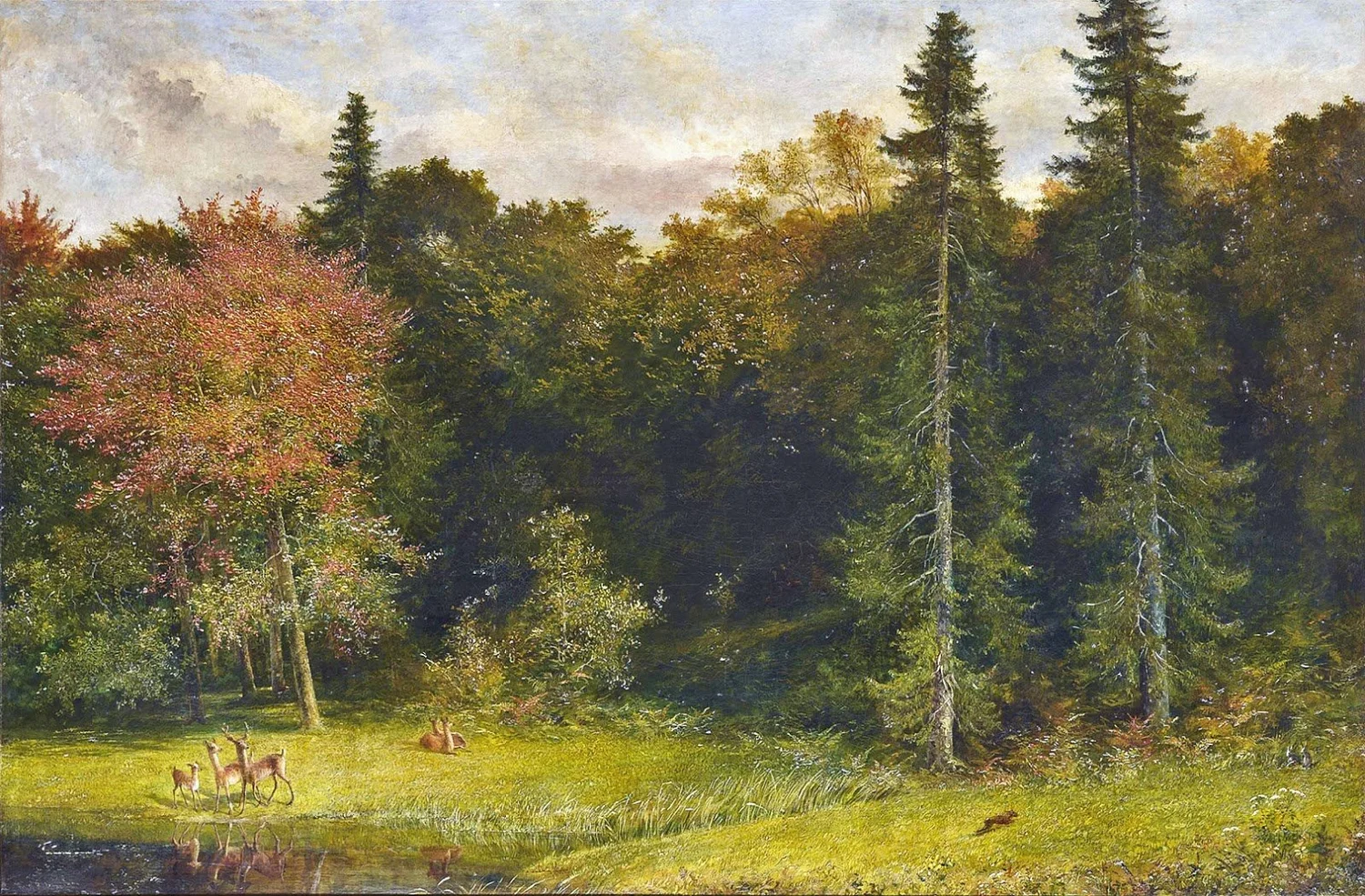
We tried to set up a wildlife refuge here at David Alfred Bywaters’s Crossword Cavalcade and Fortnightly Victorian Novel Recommender, out behind the smithy next to the organic garden. But the deer kept eating the arugula, and the lions kept eating the deer, so we had to give it up.
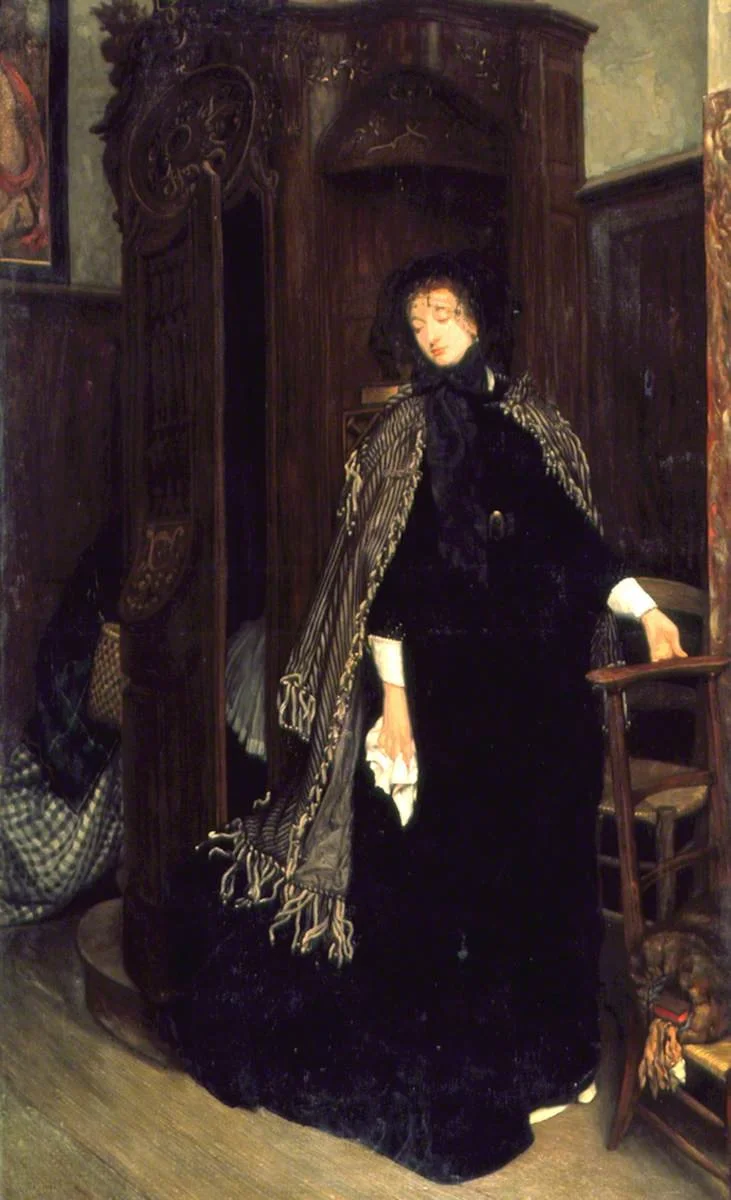
A widow falls under the spell of an Evangelical clergyman.
Here is another novel by Trollope, for whom see Novels029,079,138,189,190, and191.
“This is certainly the best novel that Mrs. Trollope has produced, as regards dramatic execution and development of character. It . . . shows how the highest and best feelings of our nature may be turned by evil guidance and misdirected enthusiasm.” Literary Gazette, September 16, 1837
“Never has the affectation of piety been more mercilessly lashed. . . . Her object—a laudable one, as every one must admit, has been to show the pernicious effects of sectarian bigotry. . . . This, Mrs. Trollope has done with unexampled vigour and ability.” Sunday Times, September 17, 1837
A contrasting view:
“To invent a succession of domestic atrocities, and then fasten them upon a particular class of religionists, proves nothing but that the author is an exceedingly illogical and absurd person. . . . In truth this work is very disagreeable. . . . Every thing in it is represented in excess . . . ; and the spirit of the whole is that of a perverse and tortuous mind, full of venom. . . . Other authors contrive to get out of themselves—to lose themselves in the fiction. . . . Mrs. Trollope never does this; she is always present to us in her books; we feel her influence in the bitter taunt, the vulgar spleen, the ill-natured reproof, the scurrilous criticism, and the giggling cant of good-breeding.” Court Magazine and Monthly Critic, October 1837
I don’t mean your tone, gentle solver! Studies have shown a strong positive correlation between appreciation for inventive, humorous wordplay, artistic gridding, fair but challenging clues, and all-around cruciverbal quality on the one hand, and a pleasing tone on the other. I’m referring to everybody else’s tone.
“The people in Sybilla Lockwood are more like . . . ‘humans’ than people in stories usually are.” Saturday Review, July 30, 1864
“The novel is a very extraordinary one. The subject is . . . adultery. . . . We cannot think ‘Sybilla Lockwood’ at all fitted for general reading. . . .Otherwise the execution, though not brilliant, is singularly faultless. The motives and the conduct of the different characters bear a rational relation to each other.” Spectator, August 13, 1864
A contrasting view:
“There is not in ‘Sybilla Lockwood’ sufficient weight of interest to carry the reader through the private affairs of the numerous characters. . . . The novel is badly constructed, being merely a bundle of personal histories, with no plot or story to bind them together.” Athenaeum, September 10, 1864
For more than five years I’ve been providing the world with a weekly Victorian novel recommendation and a weekly crossword puzzle. I thought that by now I’d be universally known and beloved. But I’m not, it seems. No one, on hearing my name at a retail outlet or on a customer-service line, has ever exclaimed, “What! No! Not the David Alfred Bywaters!” No street, however short or obscure, has been renamed in my honor. I haven’t been given a Nobel prize; I haven’t been given even a MacArthur “genius” grant, or an honorary degree.
I think that maybe I’ve been too generous, that I’ve made the world ungrateful by kinder treatment than it merits. So I’ve decided, with the new year, to post weekly not both a new crossword and a new Victorian novel recommendation, but either a new crossword or a new Victorian novel recommendation. Next Saturday, then, you’ll find on this site a novel recommendation, and the Saturday after that a new crossword, and so on and on, until my vanity is gratified, or until I grow tired of the whole business altogether.
It “possesses one of the first requisites for a novel in being interesting. It is not too long. The scene is laid in Italy, and the book contains just enough of history and politics to give the story a spice above that of the ordinary society novel; and though there is little plot, there is enough to elicit some very clever character-drawing.” Critic, June 2, 1883
“There is a good deal of originality in the mixture of characters, and the author shows that she must have a considerable knowledge of the ways and thoughts of the Italians of to-day. The story . . . is told effectively and with nice feeling in the author’s pleasant and graceful style.” Athenaeum, July 7, 1883
With the new year, this website will become David Alfred Bywaters’s Crossword Cavalcade and Fortnightly Victorian Novel Recommender. Beginning January 7, 2023, new novel recommendations will appear on alternate Saturdays. You get half as much, for the same no price!
Hey, lads and lasses, the old year passes! Deck those halls! See that blazing yule! Don that gay apparel! Troll that ancient carol! Maybe you struggle to remember that ancient carol? Well, I used to have that problem too. “Boughs of holly . . . what? what comes after ‘holly’? what’s the next line?,” I’d find myself wondering, again and again, while the merry measure went on without me. Then I hit on a mnemonic that has never failed me since. I enshrine it in this week’s crossword, as my gift to you.
“One of the best novels of the year. . . . Nothing can be happier than the development of three characters in the second volume.” Athenaeum, April 19, 1873
“We hesitate not to say that May Heriot is one of the very finest characters in the wide range of English fiction. And yet there is nothing unnatural about her—you feel that there have been, and are, just such good Scotch gentlewomen as May Heriot.” British Quarterly Review, July 1873
A (somewhat) contrasting view:
“If only she could have reduced the number of death-beds and mourning scenes with which it abounds, it would have been a very good novel indeed.” Examiner, May 5, 1873
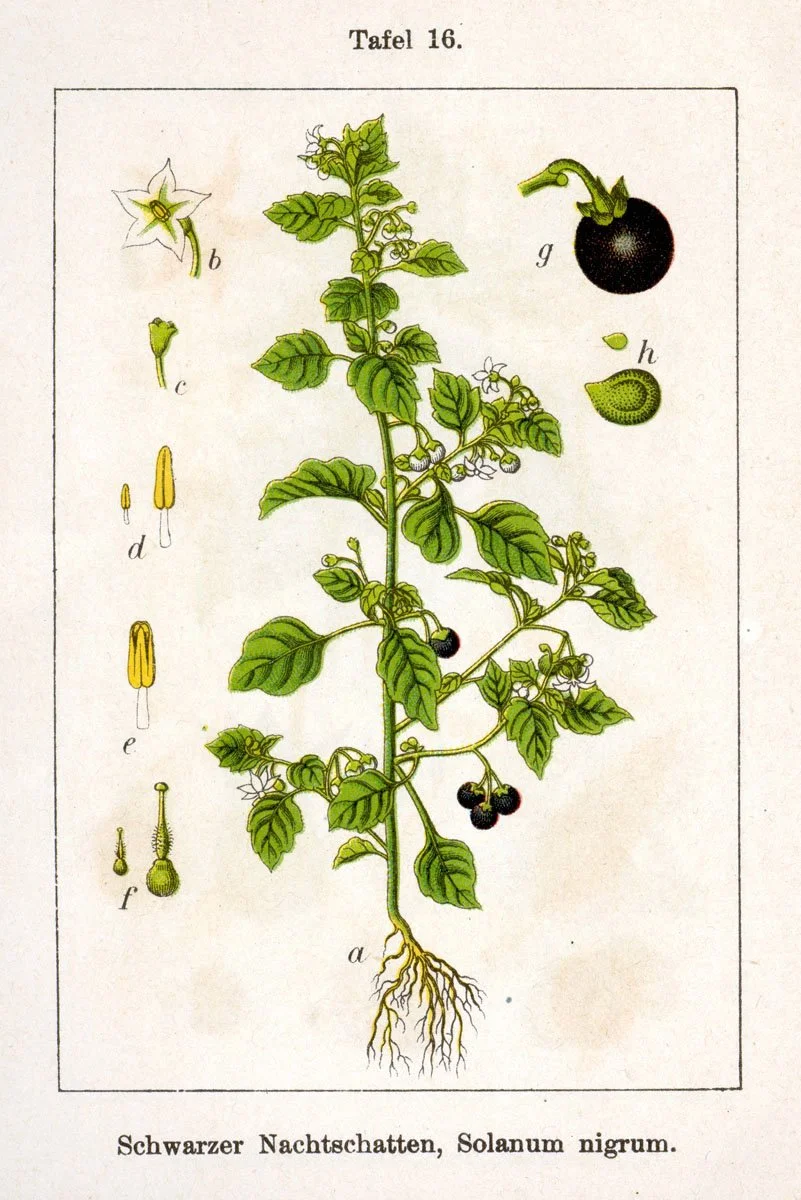
The petty morel, or black nightshade, is depicted above, in a page from Jacob Sturm’s Deutschlands Flora in Abbildungen. This puzzle follows “Heart’s Ease,” illustrated in Carl Axel Magnus Lindman’s Bilder ur Nordens Flora (seeCrossword 253), as the second in our ongoing series of crossword versions of color plates from northern European botanical guides of the 18th, 19th, and 20th centuries. Stick around; you won’t want to miss the rest!