A well-meaning man is led into disaster by unfortunate sexual impulses.
Another tale of love and adultery, of good people at the mercy of bad ones, by the great Noell Radecliffe (seeNovel 005), a writer as brilliant as she (he?) is forgotten.
“The character of the heroine . . . is conceived with singular delicacy, and sustained with admirable consistency and spirit. Other personages are introduced whom we recognise as portraitures of real life. There is Horace Ferrers, whom we all know. Arthur Darrell . . . is a man and not a conventional hero. Lady Emily . . . is a picture drawn by a masterly hand, and made effective not by bold strokes and dashing outlines, but by a quiet completeness that gradually brings out the portrait distinct and perfect as a living thing.” Critic, January 2, 1854
“Kind, good, simple, unforced, full of energy, full of feeling.” Athenaeum, January 14, 1854
Last year’s “Cavalcade of Crosswordese” was so enormously popular that I have decided to make a sequel.
But don’t suppose I’m just blindly feeding the appetite of the masses. As I’ve said before, my purpose in making puzzles is to influence the public to share my refined tastes and correct opinions by alluding to them in my grid entries. So I’ve got my favorite Norwegian city in here, and my favorite sandwich cookie (except for the Hydrox), and my favorite boxer, and my favorite bygone autocrat (doggone those Bolsheviks!). Alas, I couldn’t find a place for my favorite detective-movie dog this time, or my favorite Shakespearean quotation, or any of my favorite musicians; but no matter, I think my past work has already done enough to raise the profiles of Asta, “Et tu,” Ono, Eno, and the ELO. They’re catching on!
“How can I help in this worthy endeavor?” you ask. It’s easy. Donate $12 (and get a 15x15 bonus crossword made entirely of words and phrases current in the Victorian era), or $13.50 (and get a 21 x 21 bonus crossword made of the usual stuff) or $15 (and get both). Just click this button:
A good man is disinherited in favor of his not-so-good younger brother.
I complete this website’s second year with another novel (see Novels002and054) by the great W.E. Norris. Great literature and “classic” literature are categories that overlap only a little. If you doubt me, try comparing, with an open mind (if you have one available), any novel by the forgotten Norris with any novel by the revered Henry James.
“There is all the cleverness of characters-drawing which he long ago accustomed us to expect from him.” “There is no falling off in the supply of shrewd apothegms, or of passages in which, under the guise of quaint humour, food is afforded for serious reflection; and, added to all this, the story is a pleasant one. . . . In fine, we consider Major and Minor to be distinctly one of the leading novels of the year.” Academy, October 1, 1887
Norris’s “humour, which is never forced, has a refreshing sub-acid flavour, his descriptive powers are much greater than his anxiety to show them off, and his analysis of character and motive is sometimes not less convincing than exhaustive”; the author’s “unwillingness to excite is amply compensated for by the unflagging power to interest and amuse.” Observer, October 9, 1887
This week, as my website concludes its second year, I’m offering bonus puzzles to crossword solvers who wish to donate. I have no bonus recommendations for you novel readers, but if you’d like to show your gratitude anyway, click on the button below.
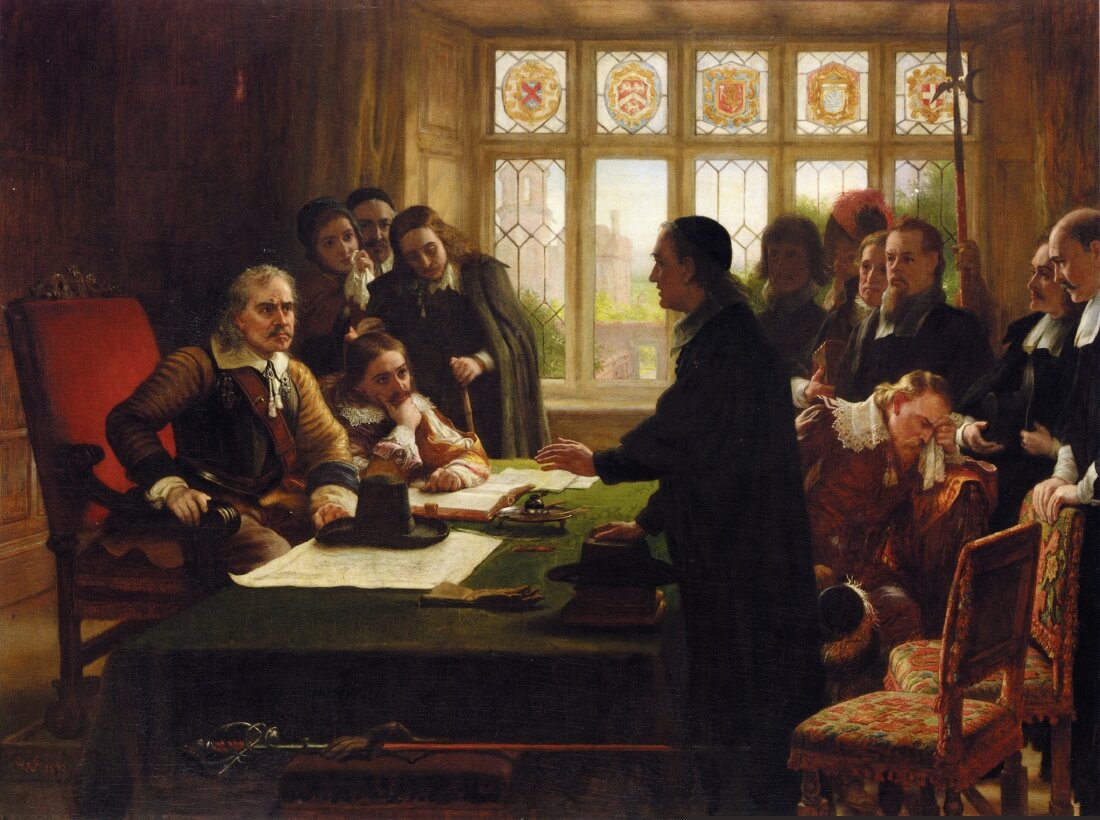
Charles West Cope, Oliver Cromwell and His Secretary John Milton, Receiving a Deputation Seeking Aid for the Swiss Protestants
The inspiration for this as for many of my puzzles is a classic work of literature:
Who would not sing for Lycidas? he knew
Himself to sing, and build the lofty rhyme.
He must not float upon his wat’ry bier
Unwept, and welter to the parching wind,
Without the meed of some melodious tear.
—John Milton, Lycidas (1637)
“Wat’ry bier”? Can you read that without thinking of a hilarious pun? I can’t. I’m sure that Milton is pleased and flattered, assuming he is in a place with web access.
I’ve now given you one hundred 15 x 15 crossword puzzles. I will conclude the second year of my website’s existence, as I did the first, with two 21 x 21 puzzles. Why do I do this? Why do I toil so long and so hard to make crosswords and recommend Victorian novels? Only because I love humanity.
But I wouldn’t mind making a little money too. And maybe you wouldn’t mind giving me a little, as a small gesture of gratitude? If not, just click the button below and follow instructions. Donate $12, and I’ll send you a 15 x 15 Victorian crossword puzzle (that is, a puzzle that uses only words and phrases current in the Victorian era)! Donate $13.50, and I’ll send you an all new 21 x 21 puzzle! Donate $15 and I’ll send you both!
And since no one claimed it last year, I am this year offering again a special bonus for the first person who donates $10,000,000 or more: not only will I send you both puzzles, but also I’ll rename this website in your honor! So if your name is, say, Warren Buffet, after your donation the website will be known as "Warren Buffet Presents David Alfred Bywaters’s Crossword Cavalcade and Victorian Novel Recommender." But don’t delay—only the first donor at the $10,000,000 level will be eligible for this bonus.
(By the way, the Squarespace system requires you to enter your name and address on its form. My privacy policy is to take no notice and make no use whatsoever of this information. But If you’d rather made a donation directly to davidalfredbywaters@gmail.com through PayPal or Venmo, please do so.)
This is the sequel to The Daisy Chain, of eight years before (Novel 053). Here Yonge moves beyond the domestic, including not only a murder but also an American episode, in which a few of her characters seek prosperity in an Indiana swamp while the Civil War rages in the distance.
“With the old Pre-Raffaelite touch Miss Yonge paints her portraits, quietly, faithfully, and as completely as she can.” Reader, June 18, 1864
Yonge “understands how to work the machinery of a large family—to show how the different members act and react on each other—in a probable and calculable manner.” Saturday Review, August 20, 1864
“In these days of exciting fiction, it is difficult to sustain public interest without doing violence to the more refined tastes of educated readers. Much insight into human nature is needed, and no small amount of artistic power. These desiderata are well supplied by the authoress of this story, and those who remember and admired her elegant style of writing will not be disappointed in her new book.” Manchester Guardian, September 6, 1864
“No one can deny that this lady draws the inner and outer life of a certain limited class of characters with a truth and reality almost unrivalled, or that her pictures of struggling middle-class interiors are finished with the fidelity of a Dutch painting.” Westminster Review, October, 1864
This puzzle’s title phrase, as the solver will probably know, comes from an old orange juice commercial. It has since been humorously appropriated to beer. “Beer: It’s Not Just for Breakfast Anymore.” Ha ha. And that’s not all. An internet search turns up several hundred other things you can insert into this ready-make little joke: pizza, bourbon, coke, chocolate, roadkill, napalm, breakfast, prozac, social media, etc., etc. It’s the hive mind at work, and I’m not too proud to make my own little contribution.
Disappointed in love, an heiress becomes a governess to prove herself.
Emma Newman (1831-1903) wrote some 13 novels between 1874 and 1897. Here she provides many excellent scenes of social comedy, which more than counterbalance her plot’s implausible premise and a final pile-up of Victorian clichés.
“Mrs. Newman has built an exceedingly bright and clever story on the insecure foundation of obvious improbablility” but she manages it “with ingenuity, grace, and humour.” Saturday Review, December 26, 1891
“It is very odd that people in novels, who are otherwise more brilliant than people out of novels, always stop short at critical moments of saying or guessing or doing the right thing. But if they acted with common sense there would be scarcely any novels written, and we should then have a dull world. . . . It only remains to say that there is not a dull page from end to end of the three volumes.” Academy, January 9, 1892
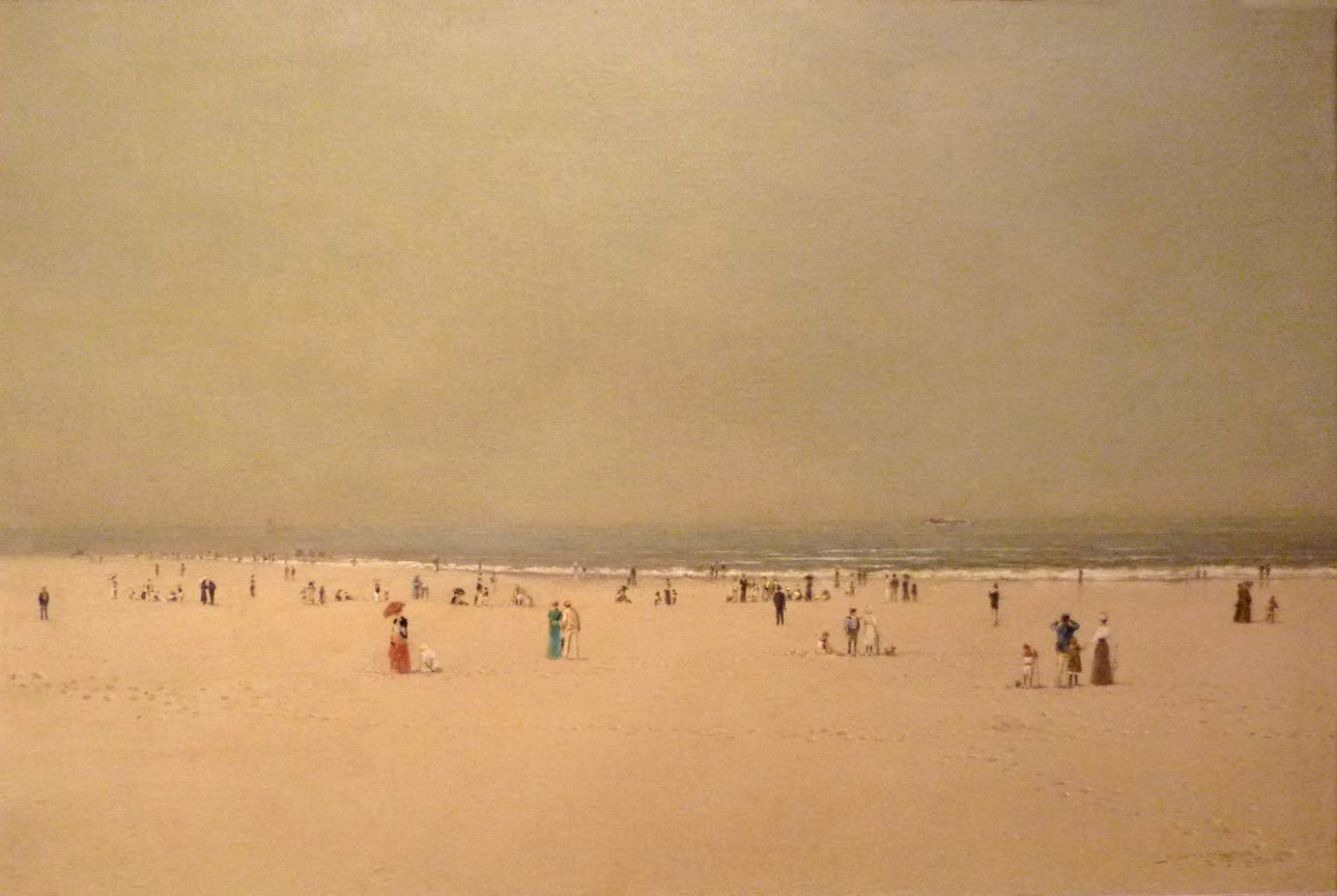
I know what you’re saying: “But your crosswords aren't weakly, David Alfred Bywaters; don't be so hard on yourself!” And of course you’re right. They’re weakly (unclogged as they are by professional sports, super-heroes, Star Wars trivia, and the latest fratboy slang) only as some agile, clever, neatly dressed fellow sipping a cool drink at the oceanside bar is weakly in comparison to the shirtless, musclebound lout gaping emptily on the beach below.
In a country village, two cousins both love the miller’s daughter.
Albert Julius Mott (?-1870) wrote three novels between 1856 and 1862 under the pseudonym A.J. Barrowcliffe. This, the last, has an intricate plot which runs its course over five days in a small village.
“The author . . . is able to breathe life into the creatures of his imagination, so that they perform his bidding naturally, and do not require the visible presence of his guiding hand. He has a thorough sympathy with nature. . . . And he has a keen insight into the complex machinery of the human mind. . . . Moreover, he possesses no small share of humour.” London Review, December 20, 1862
The author succeeds in “the production of a minutely finished and faithful picture of English country life. . . . Mr. Barrowcliffe’s story is quite sufficiently interesting, and is developed with considerable skill; but certainly the most noticeable point in his book is the extreme polish and smoothness of his style.” Spectator, December 27, 1862
“An honest purpose, a graceful style, and a certain novelty in construction, make this a very good story.” Examiner, April 4, 1863.
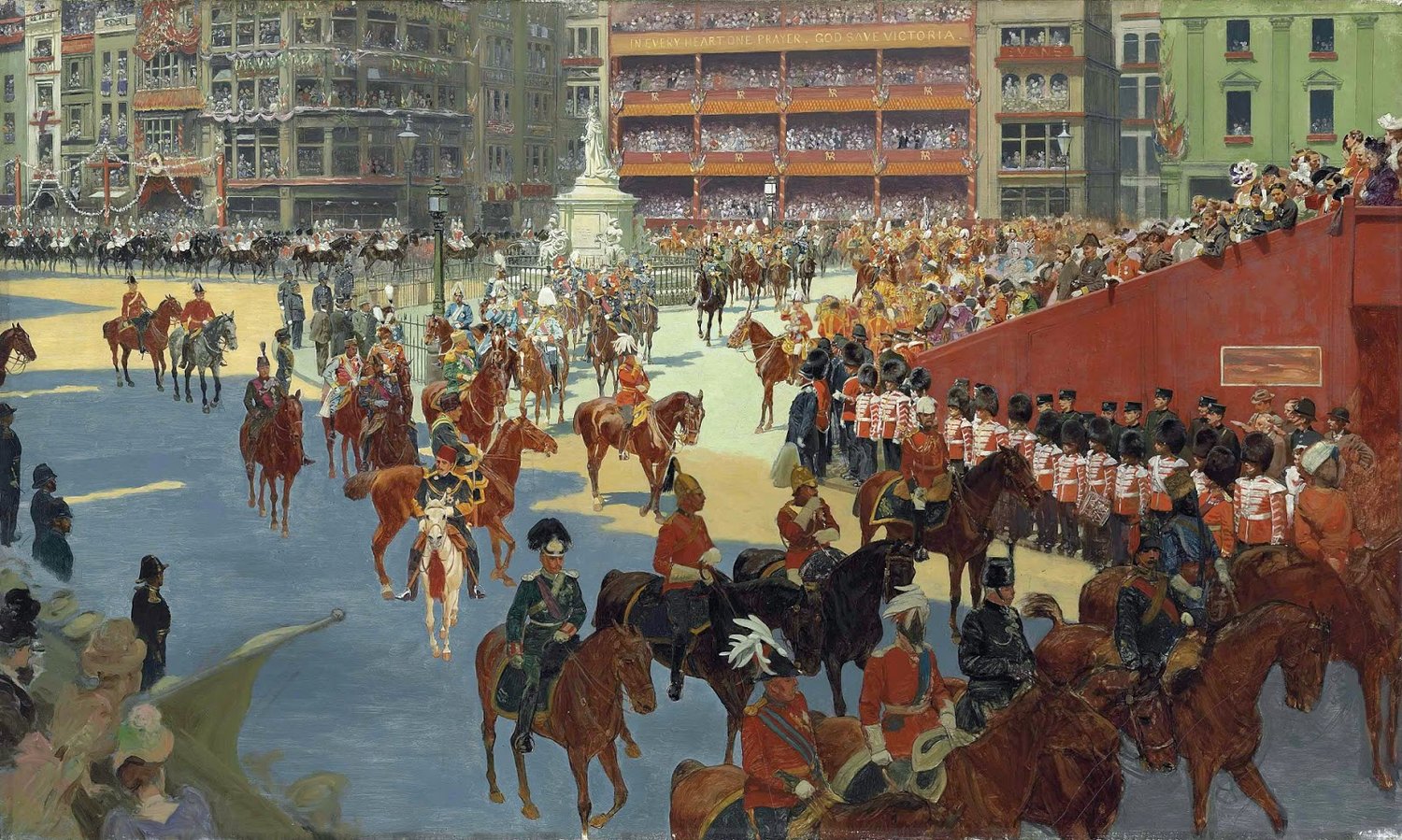
John Charlton - 'God save the Queen' - Queen Victoria arriving at St Paul's Cathedral on the Occasion of the Diamond Jubilee Thanksgiving Service, 22 June 1897
If you’ve solved my first 99 posted crosswords, you might make a shrewd guess as to the theme of my 100th. As some ancient sage said, or ought to have said, “Contempt for the obvious is as crippling as the inability to see beyond it.”
Here, to follow last week’s Mary Molesworth, is the Victorian period’s other Mary Molesworth, Mary Louisa Molesworth (1838-1921), a prolific author mainly of children’s books, though she also wrote novels for adults, like this one—a quiet story based on plausible, entertaining misunderstandings of character and purpose.
“It is a very enjoyable book. The characters of the young men and girls who are the principal persons in the little narrative drama are, in the main, admirably delineated; . . . and the conversation, which is an important element in a tale of this kind, is specially excellent.” Academy, October 15, 1892
“The characters are well drawn, the incidents probable and well led up to, and the story interesting. But the strong point of the work, after all, lies in the character drawing, especially in the subtle delineation of shades of diversity in disposition, amongst a family where all the members are chiefly remarkable for their amiability and worth.” Westminster Review, July 1893
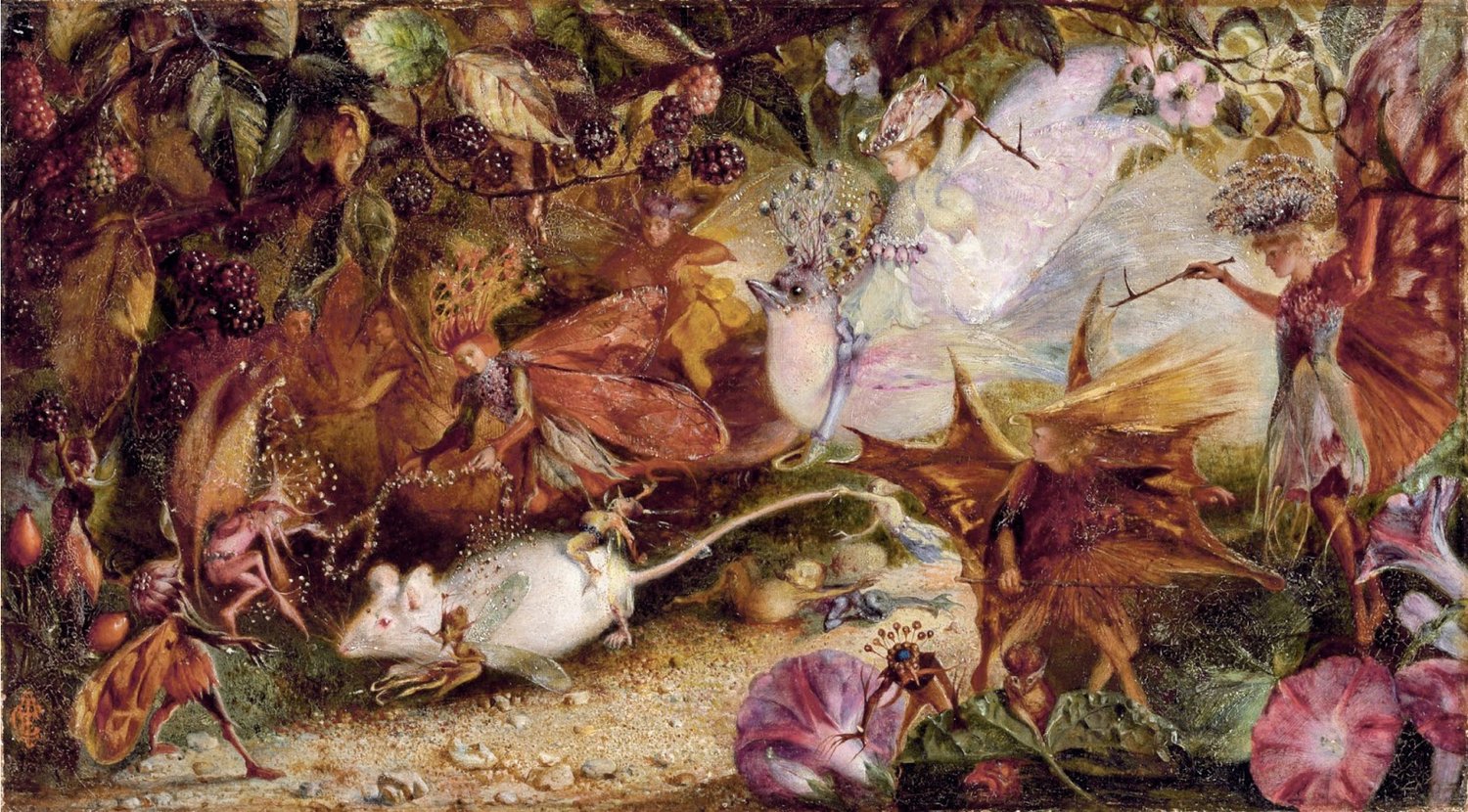
John Anster Fitzgerald, The Chase of the White Mouse
As I’ve pointed out already on this website, there’s no fun in embedding a word in a common phrase (like WORD in FOLLOW ORDERS) when you can embed it in an amusingly uncommon phrase invented for the purpose (like WORD in COW ORDINATION). I’ve done it before (006,042,047,049,055, and074); today I do it again.
A fascinating and fashionable young man in need of an income woos an older widow, while his florally named sisters meet various marital fates.
Mary Molesworth (1823-1863) wrote three novels during her relatively short life, of which this was the last. It’s enjoyable (despite a tiresome lovers’-misunderstanding plot) for its well defined characters and cleverly developed incidents.
“‘The Great Experiment’ is a carefully-written, clever novel—amusing withal” though “in the third volume the story stagnates into moralizing. . . . The characters are carefully drawn, and well-worked out” and “there is a good deal of shrewd observation manifested, and much good sense.” Athenaeum, April 21, 1860
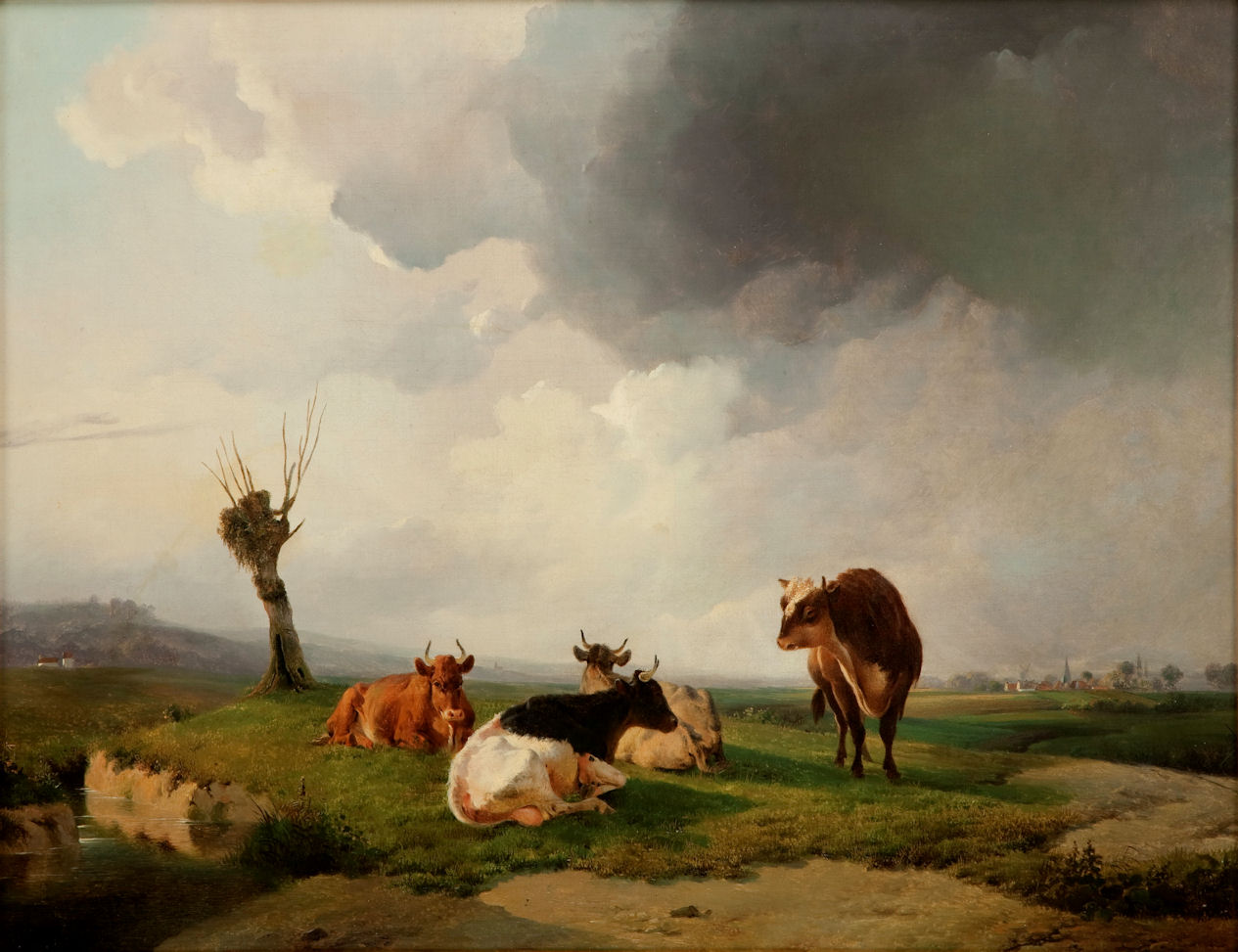
Thomas Sidney Cooper, Cattle in Canterbury Meadows
The main purpose of my work, like that of many crossword constructors these days, is to effect political change. I find that, if I mention a thing in one of my puzzles, people start thinking about that thing in the way I want them to think about it, and change ensues. Way back in April 2018, for example, I included POT in a puzzle (No.023, 65 Down), and since that time, marijuana legalization efforts have continued to gain ground nationally. This week, I call attention to the role of animal agriculture in global warming.
A disobedient daughter’s disinheritance leads to the enrichment of a socially ambitious woman.
In addition to historical works on such subjects as needlework, Elizabeth Stone (1803-1881) wrote five novels. Here, the bad characters are excellent, especially the “very nice woman,” and the plot is amusing if you don’t mind a final pile of coincidence impressive even by contemporary standards.
“The apeing of fashion by vulgar people, the wretchedness it occasions to themselves, and the laughter it provokes in others, have ever been a favourite . . . theme with novelists . . .; but seldom have we seen it accomplished with more humour and truth than in the novel before us. . . . Always vigorous, the writing is at times positively brilliant. The descriptions are remarkably graphic, yet drawn without effort. . . . The personages . . . are all . . . distinctly outlined, and most of them are manifestly sketches after nature. Mrs. Stone has a keen observation, and a quick sense of the ludicrous.” Critic, August 1, 1850
“Although ‘Mr. Dalton’s Legatee’ properly belongs to a class of books for which we have no particular affection—the fashionable novels—yet it is one of the best of its kind. The plot is intricate and interesting, and the characters amusing and well sustained.” American Whig Review, October, 1850
Okay, so it’s the same joke four times. So what? It’s a good joke. And the fourth iteration (64 Across) is not just a joke, it’s also a wry comment on the human condition.
A drawing teacher has married one of his students, angering her proud Scottish family.
This is the sole novel of Alexander Smith (1829-1867), who was better known as a poet and essayist than as a novelist. There isn’t much plot, just a collection of comic and pathetic incidents, but the style and characterization are excellent.
“There is little appearance of skill in constructing either story or actors, but there is perhaps the more art in such lack of appearance, and the more success from the absence of all straining after it.” Athenaeum, January 27, 1866
“Two or three characters are skilfully developed; there is not too much strained metaphor, and there is everywhere the thought and language of a man of much refinement and some genius, who aims high, and is studying to make the best use of his power.” Examiner, February 17, 1866
“The story of ‘Alfred Hagart’s Household’ is so simple that it would be dull if not for the skill with which it is told. It offers a picture of quiet family life in which no glaring colour is used, no violent contrasts of light and shade are introduced. There is no striking feature in it which can catch the eye at once; yet it possesses a charm which imparts a tranquil satisfaction to those who read it aright, and aftewards lingers pleasantly on their memory.” London Review, May 5, 1866
Speaking of pork, here is one of my favorite passages from the great Jonathan Swift, explaining the popularity of satire—and by the way, much of the social media of our own time:
“There is a problem in an ancient author, why dedications, and other bundles of flattery, run all upon stale musty topics, without the smallest tincture of any thing new; . . . whereas there is very little satire, which has not something in it untouched before. The defects of the former, are usually imputed to the want of invention among those, who are dealers in that kind; but, I think, with a great deal of injustice; the solution being easy and natural; for, the materials of panegyric, being very few in number, have been long since exhausted. For, as health is but one thing, and has been always the same, whereas diseases are by thousands, beside new and daily additions; so, all the virtues that have been ever in mankind, are to be counted upon a few fingers; but their follies and vices are innumerable, and time adds hourly to the heap. Now the utmost a poor poet can do, is to get by heart a list of the cardinal virtues, and deal them with his utmost liberality to his hero, or his patron: he may ring the changes as far as it will go, and vary his phrase till he has talked round: but the reader quickly finds it is all pork, with a little variety of sauce.”
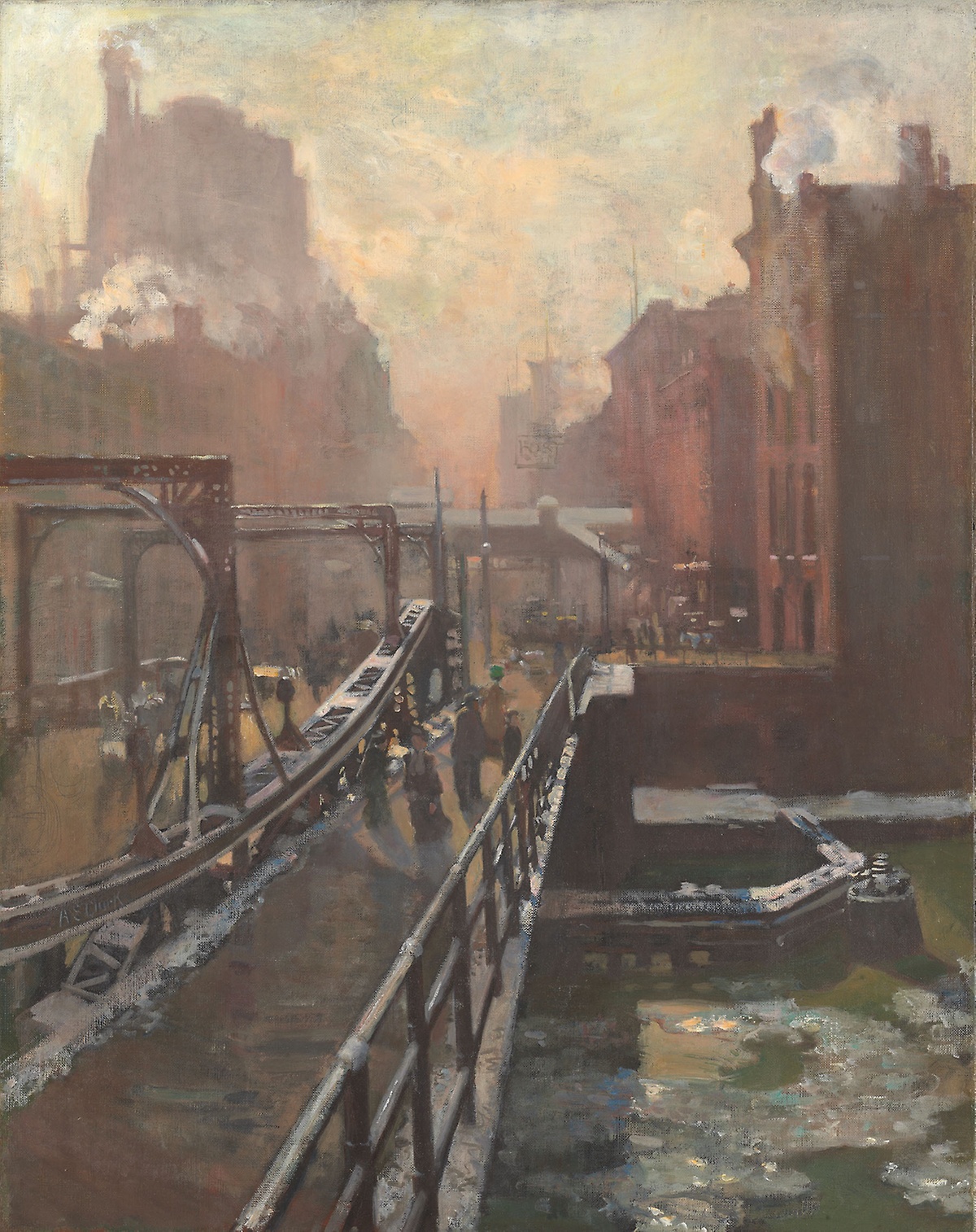
Having abandoned her adulterous husband, a young woman makes a life for herself in Chicago.
Will Payne (1865-1954) wrote nine novels between 1896 and 1929. The description in the first half of the novel of a woman’s working life in turn-of-the-century Chicago is especially interesting.
“It has been said that Chicago is fatal to any imaginative gifts, and that no novel of that city has ever risen above mediocrity. An exception must be made in favor of a new novel of strong realism which pictures several phases of Chicago life with remarkable vividness and yet contains much of the spiritual quality that relieves its materialism. . . . The story as a whole is admirably constructed and true to life. . . . In all the passages that bear on the working girls of Chicago the author shows singular closeness of observation, mingled with much sympathy.” San Francisco Chronicle, June 30, 1901
“The book is readable, and interesting to any one who wishes to hear about the way of life of the middle classes of Chicago.” Spectator, August 10, 1901
“Mr. Payne’s writing is not of the kind which arrests or startles. Rather it compels attention to detail, to a word here, a phrase there; but the portrait which is left at the end is whole and in proportion, while the background is filled in with due regard to the high lights which the painter wishes to emphasise.” Saturday Review, September 14, 1901