David Alfred Bywaters's Crossword Cavalcade & Fortnightly Victorian Novel Recommender. Every Saturday! Either a new language-torturing puzzle or an old novel by an unjustly neglected Victorian author. Why waste time on other amusements?

Novel 035: Mrs. E.J. Burbury, Florence Sackville; or, Self-Dependence
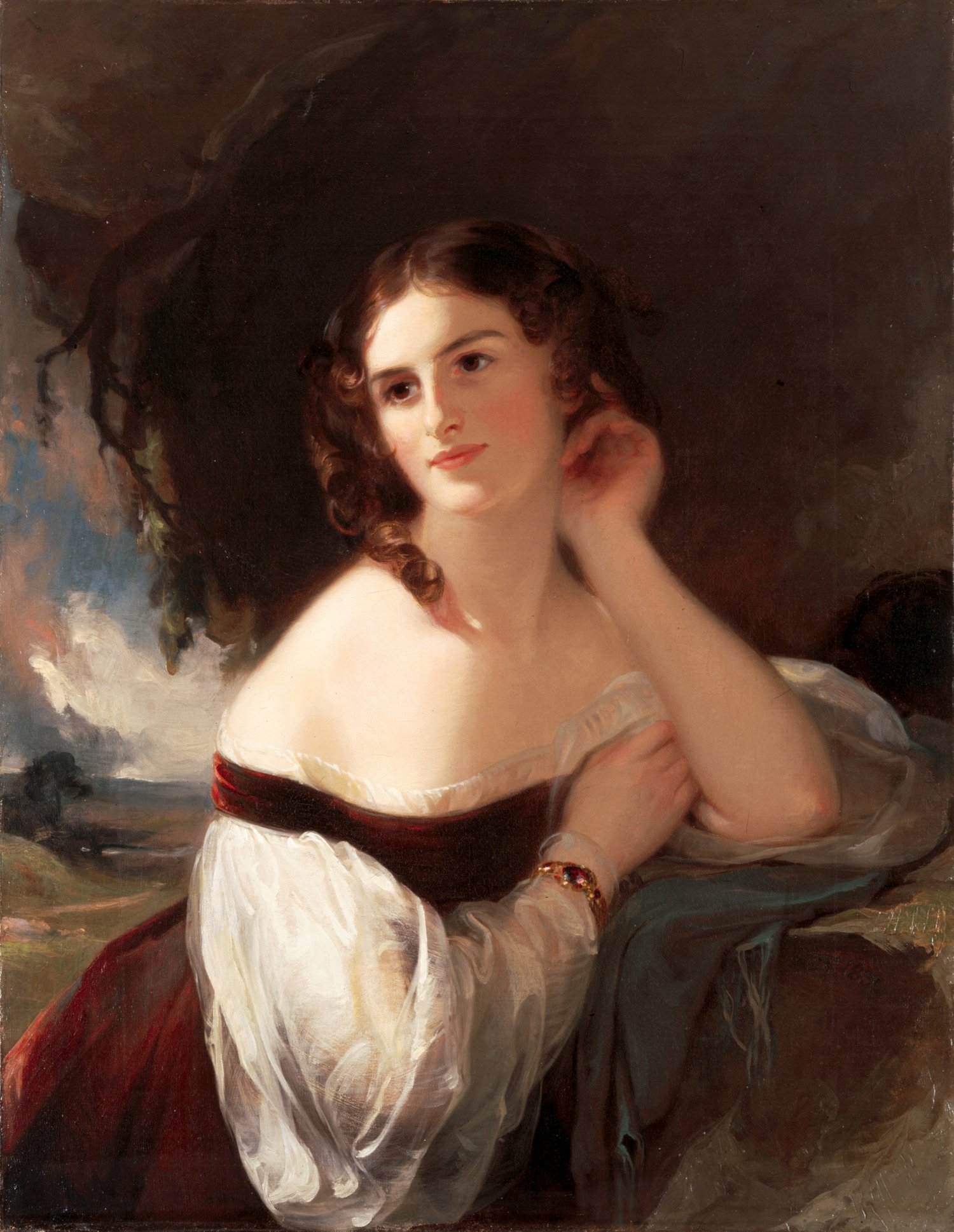
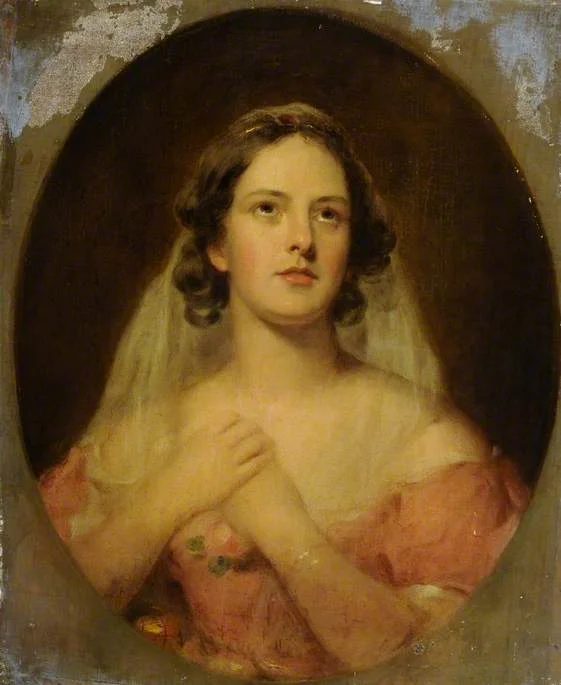
Thomas Sully, Fanny Kemble

Financial vicissitudes drive a virtuous young lady to  support herself and her family by acting in a provincial theater.


Nothing is known of Mrs. E.J. Burbury, author of only this single novel.  She appears to have tried to fit into it every noteworthy experience she ever had, whether working in theater (the miserable conditions of which, especially for women, are vividly portrayed), or driving through Oxford by moonlight.  It makes for fascinating reading, despite some mawkishness.

The author has a “clear appreciation of humour and of pathos—a firm hand in noting down the boundary lines and salient features of character, and a constancy . . . to the . . . purpose of her story.”  Athenaeum, November 11, 1851

"It is refreshing to take up a romance and to find it is not altogether an unmitigated profitless ‘love story’. . . .  Mrs. Burbury’s style is vigorous and effective, and the scenes she depicts, the characters she delineates, and the conversations she supposes, bear the stamp of a truthfulness, a penetration, and a depth of feeling, which would do honour to one who had been longer before the public.  That part of the story which relates to the theatrical career Florence is with repugnance compelled to adopt . . . is handled in a fearless and masterly style.”  New Quarterly Review, January, 1852

Download this week’s novel here:

http://solo.bodleian.ox.ac.uk/OXVU1:LSCOP_OX:oxfaleph014284777

Crossword 034: It's Magic! No. 6

Richard Doyle, Under the Dock Leaves

We’ve come to my 6th and final magic-spell-based puzzle.  I made a 7th, featuring “Mythballs” (legendary dances) and “Doctor Why” (pointless British sci-fi series)—but I’ve decided to spare you the pain and myself the embarrassment.  An 8th, with the revealer “ibex,” never got past the early planning stages.


Download this week’s crossword:

034-It’s-Magic!-No. 6.puz

034-It’s-Magic!-No. 6.pdf

Solve this week’s crossword online:

034 It’s Magic! No. 6

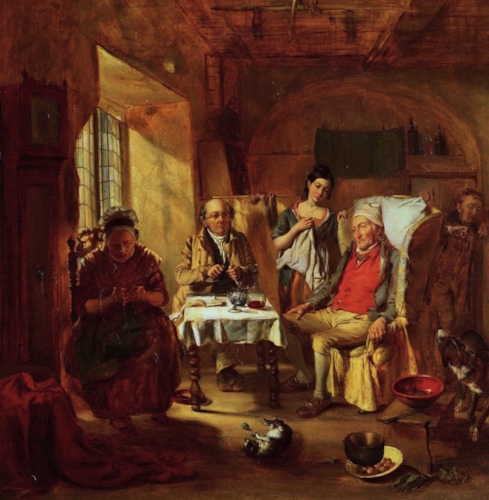
Novel 034: Anthony Trollope, Cousin Henry (1879)

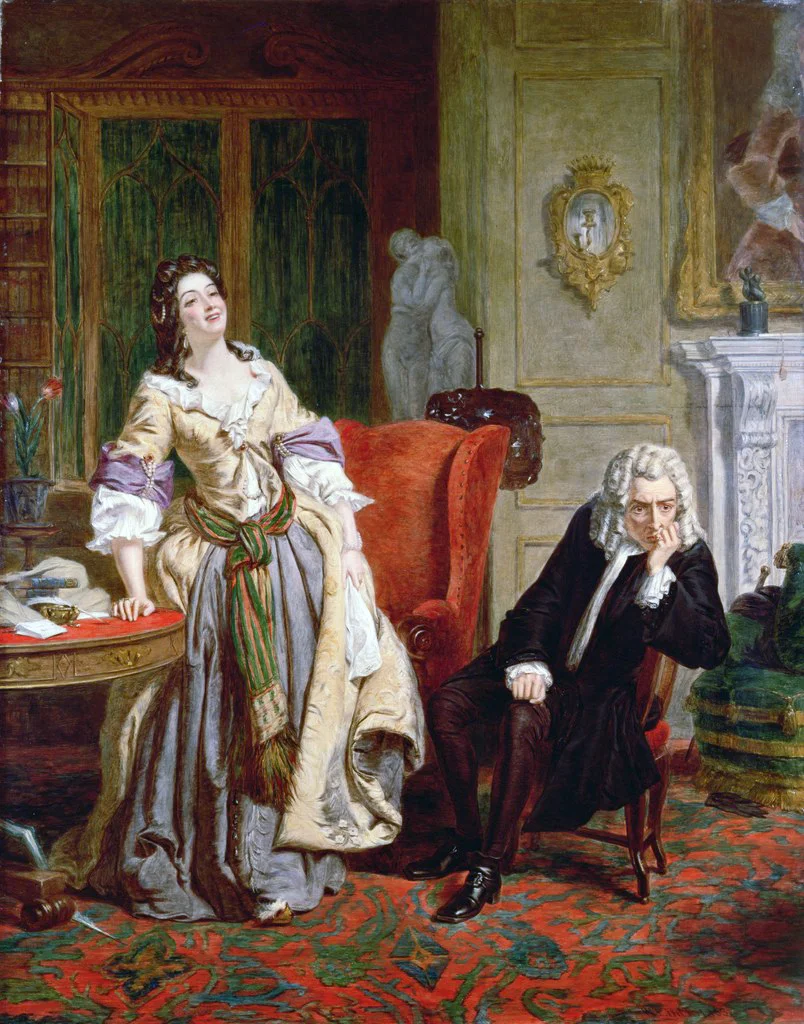
William Powell Frith, The Family Lawyer

A weak-spirited young man is led into trouble by his uncle’s multiple wills.


Anthony Trollope (1815-1882) is too well known to require introduction here; in fact he ought not to be here at all, except on the theory that, though not forgotten, he is nonetheless not often given his due, as the greatest of all novelists.  Anyway I have included him so as to complete my set of literary Trollopes.Cousin Henry exhibits in brief what makes Anthony Trollope the greatest of all novelists: his full and accurate representation of human nature.  He shows here the complicated workings of a commonplace mind bent on justifying an act of selfish injustice.

“The analysis of character is so exhaustive, and makes us so familiar with all his ins and outs, that we get to feel as if we were in some way to blame for him, or as if we ourselves might possibly have been Cousin Henry in (we hope) some very remote state of being.” Spectator, October 18, 1879

“The minute dissection of commonplace characters has long been the special feature of Mr. Trollope’s writings.  The present story excels both in minuteness and commonplace.”  Athenaeum, October 18, 1879

“His insight into the making and constitution of a poor creature is comprehensive and masterly.”  Saturday Review, October 25, 1879

Download this week’s novel here:

v.1 https://archive.org/details/cousinhenrynovel01trolrich

v.2 https://archive.org/details/cousinhenrynovel02trolrich

Crossword 033: It's Magic! No. 5

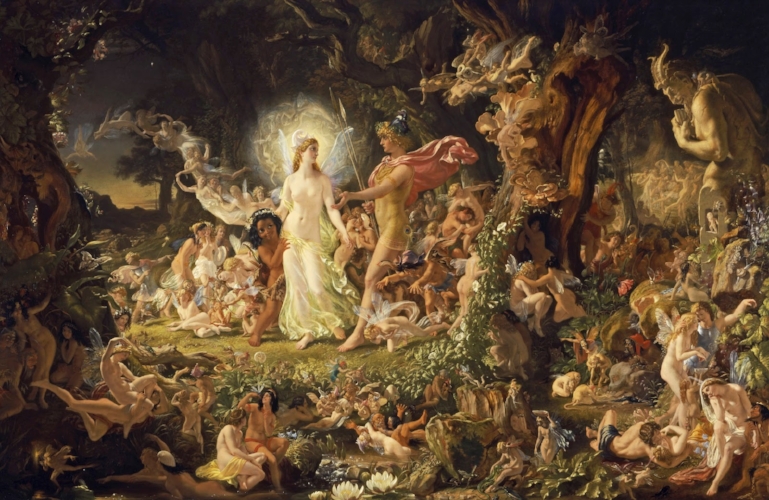
Sir Joseph Noel Paton, The Quarrel of Oberon and Titania

The more I think about the national anthem, the more annoyed I grow.  Take just the half-line “Whose broad stripes.”  Try to say it ten times rapidly.  Can’t do it?  Neither can I.  It’s hideously cacophonous: "dstr" is not a songlike sound cluster.  And the words are not even true.  The stripes on the U.S. flag are actually less broad than the stripes on most flags, just because there are more of them:  13; whereas, for example, on the French tricolor there are 3—which, since they’re vertically oriented, are very broad indeed.  The ratio of height to width for the average flag is 3 to 5.  So say your flag is 5 feet, or 60 inches, wide.  If you’re French, your stripes are fully 20 inches “broad” (60/3).  If you’re American, your stripes are not even 3 inches “broad” (36/13).  The Union Jack, the enemy’s flag for Francis Scott Key, had broader stripes than that.  If flag stripe-breadth is the measure of national merit, the U.S. falls sadly short.  But like all bad poets, Key is not even thinking of what he means.


Download this week’s crossword:

033-It’s-Magic!-No.5.puz

033-It’s-Magic!-No.5.pdf

Solve this week’s crossword online:

033 It’s Magic! No. 5

Novel 033: Frances Eleanor Trollope, A Charming Fellow (1875)

George Dunlop Leslie, Riverside, Wallingford, Berkshire

A handsome and popular young man, raised in genteel poverty by a doting mother, hopes to better his condition.


Frances Eleanor Trollope (1835-1913) was T.A. Trollope’s second wife, and therefore sister-in-law to Anthony Trollope and daughter-in-law to Frances Milton Trollope; she was also the sister of Ellen Ternan, Charles Dickens’s special friend.  She wrote a dozen or so novels between 1866 and 1892; here she delineates, with playful irony, a complex social environment made up of people who misunderstand themselves and each other.

“Mrs. Trollope has the family knack of investing commonplace life with dramatic interest”; “in the details of the drama, often both humorous and pathetic . . . the reader will find . . . evidence of considerable observation, expressed with unusual force.”  Athenaeum, January 1, 1876

“Of the minor characters, who are many, the assertion may be sweepingly made that they are all good.  Mrs. Trollope shows a really remarkable power of drawing character.” Academy, January 1, 1876

“There is a great deal of very nice and delicate work in this novel”; the title character is “extremely well done.”  Saturday Review, January 8, 1876

“Very much above the ordinary run of novels” with “three sketches of character that must be pronounced masterly.” The title character “is natural and consistent, a perfect specimen of the compatibility of winning manners and faultless temper with thorough badness of heart.”  Graphic, February 12, 1876

Download this week’s novel here:

v.1 https://archive.org/details/acharmingfellow01trolgoog

v.2 https://archive.org/details/acharmingfellow02trolgoog

v.3 https://archive.org/details/acharmingfellow00trolgoog

Crossword 032: It's Magic! No. 4

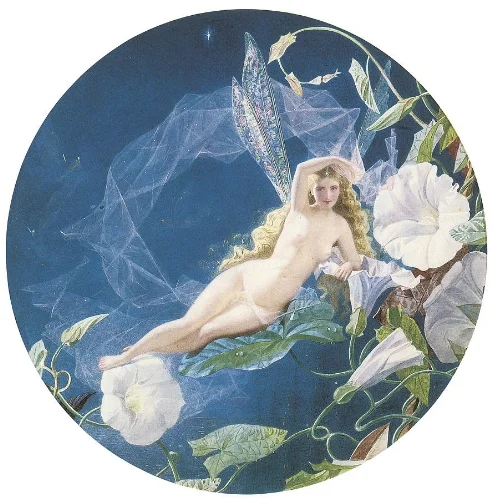
John Simmons, Fairy Lying on a Leaf

As to 18 Down, and Wednesday’s holiday—would you be interested in my opinion of our national anthem?  The music is good, the words are beyond awful.  The tortured syntax!  The stilted diction!  And the whole thing about a flag’s decorative pattern (is there anything broader about the stripes, or brighter about the stars, than one finds in the stars or stripes of other countries’ flags? and if not, can’t we be proud of something actually worth being proud of?) and the not-all-that-interesting fact that said flag didn’t catch on fire during some battle or other.  Maybe a bipartisan Congressional majority can find something reasonably anthemish by Robert Frost or Emily Dickinson or John Greenleaf Whittier or somebody, and we can retire this unmeaning doggerel?


Download this week’s crossword:

032-It’s Magic!-No. 4.puz

032-It’s Magic!-No. 4.pdf

Solve this week’s crossword online:

032 It’s Magic! No. 4

Novel 032: Cecilia Frances Tilley, Chollerton: A Tale of Our Own Times (1846)

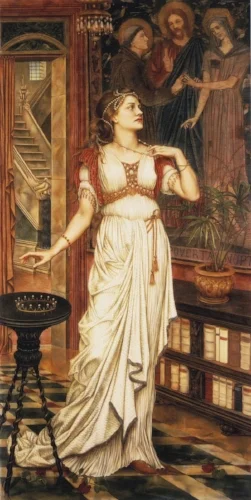
Evelyn de Morgan, The World's Wealth (The Crown of Glory)

An orphaned young lady of firm Tractarian principles, having gone to live with some distant cousins, is wooed by a baronet and admired by a clergyman


Cecilia Frances Tilley (1816–1849), Frances Trollope’s daughter, Anthony and T.A. Trollope’s sister, Henry Milton’s niece, wrote only one novel before dying of consumption in her early thirties.  Though marred somewhat by religious lecturing, Chollerton exhibits the family facility with character, plot, and style.

A “specimen of the lesser novel”: the “story sufficiently probable; the characters natural . . . the style easy, and rather elegant.”  Spectator, August 15, 1846

Though of the objectionable class of “controversial fictions,” this is “beyond measure the best”: “the plot is well constructed, the incidents flow naturally one from another, the characters are conceived vividly and sustained with skill.” And it is less “tainted with illiberality than any similar work we have seen.” Critic, October 24, 1846

Download this week’s novel:

https://archive.org/details/chollertonatale00tillgoog

Crossword 031: It's Magic! No.3

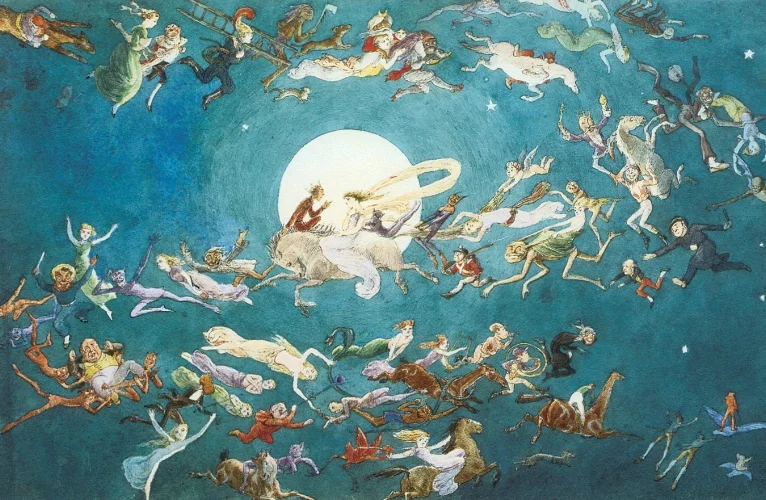
Charles Altamont Doyle, A Dance Around the Moon

There’s an odd notion afoot, among some crossword editors and reviewers, and possibly some solvers, that if you do a thing to a letter once in a crossword—delete it, replace it, turn it upside down, whatever—you have to do the same thing to that letter every time it appears, at least in the theme entries, if not in the whole puzzle.  Everywhere and always, but in this series in particular, I proceed in proud disregard of that notion.  If a magician turns her scarf into a parakeet, do you blame her if every scarf in the building, or the world, does not likewise turn into a parakeet?  Wouldn’t you rather it be just the one scarf?


Download this week’s crossword here:

031-It’s-Magic!-No.3.puz

031-It’s-Magic!-No.3.pdf

Solve this week’s crossword online:

031 It’s Magic! No. 3

Novel 031: Henry Milton, Rivalry (1840)

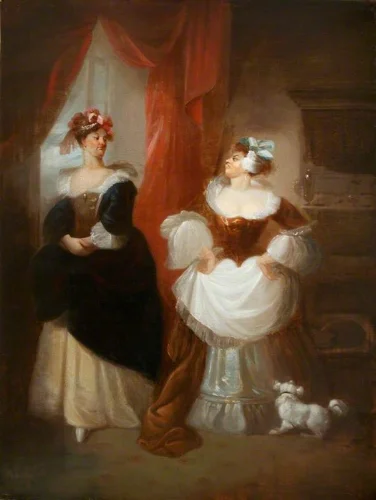
Robert Smirke, The Rival Waiting Women

Two middle-aged women vie for a bachelor; meanwhile, a virtuous young lady is besieged by scoundrels.


Henry Milton (1784–1850), Frances Trollope’s brother, Anthony and T.A. Trollope’s uncle, wrote only two novels, of which this is the first.  It amusingly combines farce and melodrama.

He is like his sister in providing “the same literal truth in the descriptions of common life; the same tendency to caricature in the humorous, and to melodramatic exaggeration in the serious parts.”  The Spectator, May 2, 1840

“His talent is equal for the serious or the comic, the one, however, sometimes verging into the melodramatic, the other occasionally approaching the burlesque.” The Morning Post, May 9, 1840

Written in “an easy and agreeable style,” the novel shows a “lively sense and good humour, . . . excellent knowledge of ordinary life,” and “nice discrimination of character in its ludicrous as well as its quiet aspects.” The Examiner, May 31, 1840

Download this week’s novel:

v.1 https://archive.org/details/rivalry01milt

v.2 https://archive.org/details/rivalry02milt

v.3 https://archive.org/details/rivalry02milt

Crossword 030: It's Magic! No. 2

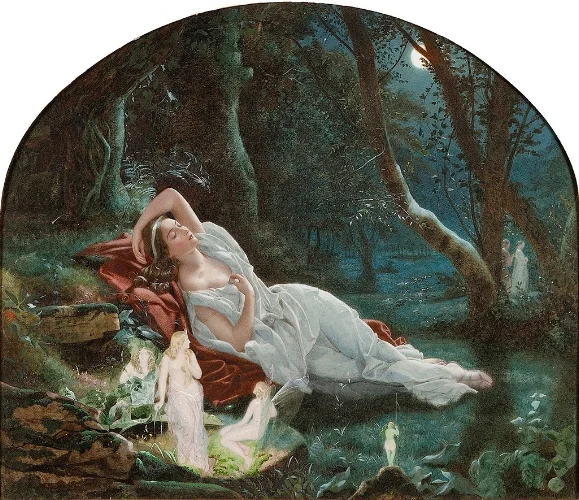
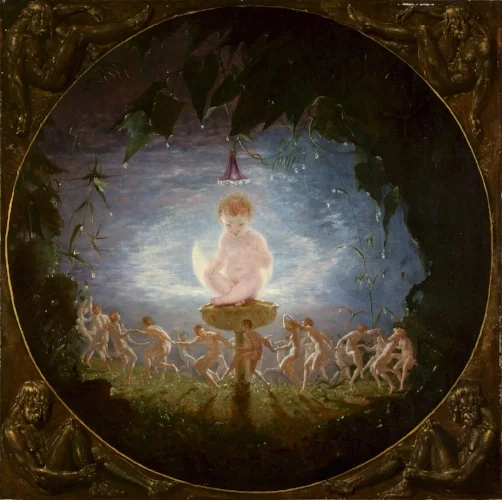
John Simmons, Titania Sleeping in the Moonlight Protected by her Fairies

10 Across was difficult to clue, in that there seems to be no one name for those little pads or screens with up and down arrows that you have to poke at in order to make some machine—the oven, the refrigerator, the furnace, etc.— do more or less of something.  Does anyone prefer poking and poking at these arrows to simply turning a 10 Across?  How do these idiotic design trends get started?  And how can we stop them?


Download this week's crossword:

030-It’s-Magic!-No.2.puz

030-It’s-Magic!-No.2.pdf

Solve this week’s crossword online:

030 It’s Magic! No. 2

Novel 030: Thomas Adolphus Trollope, Durnton Abbey (1871)

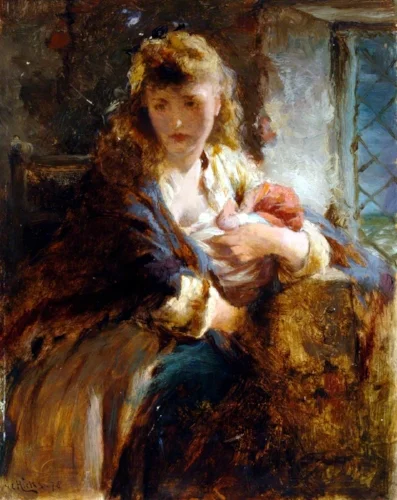
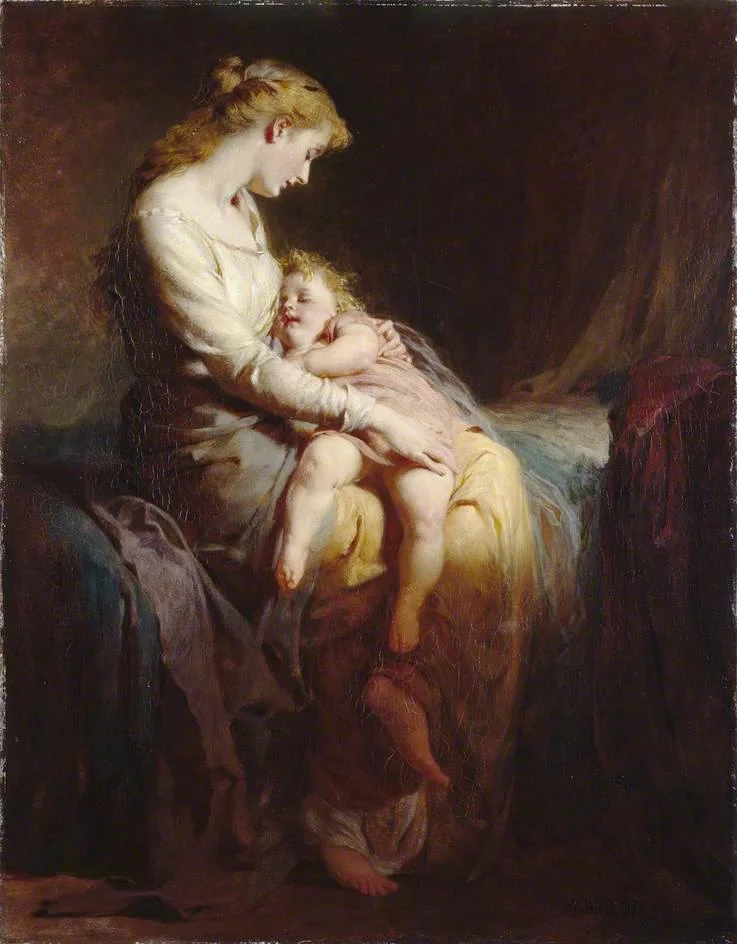
George Elgar Hicks, Mother and Baby

A feckless bank clerk woos a farmer’s daughter and is wooed by a local aristocrat in need of funds.


Thomas Adolphus Trollope (1810-1892) was Frances Milton Trollope’s first son and Anthony Trollope's older brother.  The plot of this novel heats up after a slow beginning; its bad characters are memorable studies in self-deception, led as they are by banal, routine desires into extravagantly evil behavior.

The characters are “natural but by virtue of their mediocrity. . . .  Virtue is mediocre in [Trollope's] hands, and the contrast between it and vice is marked only by the degree in which the latter falls below the mean”; still the novel is “well written, and superior to the common run of novels in originality and interest.” Athenaeum, July 29, 1871

“A well constructed, interesting story”; “one of the chief charms . . . is the humorous portraiture with which it abounds.” Graphic, August 5, 1871

“In spite of many scenes of considerable humour and not a little pathos,” the “coarse vice” portrayed in the novel “left in our mind . . . a most unpleasant recollection.”  Saturday Review, August 26, 1871

Download this week’s novel here:

v.1 http://access.bl.uk/item/viewer/ark:/81055/vdc_00000003F87C

v.2 http://access.bl.uk/item/viewer/ark:/81055/vdc_00000003F882

v.2 http://access.bl.uk/item/viewer/ark:/81055/vdc_00000003F876

Novel 029: Frances Milton Trollope, The Ward of Thorpe Combe (1842)

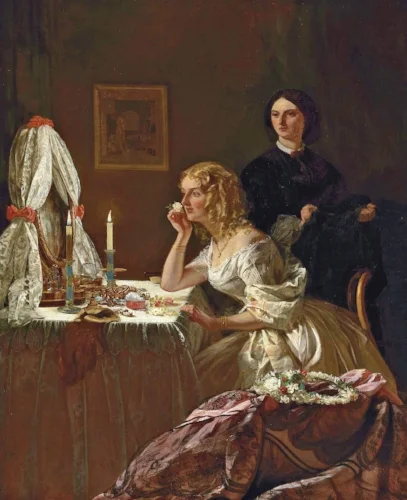
Augustus Leopold Egg, The Toilet

An eccentric old man gathers his nieces and nephews in order to choose an heir.


Frances Milton Trollope (1779-1863), mother of Anthony Trollope, Thomas Adolphus Trollope, and Cecilia Frances Tilley, and sister of Henry Milton, and mother-in-law of Frances Eleanor Trollope, wrote over 30 novels between 1835 and 1856.  Here she provides a good comic plot and an entertaining variety of characters, especially the deliciously repulsive heroine.

“The principal portraitures of people, and sketches of manners, drawn by Mrs. Trollope, are so human and natural, that they ever come pleasingly home to the feelings of her readers.” Literary Gazette, April 2, 1842

“Mrs. Trollope never objects to peep into the pantry, to gossip with a comfortable old housekeeper, or to intrigue with an astute lady’s maid, and here she is particularly strong in life below stairs.” Her plot “will excite a strong interest.”  Athenaeum, April 9, 1842

“Excellent as Mrs. Trollope has always proved herself in pourtraying human character, its varieties and eccentricities, she has been more than usually successful in her delineation of the Ward of Thorpe-Combe. . . .  The attention of the reader is never allowed to flag, or to become weary.”  Gentleman’s Magazine, July. 1842

Download this week’s novel here:

https://books.google.com/books?vid=BL:A0017528094 (1-volume Paris ed.)

Crossword 028: Poetic Justice

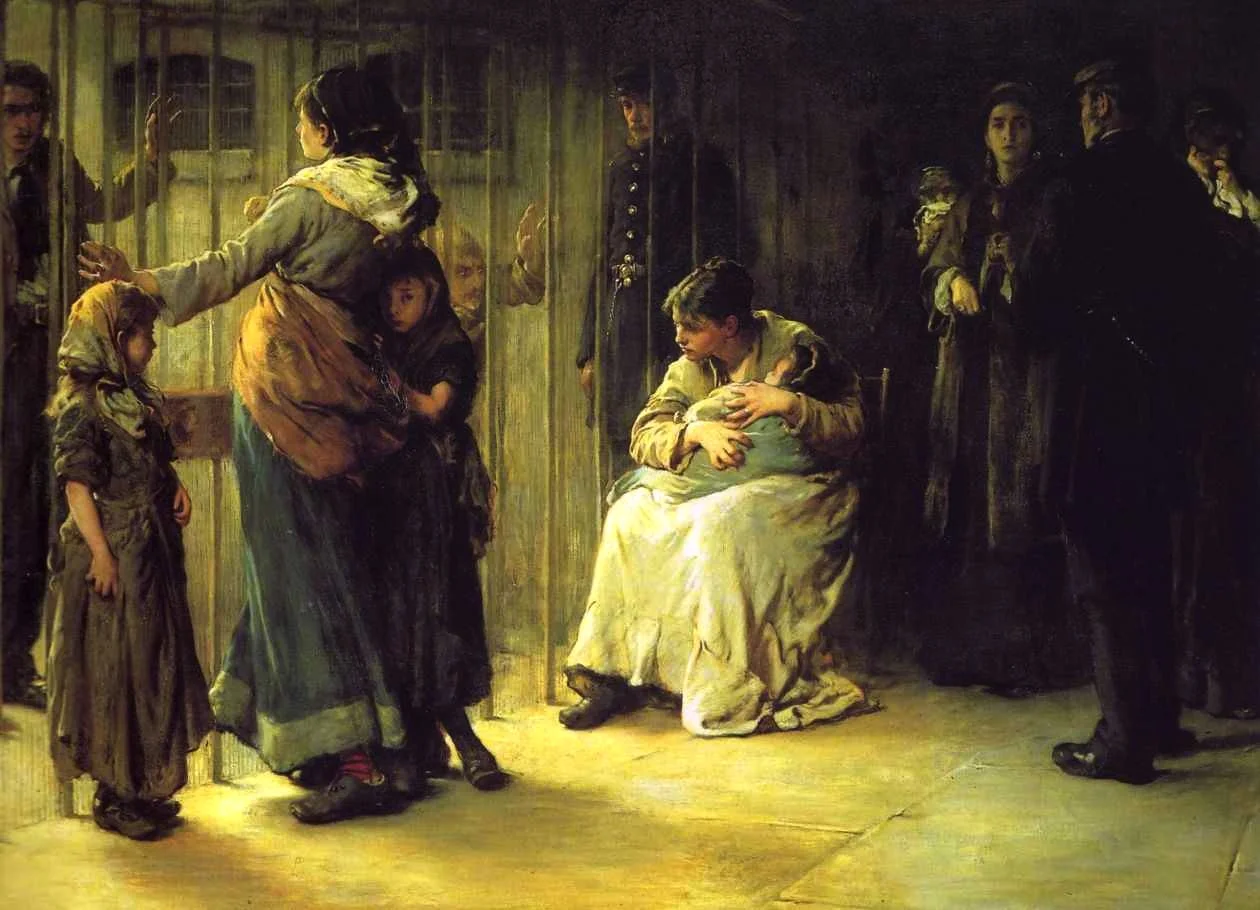
Frank Holl, Newgate: Committed for Trial

To continue the quotation begun in 37 Down: Hamlet asks, “Who would bear the whips and scorns of time, / Th’ oppressor’s wrong, the proud man’s contumely, / The pangs of despised love, the law’s delay, / The insolence of office, and the spurns / That patient merit of th’ unworthy takes”—— if it weren’t (as Hamlet might, but doesn’t, go on to ask)  for the opportunity to insert absurd phrases about such topics into crossword puzzles?  I've already touched on some of them;  I mean to cover them all eventually.  Today I take up not exactly “the law's delay,” but litigation in general, one of civilized life’s most unpleasant possibilities.


Download this week’s crossword:

028-Poetic-Justice.puz

028-Poetic-Justice.pdf

Solve this week’s crossword online:

028 Poetic Justice

Novel 028: Lucas Malet, Colonel Enderby's Wife (1885)

Hubert von Herkomer, Clematis
Hubert von Herkomer, Clematis

A quiet middle-aged man falls in love with a beautiful but strangely childlike young woman.


Mary St. Leger Harrison (1852-1931) was the daughter of novelist and reformer Charles Kingsley.  Under the pseudonym Lucas Malet, she wrote some 16 novels beginning in 1882; this one, amid more commentary on the human condition than might seem altogether necessary, presents vivid characters in helpless conflict.

“In these days of hurried workmanship it is a welcome contrast to encounter a story which combines imagination, observation and finish in such a high degree.  This is no sketch, but a whole gallery of portraits which have not suffered from the author’s elaborate method, but only gained in lifelikeness”; even if “the author, especially in her moralizing moods, is too uniformly, and perhaps consciously, clever.” Athenaeum, June 6, 1885

The novel’s style has “a quiet self-confidence and reserved power”; the author is “vivid and effective in her descriptions, and telling in her portraitures”; but “there is a morbid strain running through it; one is tempted to ask whether the imagination which conceived and executed this book has not a touch of inflammation.” Literary World, July 11, 1885

“It is poignant, grievously pathetic, a fateful, disheartening book, but it is unquestionably clever. . . .  Everything in ‘Colonel Enderby’s Wife’ is clever--the talk, the author’s pessimistic reflections, the arrangement of incident . . . and above all the delineation of character.”  Westminster Review, October, 1885

Download this week’s novel:

http://solo.bodleian.ox.ac.uk/OXVU1:LSCOP_OX:oxfaleph014443744

Crossword 027: I Drops

John MacWhirter, June in the Austrian Tyrol

Today we have the suffix with “buck,” and the detective-movie dog, and the ambient-music innovator.  I wanted to “give a shout out,” as the youngsters say, to the sandwich cookie, and the killer whale, and Yoko ___, but what with all the theme answers, I couldn’t find room.  Maybe next week!


Download this week’s crossword:

027-I-Drops.puz

027-I-Drops.pdf

Solve this week’s crossword online:

027 I Drops

Novel 027: Marian James, A Lord of Creation (1857)

William Powell Frith, The Proposal
William Powell Frith, The Proposal

A virtuous young lady falls in love with the companion of her childhood, her guardian’s nephew.


Marian James wrote five novels and a few stories between 1854 and 1872; I can discover nothing else about her.  This one-volume novel, with a plot involving inheritance and betrothal, is most notable, as the reviews suggest, for its characters, especially the anti-hero to which the title ironically refers.

“It is a clever, carefully written, though slight story, without much incident,—but that little is delicately and dexterously handled, and the result is an interesting and very readable book.  The interest turns on the delineation of the different characters, especially of . . . the ‘Lord of the Creation,’ who gives the title to the book” Athenaeum, September 26, 1857

The simple plot “gains a pervading charm from excellent treatment.  The story flows on with calm earnest directness, and towards the end becomes riveting in its interest; the language, every where adequate, is nowhere pretentious... Character, however, is the writer’s forte.  Every person . . . is a separate study . . . rendered with that true art which involves not only the knowledge of human nature, but the knowledge of delineating it.”  National Magazine, November, 1857

Download this week’s novel here:

http://access.bl.uk/item/viewer/ark:/81055/vdc_0000000452BE#?c=0&m=0&s=0&cv=0&xywh=-719%2C-124%2C2880%2C2475

Crossword 026: Rejection

William Powell Frith, The Rejected Poet

Today’s puzzle is a prequel to the one published yesterday in the Los Angeles Times—that is, the theme of this puzzle is related to that of the other as cause to effect.  I built the puzzle around 29 Across, the basis for which I have since learned is not so common a phrase as I had supposed.  Google’s ngram viewer shows that the phrase reached a peak around 1820, held steady through 1910, and then began a precipitous decline.  This is a pity, for the unhappy state of mind it tersely describes is a defining feature of human experience, one given frequent attention in Victorian novels, and one I’m delighted to reconceive, through the miracle of cruciverbalism, as a comically self-conceited anthropomorphic bird.


Download this week’s crossword:

026-Rejection.puz

026-Rejection.pdf

Solve this week’s crossword online:

026 Rejection

Novel 026: Elizabeth Darby Eiloart, The Love that Lived (1874)

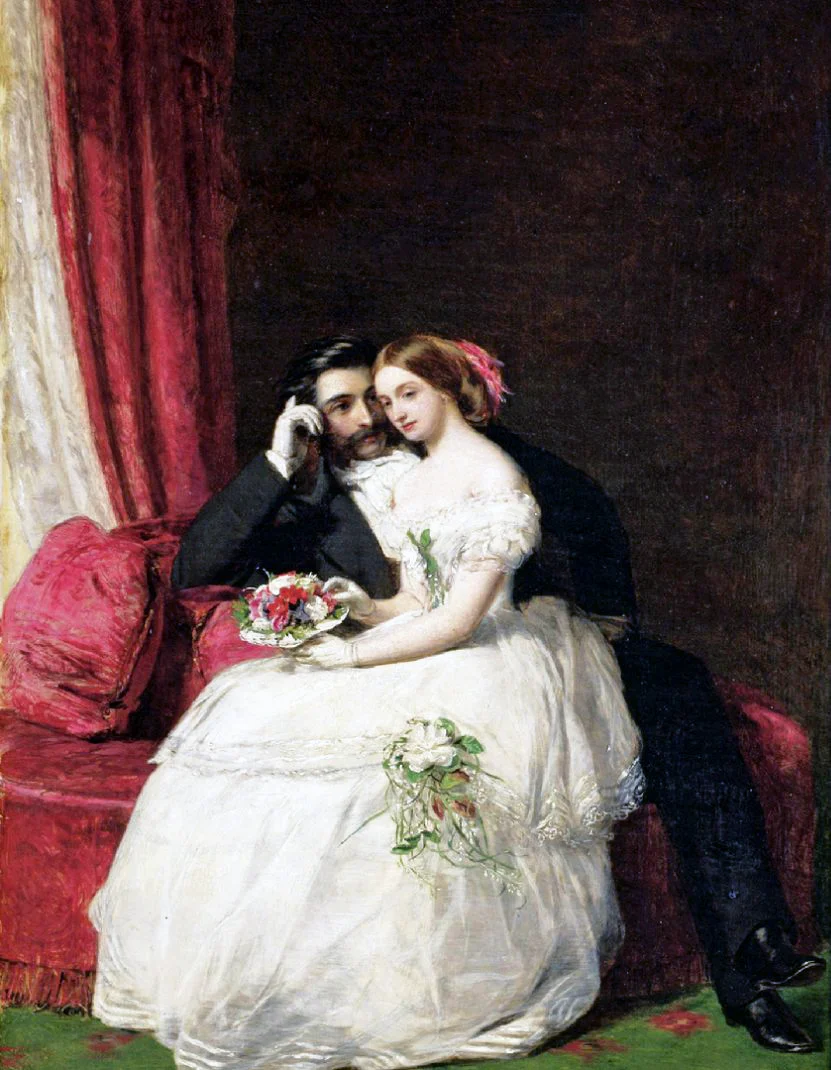
James Sant, The Bride
James Sant, The Bride

In a small town, a radical clerk is rescued from drowning by a rich young gentleman whom he resents; as it happens, the two men are connected by their parents’ secret past.


Elizabeth Darby Eiloart (1827-1898) wrote some 18 novels for adults (and several more for children) between 1865 and 1883; she specialized in middle-class characters and concerns, which emerge sharply in this novel, despite a charmingly silly plot.

“All Mrs. Eiloart’s books are honest books, spiced with independence of thought, and sweetened with a pleasant humour.”  This novel “breathes the fresh air of the country”; “its characters are true to life.”  Academy, July 18, 1874

Eiloart's “books are original and fascinating; they contain good plots, plenty of incident, and well described and distinctive characters.”  This is “one of the best and most interesting novels of the season.”  Morning Post, August 25, 1874

“Apart from the plot . . . Mrs. Eiloart’s novel is refreshingly and unaffectedly real.  There is nothing high-flown, nothing morbid in its tone.”  It “is not only a love-story.  It is a political story.  Conservatives and Radicals, rich and poor, the old school and the new, are all faithfully represented. . . .  This is one of the most pleasing and interesting novels of the season.”  Examiner, August 29 1874

Download this week’s novel:

vol. 1 http://access.bl.uk/item/viewer/ark:/81055/vdc_000000047580#?c=0&m=0&s=0&cv=4&xywh=-460%2C-181%2C3652%2C2238

vol. 2 http://access.bl.uk/item/viewer/ark:/81055/vdc_000000046A6A#?c=0&m=0&s=0&cv=4&xywh=-410%2C0%2C3265%2C200

vol. 3: http://access.bl.uk/item/viewer/ark:/81055/vdc_000000046A5E#?c=0&m=0&s=0&cv=4&xywh=-379%2C-1%2C3329%2C204