Three sisters’ marriage prospects are impaired by heavy encumbrances on the family estate.
About Laurence Brooke nothing seems to be known, except that he wrote four novels between 1879 and 1882, of which this was the last.
“Mr. Brooke is without doubt a very vivacious writer, and he has well differentiated the separate individualities of his Three Fair Daughters.” Academy, July 8, 1882
“Mr. Brooke is content to build his story on the familiar lines; he aims at nothing extravagant or eccentric, and he achieves a decided success. . . . . In fact, this is a novel which evidently shows real literary skill and no small acquaintance with his craft in its author.” Spectator, September 30, 1882
This puzzle should not be taken as an endorsement of those tasteless social events from which women are excluded (except as performers). In fact I find the idea of “stag parties” in that sense distinctly disagreeable. But if forest creatures wish to gather for their own festive purposes, I do not feel that I, from my necessarily anthropocentric subject position, have any right to condemn them.
Frederic shows “a knack of description which is clever and the reverse of wordy”; he is “a close and shrewd observer of certain human and natural phenomena.” Athenaeum, December 3, 1887
“Mr. Frederic’s novel is distinguished by its firm grasp of unhackneyed material, its realistic portraiture of life in a rural region, its repose of manner, its masterly dealing with unusual types without descent to caricature.” Literary World, December 10, 1887
“Very good indeed—simple but exceedingly workmanlike in construction, and with a really strong capable grasp of character.” Academy, December 17, 1887
“A capital story, full of point, vigour, humour, and dash.” Saturday Review, February 18, 1888
Despite the author’s inexperience, “there is no fumbling, tentative work; the author evidently knows just what he wants to do, and he does it simply and in a direct, businesslike fashion. The book has the fine finish which is characteristic of the work of the new American school of novelists, but Mr. Frederic, unlike some of his contemporaries, has provided himself with material which is worth finishing.” Spectator, February 25, 1888
“The by-play in the romance is excellent, the story is brightly written, and the little touches of sarcasm are neatly injected.” New York Times, September 27, 1891
“A vigorously conceived and delicately finished work of art. . . . an unusually good novel.” Academy, October 10, 1891
“Mr. Richard Pryce has written two or three very clever books, but he has not previously given us anything that is at once so able and so pleasing as Miss Maxwell’s Affections.” It is “one of the most enjoyable of recent novels. The portraits of women . . . are painted with such subtle truth that, had Miss Maxwell’s Affections been published anonymously, we should have had hardly any hesitation in assigning it to feminine authorship. . . . The book is rich in humour, for the most part of the subtle rather than of the obvious self-advertising order, nor is it lacking in passages of very beautiful and winning tenderness and pathos.” Spectator, October 21, 1891
Work hard, believe in yourself, and there is nothing in this world you cannot do!—except things that are impossible for everybody, like flying unassisted or becoming invisible; or things you must be especially endowed by nature to do, like winning a marathon; or things you have to have the right social connections to do, like publishing a crossword (invitation only!) in the New Yorker.
In the south of Ireland, a disinherited family lives amid squalid poverty and futile political agitation.
May Laffan Hartley (1850-1916) published several stories and five novels, of which this was the last; she struggled with mental illness and ended her life in a psychiatric asylum.
It is “marked to a singular extent by . . . strength, breadth of humour, and impartiality. . . . No one who is anxious to fathom the enigma of the Irish character will be deterred . . . from the careful study of what we have no hesitation in pronouncing to be the most valuable and dispassionate contribution towards the solution of that problem which has been put forth in this generation in the domain of fiction. . . . There is a ‘sweet wildness and unusualness’ about the scenes and characters in which we move which is distinctly captivating, and yet it is hard to say whether pain or pleasure predominates in the impression left on the mind after a perusal of the volumes. For the picture which the author gives of her compatriots is relentlessly faithful, and excites compassion and repulsion in an almost equal degree. The squalor, suspicion, and greed which are met at every turn in the mutual relations of the peasantry are illustrated with such a wealth of detail as can only be the outcome of intimate acquaintance and close observation. ‘Ismay’s Children’ contains a whole gallery of portraits, gentle and simple, some more elaborately finished than others, but of singularly uniform excellence. . . . These are living human beings who let us know what manner of men they are out of their own mouths. They are not mere lists of qualities catalogued by the author when they are severally introduced, but, as in real life, we only come to know them gradually. The pages of ‘Ismay’s Children’ are full of excellent sayings and characteristic anecdotes, all the more telling for the absence of any conscious effort to bring them in.” Athenaeum, October 15, 1887
Hartley “is as witty, as humorous, as keen-sighted, and, alas! as pessimist as ever. . . . She paints the foibles and faults of the people she knows so well with a brush steeped in black. . . . She is like the good housewife who boasted that, if she had no ear for music, she had a wonderful eye for dirt. . . . And what tends to intensify the reader’s despondency into despair is the apparent hopeless acquiescence of the author’s mind in the necessary perpetuation of the sores she probes so ruthlessly. She sees no possible cure. Her people are squalid, dirty, lying, superstitious, and dishonest. The meanest vices are made compatible with an unsimulated profession of piety and a fervid observance of the rules of the Church. Some of the most amiable and lovable of her personages are tainted with inherent insincerity and untruthfulness. Squalor is the one element she cannot omit from her canvas. If a hospitable priest or an amiable old lady offers her guests refreshment, the biscuits must be sodden and the seed-cake mouldy. . . . The author is absolutely just and fair-minded. Landlords and tenants, priests and parsons, are treated by her with the same placid, cruel impartiality. And yet, with the unpleasing materials she chooses to work upon, the author of Ismay’s Children gives us a novel which charms us in our own despite. If her pathos merges too readily into tragedy the gentler passion is never quite swallowed up by the sterner.” Saturday Review, November 19, 1887
“Though it has, as it could hardly fail to have, some gleams of very genuine humour, it is, as a whole, much too sad a book to be commended to people who demand cheerfulness in their reading; but those who are content to forego even cheerfulness for the sake of power, pathos, and unrelenting veracity of imagination, will find in Ismay’s Children a novel to their mind. . . . In spite of the gleams of gaiety which must find their way into any picture of Irish life, the book as a whole is a very sombre one. Still, sombre as it is, it is too rich in beauty, impressiveness, and pathos to be dismissed in any other words than those of grateful appreciation.” Spectator, November 26, 1887
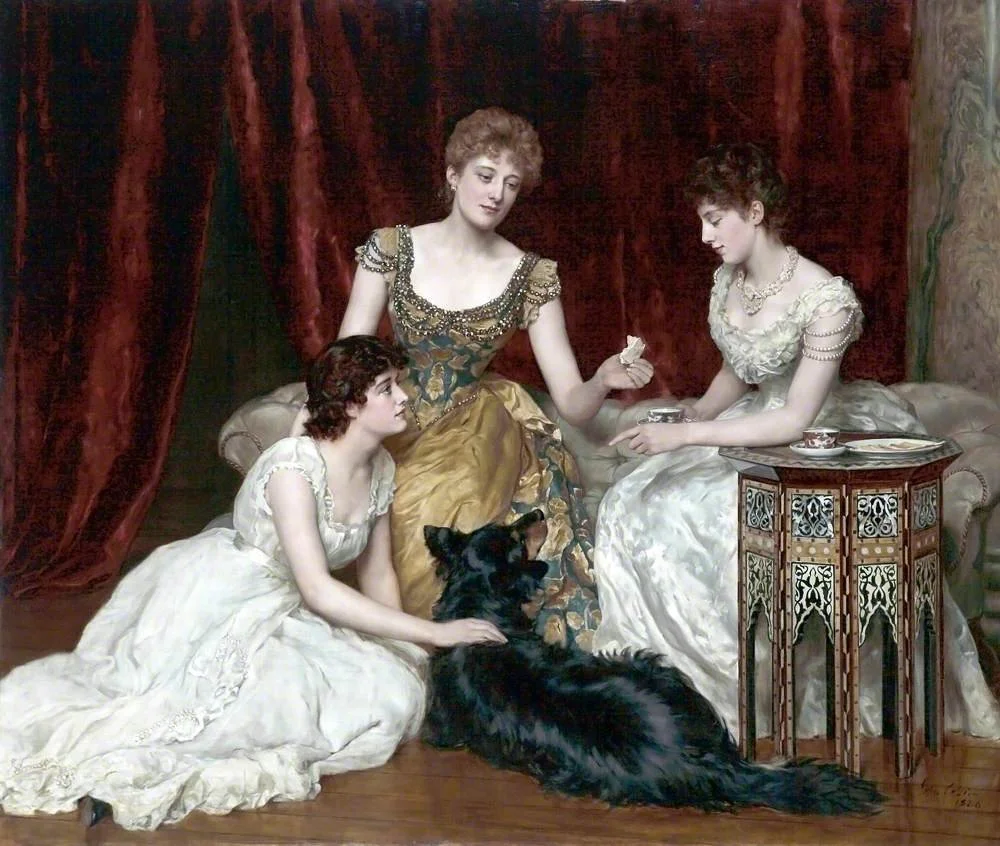
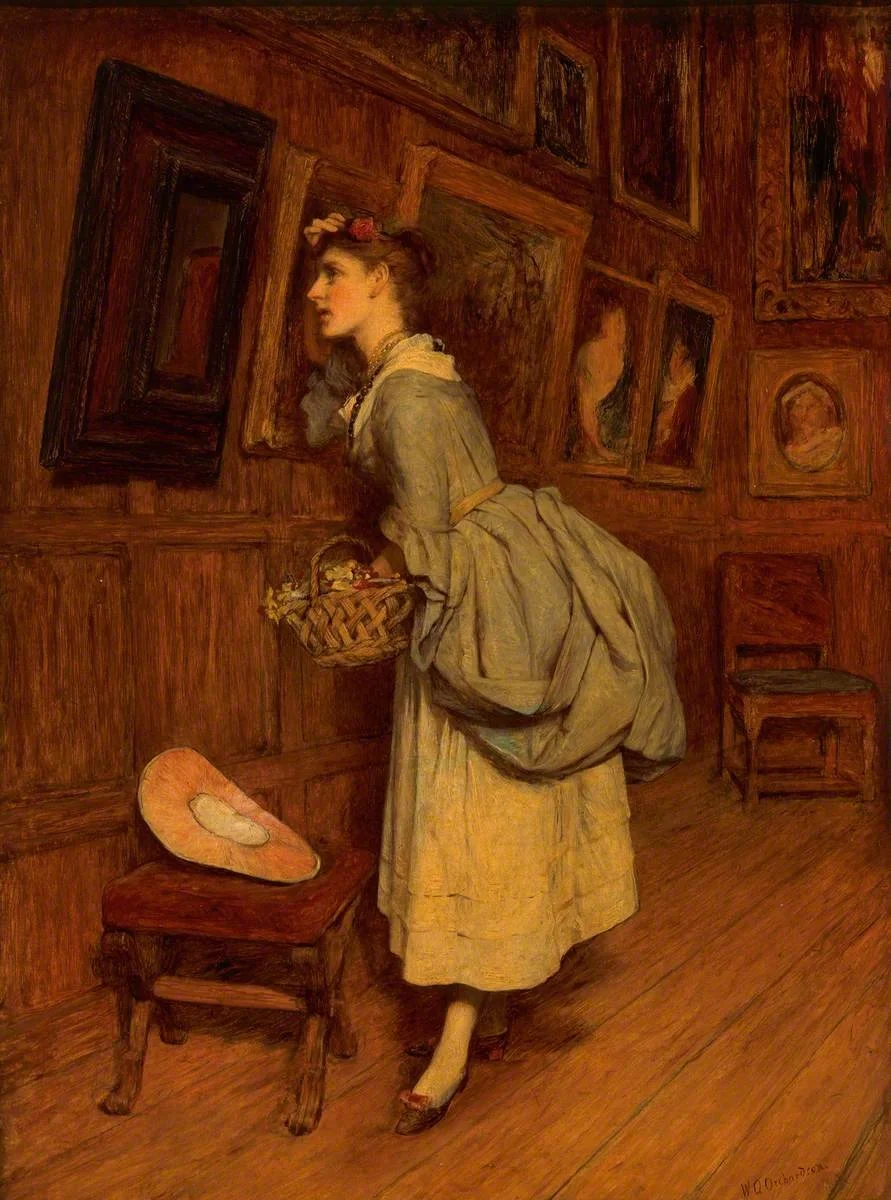
Sir William Quiller Orchardson, In the Picture Gallery
My last crossword exemplified art’s ability to lift us out of the finite worldly sphere and into the eternal; today’s exemplifies art’s complementary responsibility to represent the truth of that worldly sphere with uncompromising fidelity, however vile, however filthy, however offensive it may be. In doing so it confronts the shibboleths and pieties of our society, forcing us to reckon with the evil that lurks around and within us all.
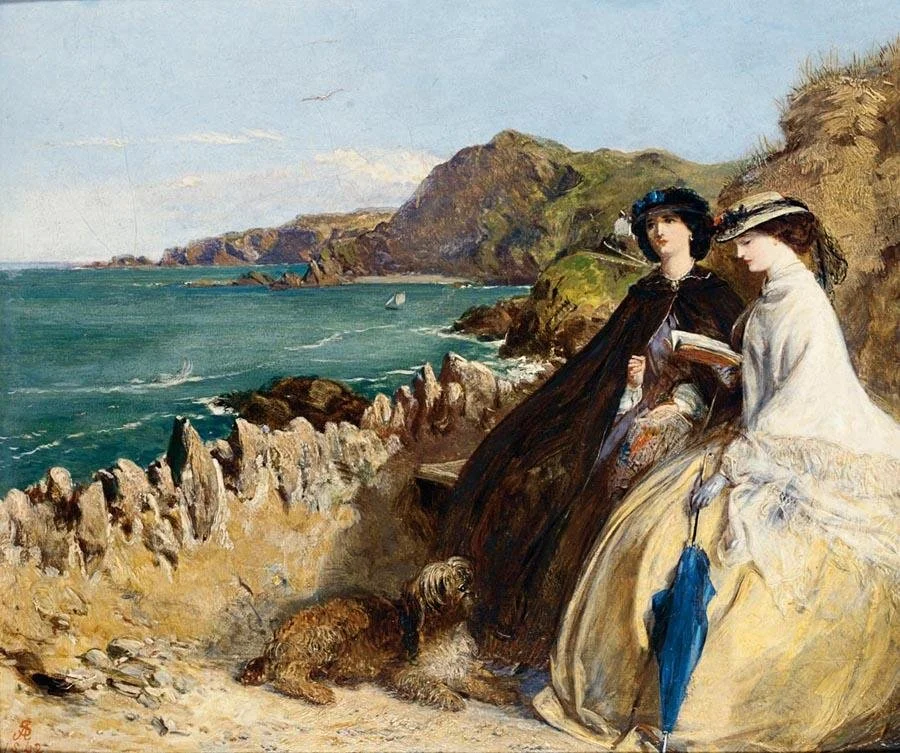
A schoolmaster passes his vacation with an ailing student at a seaside resort and there meets an attractive pair of sisters.
Moira O’Neill was the pen-name of Agnes Nesta Shakespeare Skrine, nee Higginson (1864-1955), an Irish poet who wrote just a few works of fiction, including this unassuming novella.
“Slight as is the story, at least it is a page out of real life, cleverly reflecting the conventions and tone of a highly respectable ‘set.’ . . . What is sufficiently evident here is her power of watching and marking the finer play of certain minds with whom presumably she is in sympathy.” Bookman, April 1893
It is “a story about nothing in particular, and it amuses and pleases for no definite reason either. . . . Man, from woman’s point of view, is treated with quiet sagacity and humour.” Athenaeum, April 8, 1893
“It is a novel with an attractive cultivated air, written in admirable English by a writer with a good knowledge of society, and with a keen eye for character”; there is no “aggressive display of cleverness, . . . it pleases in a quiet way by being always simply right.” Academy, April 15, 1893
That’s right—not baseball, but paronomasia. This is another of a series of puzzles on this website that encourage you to move from the physical to the mental, from the material to the spiritual; that offers you a way to transcend the vile, dust-choked, filth-smeared circumstances of earthly existence and approach the empyrean realm where the soul communes with eternity.
“There is a certain measure of brightness and originality in ‘A Winter's Tale,’ though if judged by a mere outline of the plot it would seem commonplace enough. The story is not particularly pleasant; but several passages in it are entertaining and cleverly written.” Athenaeum, March 7, 1891
“Quite a delightful story. The plot is slight, but the workmanship is delicate throughout, like a fine ivory carving. With a few light illustrative touches she causes each of her characters to live—the dialogue has the sparkle and crispness of light everyday badinage.” Saturday Review, March 21, 1891
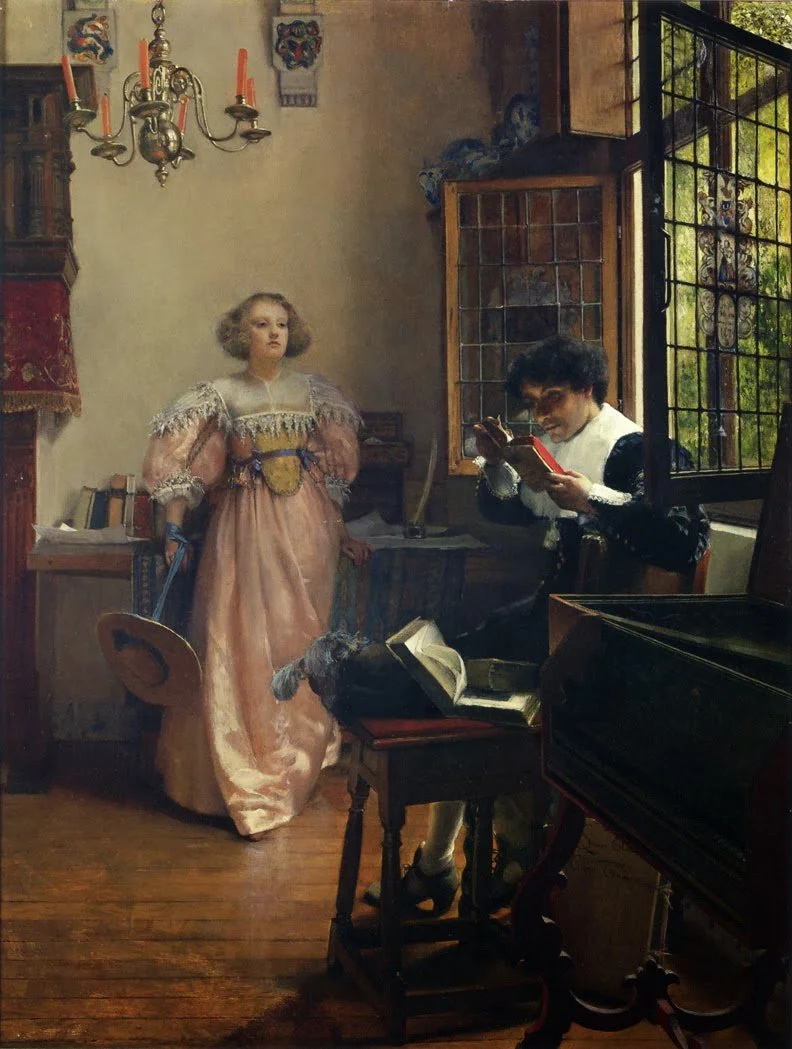
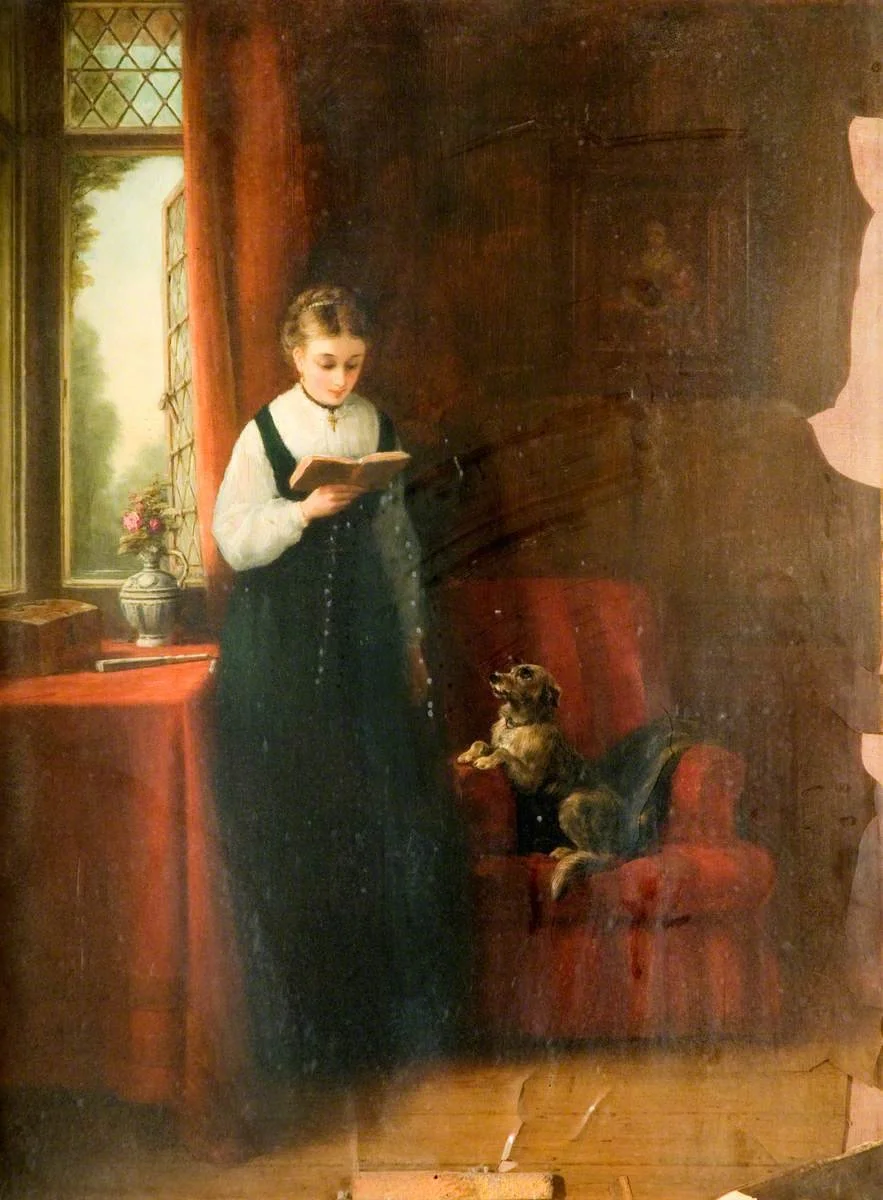
Laura Theresa Epps Alma-Tadema, The Persistent Reader
You might have learned in your high-school or college English class to extract a profound, concealed meaning, unsuspected by the thoughtless masses, from some classic work of literature. “Emma,” you might have found, is really a protest against the patriarchy, “Huckleberry Finn” a celebration of homoerotic desire, “Hamlet” a representation of incestuous obsession, etc. This sort of thing is a lot of fun, once you learn how. But why go to all the trouble of reading some long-winded classic when you can do much the same thing solving a 78-word puzzle?
In New York City, a young married man loses his fortune and is forced to make a living.
“Bright, fresh, and interesting.” Academy, September 21, 1889
“A clever and lively novel”; the plot is “highly ingenious.” Athenaeum, March 1, 1889
“A lively story.” Saturday Review, July 19, 1889
A contrasting view:
“If we could hear such a tale, as agreeably told, some leisurely summer afternoon, we would not consider the twenty minutes required to tell it wasted by raconteur or audience. But this is a printed book, 387 pages long, and there is a great deal we ought to read in this world, and very little time to do it in.” Hartford Courant, May 22, 1889
Today’s puzzle’s title is of course drawn from the warnings commonly found on packages containing machine-readable documents or frame-worthy prints. But for me it’s also a motto to live by. When I’m faced with a dispute, having taken care in advance to place myself beyond all doubt on the right side, I refuse ever to compromise, knowing as I do that any deviation from my side must arise from some fundamentally wrong and probably evil motive in my opponents, dishonestly concealed. Rather than bend in any direction, I vilify those opponents ever more scurrilously, until either they or I tire of arguing. This may not get anyone anywhere, but it passes the time, and it helps me feel good about myself, which is after all (on the advice of my therapist) the point of most everything I do.
A young artist spends time painting in the New Forest, managing her house in Chelsea, and staying with her farmer grandfather in Norfolk.
The Hon. Emily Lawless (1845-1913), daughter of an Irish baron, wrote some nine novels between 1892 and 1898.
“Cleverly written, with a good deal of natural aptitude and scarcely any sign of effort. Both the subject and its treatment are fresh, and the story moves on smoothly and lightly.” Athenaeum, October 28, 1882
“The story . . . is essentially a pleasant one”; the title character’s “griefs are just sufficiently deep and prolonged to furnish that vital necessity for truth in the portraiture of human life, which all but the absolutely ignorant or the hopelessly silly must demand as a condition of their accepting the likeness at all; her virtues are attractive, but not overpowering, and her vexations are so amusing that one is sorry to part with them”; “The author has succeeded perfectly in making her heroine real to the reader”; “a very bright and pleasing novel.” Spectator, November 4, 1882
A contrasting view (from a critic who appears not to have read the novel, well over half of which is not set in London):
“A London novel, interminable as London streets and as generally dreary.” New York Times, May 27, 1883
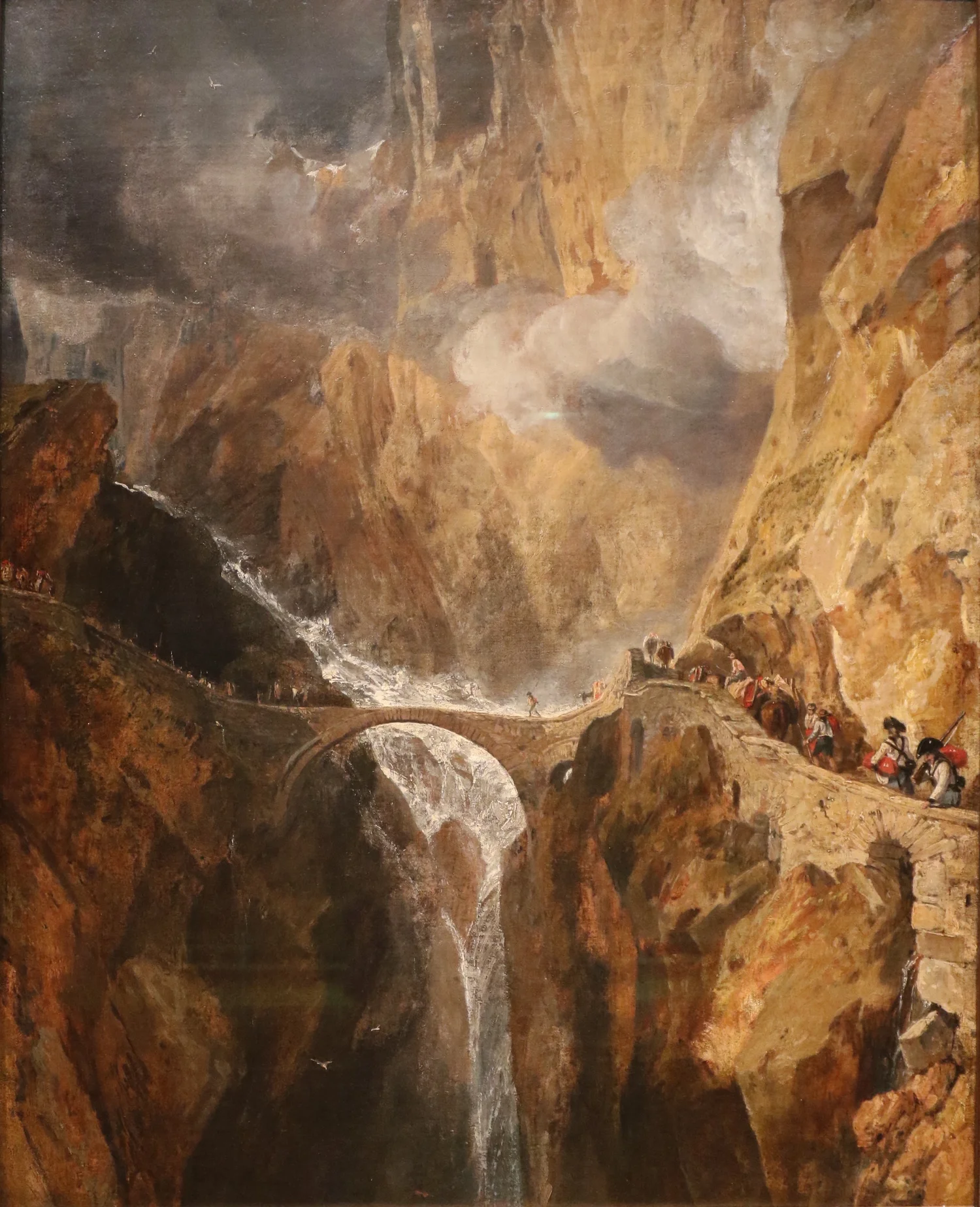
J.M.W. Turner, The Devil's Bridge, St Gotthard Pass
“When you gaze into the abyss, the abyss also gazes into you,” wrote Friedrich Nietzche, in “Beyond Good and Evil.” So, wanting to get beyond good and evil myself, I gazed into the abyss. Much to my disappointment, it didn’t gaze into me. In fact it didn’t do much of anything at all but just lie there being fathomless. So I didn’t get beyond good and evil. But I did get an idea for a crossword.
Here is another novel by the great Charlotte Yonge (for whom see Novels003,053,103,155,210, and261).
Yonge “spares no pains to discover fresh varieties of character, or to define them sharply and distinctly. For these reasons her stories are generally worth a great deal of study. . . . ‘The Clever Woman of the Family’ is well written, and teaches a good moral. . . . Upon the whole . . . the book will be read with pleasure; and it has this great advantage over many recent novels, that the author has evidently had some personal acquaintance with the phases of society that she describes.” Athenaeum, April 8, 1865
“Unquestionably the best of her novels, and a book that any writer of the day might be proud to own. In the management of a large family no one . . . is equal to Miss Yonge; she absolutely revels in the pranks and frolics of ten or a dozen brothers and sisters, all discriminated in character with a nicety of touch that belongs to a woman’s pen alone.” New York Times, June 19, 1865
A contrasting view:
“We are transported into a somewhat mawkish paradise of earnest people. . . . The purposeless anatomy of small feminine scruples and self-communings is carried out to a tedious extent.” Reader, May 27,1865
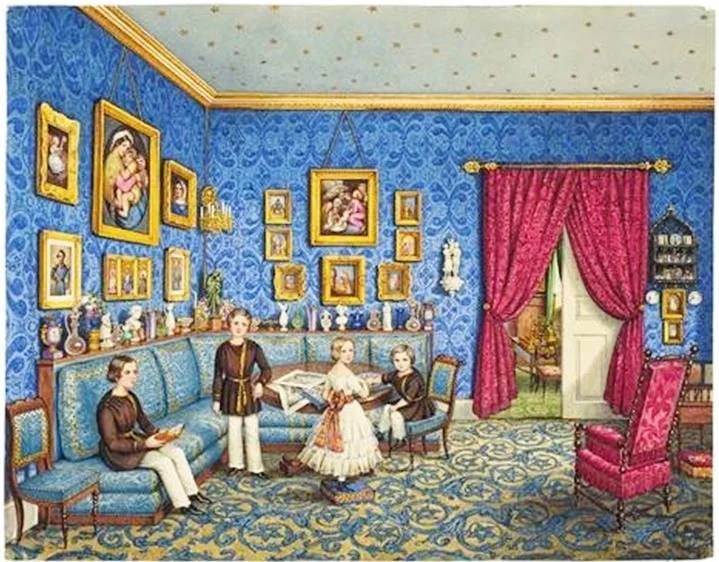
Mary Ellen Best, Blaues Zimmer der Prinzessin Elisabeth im Prinz-Carl-Palais, Darmstadt
As part of my innovative, ground-breaking, take-no-prisoners, bourgeoisie-shocking, taboo-shattering, avant-garde crossword project, I offer here a puzzle that’s not afraid to deal with the brutal, grim, soul-deadening, filth-encrusted underside of life. I warn you, however, that this is dark stuff, not for the faint of heart or the weak of knee. Do you have the inner strength to endure and the aesthetic discrimination to appreciate the most advanced cultural productions of our age? Prove it by solving, and enjoying, and praising this puzzle!
On the death of her cosmopolitan grandmother, a virtuous young lady is sent to live with a rector uncle in a dull town.
This is a sort of sequel to last fortnight’s novel, though much longer, and very different in tone.
“The author’s somewhat dangerous experiment—at this early period of her career—in continuing some of the threads of her first story has been entirely justified in its execution. The hero is at least as humorous as ever, the new heroine is also very sprightly and amusing.” Athenaeum, November 9, 1889
“Novels so amusing, so brightly written, so full of simple sense and witty observation . . . are not found every day.” Saturday Review, December 7, 1889
As I’ve mentioned before, the crossword constructors of today aren’t content simply to amuse their audience—they want to improve it, to better humanity one solver at a time. Most of them can think of no more effective way of doing this than by including in their grids people and things they think good, and excluding from them people and things they think bad, in the hope that solvers will be led to adopt their own exemplary opinions. Not I—my crosswords transcend such trivial concerns. Today’s pair of crosswords, for example, force the solver to grapple with one of the most fundamental questions of the human condition: Is there a god? Solving these crosswords may not tell you directly, but it will deepen your understanding of the question and so, in a way, of the world, and of yourself.